Showing posts with label astronomy. Show all posts

09 November 2010

Pale Blue Dot

Dr Carl Sagan would have turned 76 today but died very much prematurely from myelodysplasia on 20 December 1996.


Dr Sagan is best known for his work on astronomy and his television series Cosmos which was shown world-wide during the 1980s.

Although he did not have the same effect in astronomy as Johannes Kepler, Nicolaus Copernicus, Tycho Brahe or Galileo Galilei (and they were fighting against conventional religious thinking at the time), Dr Sagan brought an understanding of astronomy and science to a lot of people. He was a major proponent of the Search for ExtraTerrestrial Intelligence (SETI) project.

"the earth is a very small stage in a vast cosmic arena"

08 September 2010

A near miss but with little warning

A late notice from NASA


Two small asteroids in unrelated orbits will pass within the moon's distance of Earth on Wed.

September 07, 2010

PASADENA, Calif. – Two asteroids, several meters in diameter and in unrelated orbits, will pass within the moon's distance of Earth on Wednesday, Sept. 8.

Both asteroids should be observable near closest approach to Earth with moderate-sized amateur telescopes. Neither of these objects has a chance of hitting Earth. A 10-meter-sized near-Earth asteroid from the undiscovered population of about 50 million would be expected to pass almost daily within a lunar distance, and one might strike Earth's atmosphere about every 10 years on average.

The Catalina Sky Survey near Tucson, Ariz., discovered both objects on the morning of Sunday, Sept. 5, during a routine monitoring of the skies. The Minor Planet Center in Cambridge, Mass., first received the observations Sunday morning, determined preliminary orbits and concluded that both objects would pass within the distance of the moon about three days after their discovery.

Near-Earth asteroid 2010 RX30 is estimated to be 32 to 65 feet (10 to 20 meters) in size and will pass within 0.6 lunar distances of Earth (about 154,000 miles, or 248,000 kilometers) at 2:51 a.m. PDT (5:51 a.m. EDT) Wednesday. The second object, 2010 RF12, estimated to be 20 to 46 feet (6 to 14 meters) in size, will pass within 0.2 lunar distances (about 49,088 miles or 79,000 kilometers) a few hours later at 2:12 p.m. PDT (5:12 pm EDT).

Surprisingly, the objects were only detected a few days ago. What if the projected trajectories had been set for a collision with the earth? Surely a few days notice would not have provided sufficient warning if that had been the case.

22 June 2010

aurora australis


aurora australis taken by Expedition 23 crew at the International Space Station. Caption
Among the views of Earth afforded astronauts aboard the International Space Station (ISS), surely one of the most spectacular is of the aurora. These ever-shifting displays of colored ribbons, curtains, rays, and spots are most visible near the North (aurora borealis) and South (aurora australis) Poles as charged particles streaming from the Sun (the solar wind) interact with Earth’s magnetic field, resulting in collisions with atoms of oxygen and nitrogen in the upper atmosphere. The atoms are excited by these collisions, and typically emit photons as a means of returning to their original energy state. The photons form the aurora that we see. The most commonly observed color of aurora is green, caused by photons (light) emitted by excited oxygen atoms at wavelengths centered at 0.558 micrometers, or millionths of a meter. Visible light is reflected from healthy (green) plant leaves at approximately the same wavelength. Red aurora are generated by light emitted at a longer wavelength (0.630 micrometers), and other colors such as blue and purple are also sometimes observed.

While aurora are generally only visible close to the poles, severe magnetic storms impacting the Earth’s magnetic field can shift them towards the equator. This striking aurora image was taken during a geomagnetic storm that was most likely caused by a coronal mass ejection from the Sun on May 24, 2010. The ISS was located over the Southern Indian Ocean at an altitude of 350 km, with the astronaut observer most likely looking towards Antarctica (not visible) and the South Pole. The aurora has a sinuous ribbon shape that separates into discrete spots near the lower right corner of the image. While the dominant coloration of the aurora is green, there are faint suggestions of red photon emission as well (light fuscia tones at image center left). Dense cloud cover is dimly visible below the aurora. The curvature of the Earth’s horizon, or limb, is clearly visible as is the faint blue line of the upper atmosphere directly above at image top center. Several stars appear as bright pinpoints against the blackness of space at image top right.
See also NASA Earth Observatory

16 May 2010

Voyager spacecraft's invitation answered?

The Voyager 1 and 2 spacecrafts were launched into space in August 1977 to explore Jupiter and Saturn. Both have travelled beyond the orbit of Pluto, which was re-categorised as a dwarf planet in 2006. Having accomplished its original mission, both spacecrafts continued travelling into space, transmitting data back to Earth.

Until now.

On 6 May 2010, NASA reported changes in the data being received.

Engineers have shifted NASA's Voyager 2 spacecraft into a mode that transmits only spacecraft health and status data while they diagnose an unexpected change in the pattern of returning data. Preliminary engineering data received on May 1 show the spacecraft is basically healthy, and that the source of the issue is the flight data system, which is responsible for formatting the data to send back to Earth. The change in the data return pattern has prevented mission managers from decoding science data.

The first changes in the return of data packets from Voyager 2, which is near the edge of our solar system, appeared on April 22. Mission team members have been working to troubleshoot and resume the regular flow of science data. Because of a planned roll maneuver and moratorium on sending commands, engineers got their first chance to send commands to the spacecraft on April 30. It takes nearly 13 hours for signals to reach the spacecraft and nearly 13 hours for signals to come down to NASA's Deep Space Network on Earth.

Voyager 1 and 2 also included an open invitation to visit Earth through the Golden Record.
NASA placed a more ambitious message aboard Voyager 1 and 2-a kind of time capsule, intended to communicate a story of our world to extraterrestrials. The Voyager message is carried by a phonograph record-a 12-inch gold-plated copper disk containing sounds and images selected to portray the diversity of life and culture on Earth.
...

Once the Voyager spacecraft leave the solar system (by 1990, both will be beyond the orbit of Pluto), they will find themselves in empty space. It will be forty thousand years before they make a close approach to any other planetary system. As Carl Sagan has noted, “The spacecraft will be encountered and the record played only if there are advanced spacefaring civilizations in interstellar space. But the launching of this bottle into the cosmic ocean says something very hopeful about life on this planet.”
Reported by newspaper Bild, German 'alien' expert Hartwig Hausdorf was quoted as saying (after translation) “It seems almost as if someone had reprogrammed or hijacked the probe – thus perhaps we do not yet know the whole truth…” - „Es scheint fast, als hätte jemand die Sonde umprogrammiert oder entführt – vielleicht, damit wir noch nicht die ganze Wahrheit erfahren ...“

An interesting speculation.

Bild could be considered to be sensationalist. Hausdorf, author of Ufos – Sie fliegen noch immer (UFOs – They Are Still Flying) has made other speculative claims.

We can only wait. Until the invasion.

05 April 2010

Discovery launched

Twenty minutes ago, Space Shuttle Discovery was launched from Kennedy Space Center on mission STS-131.

I followed the launch on the internet at
www.spaceflightnow.com/shuttle/sts131/status.html
1021 GMT (6:21 a.m. EDT)
T+plus 15 seconds. Houston is now controlling as Discovery maneuvers to the proper course for intercepting the space station early Wednesday.

1021:25 GMT (6:21:25 a.m. EDT)
T-minus 10 seconds, go for ignition of the space shuttle main engines, 5, 4, 3, 2, 1 and LIFTOFF! Liftoff of shuttle Discovery, launching new science and supplies to support our orbiting space laboratory!

1020:54 GMT (6:20:54 a.m. EDT)
T-minus 31 seconds. AUTO SEQUENCE START! The handoff has occurred from the Ground Launch Sequencer to the space shuttle. Discovery's computers now controlling.

In the next few seconds, the solid rocket booster hydraulic steering system will be started, the orbiter's body flap and speed brake moved to their launch positions, the firing chain armed. Main engine ignition begins at T-minus 6.6 seconds.
The site also live streamed by video. For those who are able to access it, NASA TV.

Here is a replay from NASAtelevision


A suitable song to go with the launch is Calling Occupants of Interplanetary Craft (The Carpenters)


Awesome!

27 February 2010

New on the weather channel - solar storm reports

I previously wrote about the possible effect of solar flare activity on earth.

Also from from NPR All Things Considered comes a report, again from Jon Hamilton, about the effect of solar storms


Extract of transcript
A massive solar storm could leave millions of people around the world without electricity, running water, or phone service, government officials say.

That was their conclusion after participating in a tabletop exercise that looked at what might happen today if the Earth were struck by a solar storm as intense as the huge storms that occurred in 1921 and 1859.

Solar storms happen when an eruption or explosion on the surface of the sun sends radiation or electrically charged particles toward Earth. Minor storms are common and can light up the Earth's Northern skies and interfere with radio signals.

Every few decades, though, the sun experiences a particularly large storm. These can release as much energy as 1 billion hydrogen bombs.
The exercise was conducted by the Space Weather Prediction Center, part of the US National Oceanic and Atmospheric Administration (attached to the Department of Commerce). The exercise found that satellites would be disrupted, affecting telecommunications including telephones and banking/credit card transactions. It would also affect the electricity grid, blowing transformers and in turn affecting water pumps and probably sewerage.

Solar flares and storms are related. Flares are regular occurrences while storms are intensive.

It might be time to revive Y2K disaster recovery plans on an ongoing basis.

09 February 2010

astro tweets

Wow, Buzz Aldrin is on Twitter twitter.com/TheRealBuzz

A few NASA (and non-NASA) astronauts are also on Twitter and have been tweeting from the International Space Station (ISS). According to the website, currently at ISS are astronauts

Jeff Williams (Twitter - Astro_Jeff)
Maxim Suraev
Oleg Kotov
T.J. Creamer (Astro_TJ)
Soichi Noguchi (Astro_Soichi)

It seems that Jose Hernandez (Astro_Jose) has also been tweeting from space.

I've been following most of them for the past few weeks and Soichi's twitpics (photos) from space over the past two weeks have been amazing.


Sydney, Australia (two hours ago)

Thanks to Claire O'Neill at NPR for the prompt.

02 February 2010

New on the weather channel - solar flare reports

A fascinating report from NPR All Things Considered by Jon Hamilton on the effect of solar flares on earth activities. Excerpt

When the weather in space is bad, you don't want to be in a plane taking a polar route, says Bill Murtagh of the National Oceanic and Atmospheric Administration's Space Weather Prediction Center in Boulder, Colo.

"The air traffic controller could be talking to the pilot one minute and really, literally within a minute or so, that signal can go from quite clear to scratchy noise," Murtagh says.

Radio interference is just one problem caused by space weather. A burst of energy from a solar flare can knock out GPS navigation systems, Murtagh says. A radiation storm could expose people on a polar flight to the equivalent of a dozen chest X-rays.

Despite the risks, airlines have pursued polar flights aggressively because they let planes fly the shortest path between North America and Asia, or Argentina and New Zealand.

"You're shaving off a couple of hours of flight time, which everyone appreciates," Murtagh says. Passengers reach their destinations sooner and the airlines can save thousands of gallons of fuel.


The sun's coronal loops, seen here, are often precursors to solar flares. Such flares emit strong electromagnetic energy, disrupting radio contact and GPS systems in airplanes flying near Earth's poles. (NASA photo)

Thank goodness for SOHO, the Solar & Heliospheric Observatory (a project of international collaboration between ESA and NASA to study the Sun from its deep core to the outer corona and the solar wind).

Hopefully they will be able to warn when our sun expands into a red giant. In five billion years.

15 November 2009

aqua luna 2

NASA has announced that they did find water on the moon. From media release
Jonas Dino
Ames Research Center, Moffett Field, Calif.
650.604.5612
Jonas.Dino@nasa.gov

Nov. 13, 2009
RELEASE : 09-146AR
NASA'S LCROSS Impacts Confirm Water in Lunar Crater

MOFFETT FIELD, Calif. -- Preliminary data from NASA's Lunar Crater Observation and Sensing Satellite, or LCROSS, indicates the mission successfully uncovered water in a permanently shadowed lunar crater. The discovery opens a new chapter in our understanding of the moon.

The LCROSS spacecraft and a companion rocket stage made twin impacts in the Cabeus crater Oct. 9 that created a plume of material from the bottom of a crater that has not seen sunlight in billions of years. The plume traveled at a high angle beyond the rim of Cabeus and into sunlight, while an additional curtain of debris was ejected more laterally.

"We're unlocking the mysteries of our nearest neighbor and, by extension, the solar system," said Michael Wargo, chief lunar scientist at NASA Headquarters in Washington. "The moon harbors many secrets, and LCROSS has added a new layer to our understanding."

Scientists long have speculated about the source of significant quantities of hydrogen that have been observed at the lunar poles. The LCROSS findings are shedding new light on the question with the discovery of water, which could be more widespread and in greater quantity than previously suspected. If the water that was formed or deposited is billions of years old, these polar cold traps could hold a key to the history and evolution of the solar system, much as an ice core sample taken on Earth reveals ancient data. In addition, water and other compounds represent potential resources that could sustain future lunar exploration.

Since the impacts, the LCROSS science team has been analyzing the huge amount of data the spacecraft collected. The team concentrated on data from the satellite's spectrometers, which provide the most definitive information about the presence of water. A spectrometer helps identify the composition of materials by examining light they emit or absorb.

"We are ecstatic," said Anthony Colaprete, LCROSS project scientist and principal investigator at NASA's Ames Research Center in Moffett Field, Calif. "Multiple lines of evidence show water was present in both the high angle vapor plume and the ejecta curtain created by the LCROSS Centaur impact. The concentration and distribution of water and other substances requires further analysis, but it is safe to say Cabeus holds water."

The team took the known near-infrared spectral signatures of water and other materials and compared them to the impact spectra the LCROSS near infrared spectrometer collected.

"We were able to match the spectra from LCROSS data only when we inserted the spectra for water," Colaprete said. "No other reasonable combination of other compounds that we tried matched the observations. The possibility of contamination from the Centaur also was ruled out."

Additional confirmation came from an emission in the ultraviolet spectrum that was attributed to hydroxyl, one product from the break-up of water by sunlight. When atoms and molecules are excited, they release energy at specific wavelengths that can be detected by the spectrometers. A similar process is used in neon signs. When electrified, a specific gas will produce a distinct color. Just after impact, the LCROSS ultraviolet visible spectrometer detected hydroxyl signatures that are consistent with a water vapor cloud in sunlight.

Data from the other LCROSS instruments are being analyzed for additional clues about the state and distribution of the material at the impact site. The LCROSS science team and colleagues are poring over the data to understand the entire impact event, from flash to crater. The goal is to understand the distribution of all materials within the soil at the impact site.

"The full understanding of the LCROSS data may take some time. The data is that rich," Colaprete said. "Along with the water in Cabeus, there are hints of other intriguing substances. The permanently shadowed regions of the moon are truly cold traps, collecting and preserving material over billions of years."

LCROSS was launched June 18 from NASA's Kennedy Space Center in Florida as a companion mission to the Lunar Reconnaissance Orbiter, or LRO. Moving at a speed of more than 1.5 miles per second, the spent upper stage of its launch vehicle hit the lunar surface shortly after 4:31 a.m. PDT Oct. 9, creating an impact that instruments aboard LCROSS observed for approximately four minutes. LCROSS then impacted the surface at approximately 4:36 a.m.

LRO observed the impact and continues to pass over the site to give the LCROSS team additional insight into the mechanics of the impact and its resulting craters. The LCROSS science team is working closely with scientists from LRO and other observatories that viewed the impact to analyze and understand the full scope of the LCROSS data.

For information about LCROSS, visit:

http://www.nasa.gov/lcross
Of course, India's moon mission Chandrayaan-1 had also announced it had found evidence of water on the moon only recently.

Most people are probably not even aware that India even has a space program.


10 October 2009

aqua luna

NASA's search for water on the moon is incredibly fascinating. From media release
Grey Hautaluoma/Ashley Edwards
Headquarters, Washington
202-358-0668/1756
grey.hautaluoma-1@nasa.gov,ashley.edwards-1@nasa.gov

Jonas Dino
Ames Research Center, Moffett Field, Calif.
650.604.5612
Jonas.Dino@nasa.gov

Oct. 9, 2009
MEDIA ADVISORY : 09-131AR
NASA Spacecraft Impacts Lunar Crater in Search for Water Ice
MOFFETT FIELD, Calif. -- NASA's Lunar Crater Observation and Sensing Satellite, or LCROSS, created twin impacts on the moon's surface early Friday in a search for water ice. Scientists will analyze data from the spacecraft's instruments to assess whether water ice is present.

The satellite traveled 5.6 million miles during an historic 113-day mission that ended in the Cabeus crater, a permanently shadowed region near the moon's south pole. The spacecraft was launched June 18 as a companion mission to the Lunar Reconnaissance Orbiter from NASA's Kennedy Space Center in Florida.

"The LCROSS science instruments worked exceedingly well and returned a wealth of data that will greatly improve our understanding of our closest celestial neighbor," said Anthony Colaprete, LCROSS principal investigator and project scientist at NASA's Ames Research Center in Moffett Field, Calif. "The team is excited to dive into data."

In preparation for impact, LCROSS and its spent Centaur upper stage rocket separated about 54,000 miles above the surface of the moon on Thursday at approximately 6:50 p.m. PDT.

Moving at a speed of more than 1.5 miles per second, the Centaur hit the lunar surface shortly after 4:31 a.m. Oct. 9, creating an impact that instruments aboard LCROSS observed for approximately four minutes. LCROSS then impacted the surface at approximately 4:36 a.m.

"This is a great day for science and exploration," said Doug Cooke, associate administrator for the Exploration Systems Mission Directorate at NASA Headquarters in Washington. "The LCROSS data should prove to be an impressive addition to the tremendous leaps in knowledge about the moon that have been achieved in recent weeks. I want to congratulate the LCROSS team for their tremendous achievement in development of this low cost spacecraft and for their perseverance through a number of difficult technical and operational challenges."‪

Other observatories reported capturing both impacts. The data will be shared with the LCROSS science team for analysis. The LCROSS team expects it to take several weeks of analysis before it can make a definitive assessment of the presence or absence of water ice.

"I am very proud of the success of this LCROSS mission team," said Daniel Andrews, LCROSS project manager at Ames. "Whenever this team would hit a roadblock, it conceived a clever work-around allowing us to push forward with a successful mission."

The images and video collected by the amateur astronomer community and the public also will be used to enhance our knowledge about the moon.

"One of the early goals of the mission was to get as many people to look at the LCROSS impacts in as many ways possible, and we succeeded," said Jennifer Heldmann, Ames' coordinator of the LCROSS observation campaign. "The amount of corroborated information that can be pulled out of this one event is fascinating."

"It has been an incredible journey since LCROSS was selected in April 2006," said Andrews. "The LCROSS Project faced a very ambitious schedule and an uncommonly small budget for a mission of this size. LCROSS could be a model for how small robotic missions are executed. This is truly big science on a small budget."

For more information about the LCROSS mission, including images and video, visit:

http://www.nasa.gov/lcross
Here is the video of the press conference after impact


NASA isn't really looking for water. They are trying to get the subterranean inhabitants of the moon to come to the surface!

11 September 2009

Planetary Nebula NGC 6302


Also known as the Butterfly Nebula or Bug Nebula, this photo was recently released by NASA and was taken by the Hubble Space Telescope.

source (including larger high resolution images)

12 August 2009

messages from Earth

At 20.3 light years away in the constellation of Libra and orbiting the low-mass dwarf star Gliese 581 is the planet Gliese 581d, which may or may not be inhabited by intelligent life. Australians have been invited to send a message. From COSMOS magazine's website www.hellofromearth.net
At COSMOS magazine, we thought it would be a cool way to celebrate National Science Week in Australia - and the International Year of Astronomy - by sending a message to a potentially habitable planet outside the Solar System.

Thanks to the support of Australia's Department of Innovation, Industry, Science and Research, the CSIRO and NASA, and a bunch of other really helpful people, the text messages collected on this site will be transmitted to the closest Earth-like planet that might harbour life: Gliese 581d.

At the end of Science Week, NASA will transmit the messages to Gliese 581d using the Canberra Deep Space Communication Complex in Tidbinbilla.
Messages are limited to 160 characters and only in the English language. Totally useless of course to an alien civilisation.

At any rate, random gibberish in an Earth language would still reach Glieese 581d well before the Voyager space craft, which is now outside of our solar system, is intercepted by intelligent extra-terrestrial life forms.

09 July 2008

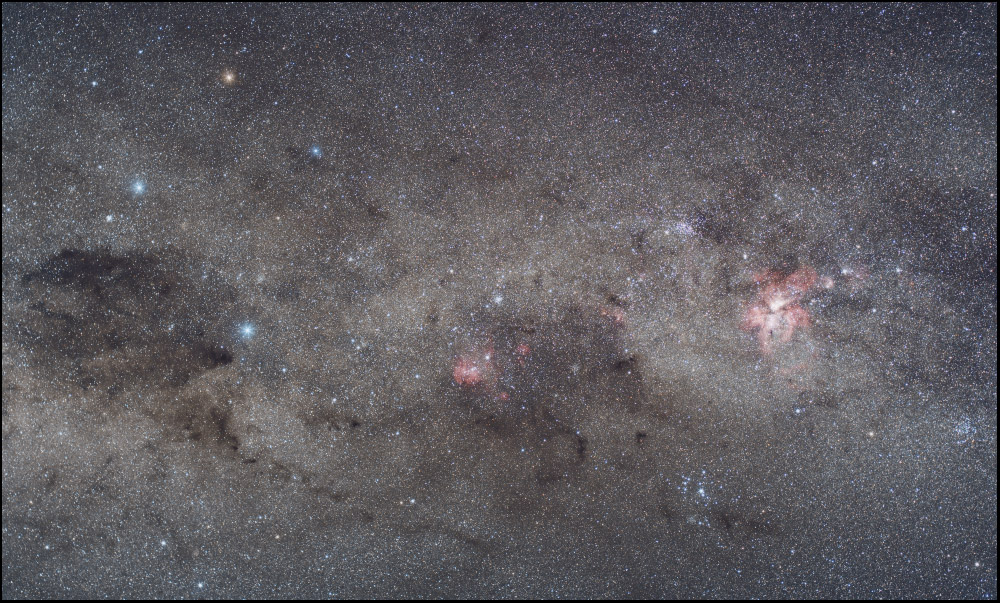
the southern cross

Also known as Crux.


source

I can usually find it in the sky, but don't always look.

***********
It was another cold day today.

Emily came around tonight and even cooked. She baked chicken Kiev (from the butchers) and roast tomatoes, with corn and green beans.

05 February 2008

across the universe

Music from Earth is already out there in universe, sent with Voyager in 1977, and now at the edge of our solar system. Joining that music is 'Across the Universe' by the Beatles. From NASA
NASA Beams Beatles' 'Across the Universe' Into Space
01.31.08

For the first time ever, NASA beamed a song -- The Beatles' "Across the Universe" -- directly into deep space at 7 p.m. EST on Feb. 4.


The transmission over NASA's Deep Space Network commemorated the 40th anniversary of the day The Beatles recorded the song, as well as the 50th anniversary of NASA's founding and the group's beginnings. Two other anniversaries also are being honored: The launch 50 years ago this week of Explorer 1, the first U.S. satellite, and the founding 45 years ago of the Deep Space Network, an international network of antennas that supports missions to explore the universe.

The transmission was aimed at the North Star, Polaris, which is located 431 light years away from Earth. The song will travel across the universe at a speed of 186,000 miles per second. Former Beatle Sir Paul McCartney expressed excitement that the tune, which was principally written by fellow Beatle John Lennon, was being beamed into the cosmos.

"Amazing! Well done, NASA!" McCartney said in a message to the space agency. "Send my love to the aliens. All the best, Paul."

NASA Lennon's widow, Yoko Ono, characterized the song's transmission as a significant event.

"I see that this is the beginning of the new age in which we will communicate with billions of planets across the universe," she said.

It is not the first time Beatles music has been used by NASA; in November 2005, McCartney performed the song "Good Day Sunshine" during a concert that was transmitted to the International Space Station (› Related Story). "Here Comes the Sun," "Ticket to Ride" and "A Hard Day's Night" are among other Beatles' songs that have been played to wake astronaut crews in orbit.

Feb. 4 has been declared "Across The Universe Day" by Beatles fans to commemorate the anniversaries. As part of the celebration, the public around the world has been invited to participate in the event by simultaneously playing the song at the same time it is transmitted by NASA. Many of the senior NASA scientists and engineers involved in the effort are among the group's biggest fans.

"I've been a Beatles fan for 45 years – as long as the Deep Space Network has been around," said Dr. Barry Geldzahler, the network's program executive at NASA Headquarters, Washington. "What a joy, especially considering that 'Across the Universe' is my personal favorite Beatles song."
See also music video from NASA
- Realplayer
- Windows media player

The perfect song to send across the universe. On the other hand, extra-terrestrial life forms may not find the song to their taste. They still have Bach's Brandenburg Concerto No. 2 from Voyager.

27 January 2008

life on Mars?

NASA released a composite photo of the Martian surface on 2 January 2008 from the rover Spirit.
NASA'S Mars Exploration Rover Spirit captured this westward view from atop a low plateau where Sprit spent the closing months of 2007.

After several months near the base of the plateau called "Home Plate" in the inner basin of the Columbia Hills range inside Gusev Crater, Spirit climbed onto the eastern edge of the plateau during the rover's 1,306th Martian day, or sol, (Sept. 5, 2007). It examined rocks and soils at several locations on the southern half of Home Plate during September and October. It was perched near the western edge of Home Plate when it used its panoramic camera (Pancam) to take the images used in this view on sols 1,366 through 1,369 (Nov. 6 through Nov. 9, 2007). With its daily solar-energy supply shrinking as Martian summer turned to fall, Spirit then drove to the northern edge of Home Plate for a favorable winter haven. The rover reached that northward-tilting site in December, in time for the fourth Earth-year anniversary of its landing on Mars. Spirit reached Mars on Jan. 4, 2004, Universal Time (Jan. 3, 2004, Pacific Standard Time). It landed at a site at about the center of the horizon in this image.

This panorama covers a scene spanning left to right from southwest to northeast. The western edge of Home Plate is in the foreground, generally lighter in tone than the more distant parts of the scene. A rock-dotted hill in the middle distance across the left third of the image is "Tsiolkovski Ridge," about 30 meters or 100 feet from the edge of Home Plate and about that same distance across. A bump on the horizon above the left edge of Tsiolkovski Ridge is "Grissom Hill," about 8 kilometers or 5 miles away. At right, the highest point of the horizon is "Husband Hill," to the north and about 800 meters or half a mile away.

This view combines separate images taken through Pancam filters centered on wavelengths of 753 nanometers, 535 nanometers and 432 nanometers to produce an approximately true-color panorama.

Image credit: NASA/JPL-Caltech/Cornell University
The image was widely reported in the media on 23/24 January 2008. The only reason why the media took an interest was because of fuss on the internet about the image of a possible humanoid.


The thing is, not even the BBC checked the original facts
The image is from a Nasa posting of the Spirit's landing site in 2004.
Wrong! It was 6-9 November 2007.

In any case, Martian life forms may not be humanoid. The easiest proof would be for the rover Spirit to return to the same site and take another picture of the same place, perhaps closer. If the 'humanoid' hasn't moved, then it is a rock formation.

***************
I slept in today until 10am! Haven't done that in a long time. Most of the day was vegging on the couch watching episodes of season two of Angel. Well, until the late afternoon anyway.

Devi came over in the afternoon with her electric (battery) hedge trimmer and trimmed the driveway hedge while I finished mowing the lawn. Devi also did a lot more other gardening than I did, as I took Kane2 for a walk.

I cooked Mongolian lamb (off a leg of lamb, sauce made with a tablespoon each of bean sauce, hoisin sauce, ketchup and a teaspoon of hot chilli sauce and a wedged onion) for dinner with rice.

17 August 2007

Mira... a star

Mira is literally a star. A heavenly body!


Above: Mira's comet-like tail stretches more than 13 light years. [More]
(click picture to enlarge)

From NASA (15 August 2007)
Galaxy Evolution Explorer--"GALEX" for short--scanned the popular star during its ongoing survey of the entire sky in ultraviolet light. Astronomers then noticed what looked like a comet with a gargantuan tail. In fact, material blowing off Mira is forming a wake 13 light-years long, or about 20,000 times the average distance of Pluto from the sun. Nothing like this has ever been seen before around a star.

"I was shocked when I first saw this completely unexpected, humongous tail trailing behind a well-known star," says Christopher Martin of the California Institute of Technology. "It was amazing how Mira's tail echoed on vast, interstellar scales the familiar phenomena of a jet's contrail or a speedboat's turbulent wake." Martin is the principal investigator for the Galaxy Evolution Explorer, and lead author of a Nature paper appearing today to announce the discovery.

Astronomers say Mira's tail offers a unique opportunity to study how stars like our sun die and ultimately seed new solar systems. Mira is an older star called a red giant that is losing massive amounts of surface material. As Mira hurtles along, its tail sheds carbon, oxygen and other important elements needed for new stars, planets and possibly even life to form. This tail material, visible now for the first time, has been released over the past 30,000 years.

"This is an utterly new phenomenon to us, and we are still in the process of understanding the physics involved," says co-author Mark Seibert of the Observatories of the Carnegie Institution of Washington in Pasadena. "We hope to be able to read Mira's tail like a ticker tape to learn about the star's life."

Billions of years ago, Mira was similar to our sun. Over time, it began to swell into what's called a variable red giant - a pulsating, puffed-up star that periodically grows bright enough to see with the naked eye. Mira will eventually eject all of its remaining gas into space, forming a colorful shell called a planetary nebula. The nebula will fade with time, leaving only the burnt-out core of the original star, which will then be called a white dwarf.

Right: Click on the image to play an animated artist's concept of red giant Mira evolving its comet-like tail. [More]

Compared to other red giants, Mira is traveling unusually fast, possibly due to gravitational boosts from other passing stars over time. It now plows along at 130 kilometers per second, or 291,000 miles per hour. Racing along with Mira is a small, distant companion thought to be a white dwarf. The pair, also known as Mira A (the red giant) and Mira B (the white dwarf), orbit slowly around each other as they travel together through the constellation Cetus 350 light-years from Earth.

In addition to Mira's tail, GALEX also discovered a bow shock, a type of buildup of hot gas, in front of the star, and two sinuous streams of material coming out of the star's front and back. Astronomers think hot gas in the bow shock is heating up the gas blowing off the star, causing it to fluoresce with ultraviolet light. This glowing material then swirls around behind the star, creating a turbulent, tail-like wake. The process is similar to a speeding boat leaving a choppy wake, or a steam train producing a trail of smoke.

The fact that Mira's tail only glows with ultraviolet light might explain why other telescopes have missed it. GALEX is very sensitive to ultraviolet light and also has an extremely wide field of view, allowing it to scan the sky for unusual ultraviolet activity.

"It's amazing to discover such a startlingly large and important feature of an object that has been known and studied for over 400 years," says James D. Neill of Caltech. "This is exactly the kind of surprise that comes from a survey mission like the Galaxy Evolution Explorer."

Mira, you're a STAR!

**********************
What a week! I am glad for the weekend. And at home too.