Showing posts with label community. Show all posts

15 October 2011

Measuring up. The Martians are here. The Sydney Story Factory.

Inspired by 826 Valencia, a writing centre in San Francisco for children founded by novelist Dave Eggers and educator Ninive Caligari, the Sydney Story Factory is scheduled to open late in 2011 in Redfern, Sydney. From their website
The Sydney Story Factory is a not-for-profit creative writing centre for children. Volunteer tutors offer free help to tell stories of all kinds. Programs are targeted at disadvantaged children, especially those from indigenous and non-English speaking backgrounds, but are open to all.

Sydney Story Factory programs are project-based, and every child walks away with a published piece of work. At the end of a one-off, two-hour workshop, children might have a bound and illustrated chap book to take home. At the end of a longer program, they may have produced a book, zine, school newspaper or short animated film. They might have had an article published in The Sydney Morning Herald, our media partner.

The Sydney Story Factory is dedicated to developing creativity. There is growing global awareness that the ability to think creatively and flexibly is key to preparing children for a future we cannot yet imagine. All programs at the Sydney Story Factory are designed to nurture the creativity that is innate to every child. Programs will increase children's abilities to express their thoughts and feelings, and give them new ways of understanding the world around them.

Read more.
The proposed work of the Sydney Story Factory is best shown in the video Measuring Up


The most powerful tool a child has is his or her imagination.

See reporting in the Sydney Morning Herald.

23 October 2010

The ugly face of Islamaphobia


From (US) ABC News
The Sept. 11 attacks, the Iraq war and suicide bombings worldwide have changed not only the way we live but the way we look at those around us, especially Muslims. "Islamophobia" has entered the American vernacular, and the anti-Muslim attitudes and prejudice it describes remain common.

But what if you witnessed "Islamophobia" in action and saw someone being victimized because of someone else's prejudices? What would you do?
As the father, of a soldier just returned home from serving in Iraq, said "every person deserves to be treated with respect and dignity".

18 October 2010

Hipsters 2 (everybody hates them, even other hipsters)

In August, I wrote that Hipsters are today's alternative counter-culture fashionable wannabes.

Alex Rayner in The Guardian wrote about why people hate hipsters "Hipster-hate blogs are multiplying online. But who are these much-maligned trendies – and why do people find them so irritating? Perhaps we should learn to love our skinny-jeaned friends instead" Excerpt
Nevertheless, from London to Lima, Sydney to Mexico City, detractors might not know exactly what a hipster is, but they do know what they don't like: a tiresome sort of trendy, ostentatious in their perceived rebellion, yet strangely conformist; meticulous in their tastes, yet also strangely limited. Squatting somewhere between MGMT, The Inbetweeners and Derek Zoolander, this modern incarnation is all mouth and skinny trousers.
Read more (the article has numerous links to interesting websites).

Since 9 September 2010, a video mocking hipsters has received over three million views.


Hipsters are surely the new Bohemians, except that they are cashed-up and more self-centred. So did emos evolve or are do they still exist and missing the attention?

08 October 2010

The right to dry.

A battle is raging across the United States by people fighting for the right to dry their laundry naturally outside on clotheslines.


See Drying for Freedom (trailer of film above)
Tens of millions of individuals across Northern America are banned from outdoor line drying by the very communities they live in, forcing them to turn to the dryer. Homeowners who break the rules are fined, sued and even foreclosed on. This ban is not only infringing on civil rights, it's contributing to the environmental and energy crisis. The dryer is responsible for 6% of the average household's energy bill and it costs residential ratepayers in the US an estimated $5 billion annually.
The right to dry movement embodied by Project Laundry List was founded following a speech by former Australian Dr Helen Caldicott.

See also Chicago Tribune and BBC News Magazine.

The concept of not being allowed to dry clothes outdoors is unthinkable in Australia, where the rotary clothesline known as the Hills Hoist was invented.

25 September 2010

Storm in a D cup on Sesame Street

A clip of a duet between Elmo and Katy Perry was planned to go to air. A preview was provided on YouTube (both Sesame Street and Katy Perry channels). Following complaints from some parents, the video was removed from Sesame Street's YouTube channel and will now not air. The basis of the complaints was that Ms Perry's clothing was too revealing. Here is the clip.


Sesame Street released a statement via facebook
Sesame Street has a long history of working with celebrities across all genres, including athletes, actors, musicians and artists. Sesame Street has always been written on two levels, for the child and adult. We use parodies and celebrity segments to interest adults in the show because we know that a child learns best when co-viewing with a parent or care-giver. We also value our viewer’s opinions and particularly those of parents. In light of the feedback we’ve received on the Katy Perry music video which was released on You Tube only, we have decided we will not air the segment on the television broadcast of Sesame Street, which is aimed at preschoolers. Katy Perry fans will still be able to view the video on KatyPerry.com.
"Aimed at preschoolers", so perhaps the clip could have been focus group tested for those preschoolers' reactions, NOT their parents. More than likely, those same preschoolers would not have even noticed anything of concern raised by some parents.

It is a shame that adults read sinister meanings into perfectly innocent situations.

See Rolling Stone magazine and The Punch (Australian).

02 August 2010

Hipsters

Hipsters are today's alternative counter-culture fashionable wannabes.


Look at some of my links of favourite websites on the right-hand-side. Oh dear.

01 August 2010

when someone goes missing, a day spent waiting is a day lost


This week is National Missing Persons Week (in Australia).

National Missing Persons Week is an annual campaign to raise awareness of the issues and impacts surrounding missing persons.

Research has shown there is a persistent myth that people believe they have to wait 24 hours to report a person missing. In 2010 the focus of the week is to dispel this myth. If you don't know the whereabouts of a loved one and you are concerned for their safety and welfare, you don't have to wait before reporting to police.

The tagline for the 2010 campaign is -

'when someone goes missing, a day spent waiting is a day lost'.

National Missing Persons Week also seeks to bring to light national efforts to find missing Australians and prevent others from becoming a missing person.

Information on people reported as missing in Australia can be found here.

25 May 2010

The Dalai Lama on religious harmony

His Holiness the Dalai Lama (the 14th Dalai Lama of Tibet) wrote an op-ed piece for the New York Times on 24 May 2010. Extract
WHEN I was a boy in Tibet, I felt that my own Buddhist religion must be the best — and that other faiths were somehow inferior. Now I see how naïve I was, and how dangerous the extremes of religious intolerance can be today.

Though intolerance may be as old as religion itself, we still see vigorous signs of its virulence. In Europe, there are intense debates about newcomers wearing veils or wanting to erect minarets and episodes of violence against Muslim immigrants. Radical atheists issue blanket condemnations of those who hold to religious beliefs. In the Middle East, the flames of war are fanned by hatred of those who adhere to a different faith.

Such tensions are likely to increase as the world becomes more interconnected and cultures, peoples and religions become ever more entwined. The pressure this creates tests more than our tolerance — it demands that we promote peaceful coexistence and understanding across boundaries.

Granted, every religion has a sense of exclusivity as part of its core identity. Even so, I believe there is genuine potential for mutual understanding. While preserving faith toward one’s own tradition, one can respect, admire and appreciate other traditions.
Read more. It's a powerful article worth reading.

Interfaith dialogue is an important means of social interaction to improve mutual understanding.

Interestingly, the byline used was Tenzin Gyatso, meaning ocean of wisdom. It's the shortened version of the full name of Jetsun Jamphel Ngawang Lobsang Yeshe Tenzin Gyatso (Holy Lord, Gentle Glory, Compassionate, Defender of the Faith, Ocean of Wisdom) given to the Dalai Lama as a young boy who was born as ལྷ་མོ་དོན་འགྲུབ་ (Lhamo Döndrub) after he was recognised as the 14th reincarnation.

Given the name Dalai Lama is a title, similar to Pope, the byline could not have been simply 'Dalai Lama'. Similarly, an article by Pope Benedict XVI would probably have the byline 'Benedict XVI' and not Joseph Ratzinger or 'Pope'.

Unlike the Dalai Lama (aside from the expected criticism from the Chinese Government) who has been considered to be embracing of all people, Pope Benedict XVI has been criticised by some for divisive views.

29 January 2010

Vindaloo against violence

A grass roots response to the ongoing concerns of assaults targeted at Indian students in Melbourne (though with no racial intent) is quite novel. Reported by ABC (Brigid Andersen)

Melburnians have always been known as foodies, but now they have a new reason to eat out.

The city's reputation has taken a battering in the last 12 months amid reports surfacing of racially-motivated attacks targeting Indian students.

Fed up with violence and the bad wrap her city was receiving, Mia Northrop decided to embrace Melbourne's love of food in a show of support for the Indian and migrant community.

On February 24, she is encouraging people all over Australia to take part in Vindaloo Against Violence.

Ms Northrop, who works as a digital media designer, says the idea is simple.

"The idea is that you just go to your local Indian restaurant and just dine on Indian food as a way of embracing the Indian community," she said.

"[My husband and I] wanted something that the maximum number of people could get behind, so it just kind of popped into my head.

"You can have this show of force that thousands of people are doing this same thing at the same time."

Ms Northrop, who lived in New York for several years, says she first heard about the attacks when she was overseas.

"Some of it had circulated overseas and was in the media there and I was kind of getting more and more appalled with what was happening," she said.

"Since the 2000 Olympics the overseas love affair with Australia seems to have soured. We've had a couple of incidents where there's been perceptions where we're perhaps racist.

"Things had been circulating [overseas] about [Australia's] immigration stance and boat people and then these attacks and then people were asking 'What's happening in Melbourne? What does the everyday person think about all of this? What's it like to actually live there?"

Ms Northrop says she is amazed at the response Vindaloo Against Violence has received.

She says the event has even attracted the attention of Prime Minister Kevin Rudd, who has started following the Vindaloo Against Violence Twitter stream.

"I've actually been floored. There's been comments from all over Australia. We've had people from Sydney and Adelaide and Brisbane and Perth and Canberra, Hobart, saying 'Make this event national, I'm organising a thing in Canberra', 'I'm organising a thing in Sydney'," she said.

"We've got people from Tennessee and Vancouver and Singapore and Hong Kong saying 'We're going to do it here'.

"I don't know how they found out about it, but certainly people from across Australia, it's resonating with them."

'Mixed messages'

The Victorian Police have been accused of down playing the motive for the attacks, but Ms Northrop says that is not the point.

"I think we've been getting mixed messages. So it is confusing to work out what is the media hype and what is really happening," she said.

"But either way I think that people don't want this to be happening in their city.

"It's almost besides the point [whether the attacks are racially motivated or not]. The perception is out there ... either way, Indians are feeling unsafe on the street."

But there is no doubt the perception in India is that its nationals have being targeted in violent attacks perpetrated by Australians.

And Ms Northrop says she hopes word of Vindaloo Against Violence reaches India.

"My main aim now is making sure I can get it to the people that the message is supposed to go to, both here and overseas," she said.

"I'm hoping the Indian media will pick up on this."

She also hopes publicity surrounding the event will lead to a re-evaluation of behaviour in Australia.

"Everyday Australians don't accept racially-motivated violence. I think we want to shift the focus from what Indians need to be doing to protect themselves in terms of their safety, to finding out why is this happening in our society," she said.

"Who are the people who are doing this? Let's try and diffuse this criminal behaviour and get to the core of it. Flush out the reasons or the issues behind it."

Ms Northrop says Vindaloo Against Violence - an idea initially thrown around with family and friends - is now taking up all of her spare time.

"I initially sent it out to 100 friends on Facebook and then I put the Twitter account together and did the website and I really had no idea how it was going to be. It could have been me and 30 friends having some Indian food on a Wednesday night," she said.

She says all Australians can support Vindaloo Against Violence by registering online and going to their local Indian restaurant on February 24.

And she says if the traditional vindaloo is too hot for your tastebuds, tucking into a butter chicken, korma or rogan josh are all acceptable ways of showing your support for the Indian community.

"You can have whatever Indian food you like, there's certainly plenty to choose from," she said.

See also event on Facebook. Reuters India did report on it, as 'Australia seeks to curry favour with Indian', which was quite positive.

Members of the public may not prevent miscreants from indulging in acts of violence by simply eating Indian cuisine, but the gesture of support would affirm the acceptance of Indian students within local communities. Besides, who could turn down a delicious vindaloo or rogan josh?

30 October 2009

Living in a cashless society - a freeconomy

Some people are challenging the notion that money makes the world go round.

Suelo has been living without money for nearly nine years around Moab and Portland (presumably in Oregan USA). See his website.

More recently, Mark Boyle in Bristol UK has lived for nearly a year without money and wrote an article for The Guardian about it.

In the photo that he provided for the article, it shows that he looks healthy and not malnourished.


It's a noble concept, which relies on the kindness of others. The other extreme is greed, where people exploit others for personal gain (and wealth). Thankfully most people lie somewhere in between, though most people would like to have more money than they really need.

Root of all evil?

11 April 2009

Bigotry in action

From Fox News.
Asian-Americans Blast Texas Congressman's Call for 'Easier to Deal With' Names
Asian-Americans are outraged following what they say were offensive comments made by a Texas lawmaker who suggested that voters of Asian descent adopt names that are "easier for Americans to deal with" at the polls.

By Joshua Rhett Miller
FOXNews.com
Thursday, April 09, 2009

Asian-Americans say they are outraged that a Texas lawmaker suggested in a hearing that Asian-American voters should adopt names that are "easier for Americans to deal with" at the polls.

Texas Rep. Betty Brown, a Republican, made the comments on Tuesday as Ramey Ko, an associate member of the Organization of Chinese Americans, testified before the Texas House Elections Committee on voter identification legislation.

Ko testified that people of Asian descent frequently have difficulties voting due to differences in their legal transliterated names and the English name shown on their driver's licenses.

Brown asked Ko: "Rather than everyone here having to learn Chinese -- I understand it's a rather difficult language -- do you think that it would behoove you and your citizens to adopt a name that we could deal with more readily here?"

Brown later said, "Can't you see that this is something that would make it a lot easier for you and the people who are poll workers if you could adopt a name just for identification purposes that's easier for Americans to deal with?"

The Texas Democratic Party called on Brown to apologize on Wednesday.

The exchange, which has appeared on YouTube, has angered many Asian-Americans.

"It really goes to show you that no matter how much progress is made when it comes to race, ignorance still exists in America," said Brad Baldia, national president of the National Association of Asian American Professionals. "It's a slap in the face and it goes to show that there needs to be more education of our government in terms of diversity in America."

Baldia said the comments were particularly "insensitive" as Asian-Americans are becoming increasingly involved in the political process.

Karen Narasaki, president and executive of the Asian American Justice Center, said Brown's comments indicate a lack of understanding.

"I think Rep. Brown owes an apology to the entire Asian-American community," Narasaki said. "But more than that, she needs to show that she understands that that's an unacceptable solution. She probably thinks that President Obama should change his last name too."

Jordan Berry, a spokesman for Brown, defended the lawmaker and said her comments were not racially motivated.

"It had nothing to do with race," Berry told FOXNews.com. "What she was talking about was the Chinese name, just transposing it from Chinese to English."

Berry said Brown apologized to Ko shortly after the hearing.

"She reached out to him immediately," Berry said. "What more do you want?"

Sarah Smith, communications manager for the Organization of Chinese Americans, said the group was "disappointed" by Brown's comments. It was not immediately clear whether Ko and Brown had connected, she said. Ko could not be reached for comment.

"Representative Brown's comments made clear that she lacks an understanding of Asian American cultures and that she in fact undervalues other cultures," OCA Executive Director George Wu said in a statement issued late Thursday.

Texas Democratic Party Chairman Boyd Richie called on Brown to apologize and accused her Republican counterparts of trying to suppress votes with a partisan voter identification bill.

"It's shameful that Rep. Brown's immediate and initial reaction to hearing a legitimate problem with a Voter ID bill was to ask a fellow American to sacrifice his good family name and tradition for the convenience of her partisan agenda," Richie said in a statement to FOXNews.com.

"Texans are proud of our family names, and for one of our lawmakers to suggest even once that a fellow Texan should sacrifice his name is an insult to our most precious values."

Berry said Democrats were "looking for an issue" and took Brown's comments out of context.

Russell Leong, an adjunct professor of Asian American studies at UCLA, said the incident highlights "anti-immigrant xenophobia" in the United States.

"Beyond partisan politics of Democratic and Republican, the bottom line issue is the anti-immigrant xenophobia that has developing after 9/11 -- against all groups including but not limited to Asians, Arabs, Middle Easterners, and Mexicans and Latinos," Leong told FOXNews.com in a statement.

"How far is America willing to go to be inclusive of its non-white and non-European immigrants? Did America have problems with its Russian, Polish, and Eastern European immigrants or refugees who passed through Ellis Island? Were not their names also difficult to pronounce or spell? Asian names are no more difficult, in my view."

Officials from the Asian American Institute said Brown's comments were "outrageous, offensive and hurtful."

"Her comments send the message that diversity is not welcome in Texas, and that Asian Americans are foreigners who are unwelcome in the United States," AAI Executive Director Tuyet Le said in a statement to FOXNews.com.


Even Rachel Farris was outraged in Huffington Post.

Outrageous. It is hard to believe that in this day and age certain people still have this attitude. Perhaps Betty Brown would like to return to the days of racial segregation. Next she'll want to make it illegal for Americans of Latino background to speak Spanish.

15 March 2009

the land of opportunity...

One can understand how cities like Mumbai have 'slums' like Dharavi.

When the richest country on earth, especially one of the wealthiest states and one of the world's largest economies starts boasting a slum building up in the state capitol, it makes you wonder who is worse off.

27 November 2008

moralising human nature

An interesting book review published in The Nation
A few years ago, in the course of researching her dissertation on changing sexual mores in the Islamic Republic of Iran, a young Iranian-American anthropologist named Pardis Mahdavi stopped by the Ministry of Education in Tehran to inquire about the country's sex education curriculum. Another visitor happened to be there. An older woman named Mrs. Erami, she was covered head to toe in the most conservative form of Iranian hijab: the tentlike black chador, held in place by the wearer's teeth such that it obscures half the face. Under her chador, Mrs. Erami wore another voluminous layer of hijab, including a hoodlike head scarf and a long, loose coat. Hers was the uniform of the government faithful, the traditional-minded and the sexually puritanical--the very image of the older generation that Mahdavi's main research subjects, Tehrani youth, rebuffed with their outsized vanity and sexual libertinism.

But Mrs. Erami had come to the ministry on a mission related to Mahdavi's. She taught courses on health, puberty and relationships at a Tehran high school, and she had come to talk to the minister about her frustration with her students' unwillingness to discuss sexual matters frankly with her. In a country where premarital sex with multiple partners is increasingly common but remains culturally taboo and punishable under the law, this severe-looking, chador-clad woman was, at a glance, hardly the person in whom one might feel comfortable confiding one's illicit activities or seeking intimate advice. Mahdavi didn't even feel comfortable letting the older woman see her nail polish, which is illegal but commonplace in Iran. Nonetheless, Mrs. Erami could not understand her students' reticence. "They are so difficult," she told Mahdavi. "I can't get them to talk to me, but I know what they are doing and what they are not doing. I had a teenage daughter myself, and I know that they are having a lot of sex, but not doing it right. I just can't get them to talk to me about it."

Mrs. Erami, it turns out, is one of the more dramatic products of the generational upheaval in Iranian attitudes toward sex. A conservative Muslim, she was not sympathetic, some years before her encounter with Mahdavi, when her gay son came out of the closet. Her husband threw him out of the house. When their unmarried daughter announced that she had a boyfriend, Mrs. Erami slapped her and called her a prostitute. The daughter left home that day, never to return. And so the Eramis lost both of their children over their unwillingness to accept sexual behavior that had become the norm not only globally but even within many circles inside Iran. A year later Mrs. Erami's husband died, leaving his wife entirely alone and flooded with regret. That was when she devoted herself to sex education reform, both as a teacher and as a campaigner within Iran's education ministry.


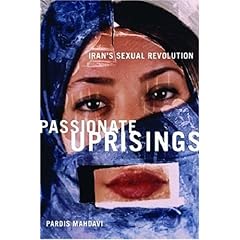
cover of the book Passionate Uprisings (Amazon.com)

I love irony. Repress people's human nature and they will try to express it in an extreme manner.

*****************
Emily didn't come around for dinner last night, so I had baked beans on toast.

31 October 2008

Day for Daniel

I do like special days when it is about me.

Today was Day for Daniel, but it was not about me.

Day for Daniel is a day to honour Daniel Morcombe who was nearly 14 when he was abducted by two men while waiting for a bus. He is still on the missing persons list.

Name:

MORCOMBE,
Daniel James

Daniel James Morcombe

D.O.B: 1989
Height: 150 cm
Complexion: Fair
Eye Colour: Blue
Hair Colour: Dark Brown
Build: Proportionate
Tattoo(s)/Marks: Nil
Last Heard: The missing person was last seen at his residence at Palmwoods on 7 December 2003. He intended on walking to an undesignated bus stop on the Nambour connection Road near the Kiel Mountain overpass.
Day for Daniel is an event organised by the Daniel Morcombe Foundation (set up by his parents) to raise awareness of child safety.


Daniel's family continue to suffer the anguish of still not knowing what happened to their son. He will turn 19 in December and his parents have missed the best years of his life, growing from a boy into a man.

Through their tragedy, his parents have helped many others.

*****************
It has been a busy week at work.

29 October 2008

African Danish

No, not a form of pastry.

When I visited Lisbon a few years ago, I noticed on the metro that most of the 'white' Portuguese people seemed to avoid those who looked African. It made me wonder if perhaps Portugal had a refugee program.

Then it dawned on me that African Portuguese have been there for a long long time. The Portuguese empire stretched to Africa. In 1441, African slaves were first brought to Lisbon, with slave trading becoming a lucrative in Portuguese commerce.

Knowing a bit of history helps to counter wrongful assumptions.

Anyway, Denmark has received African migrants for some time and some 45 000 Africans are now home in Copenhagen, many arriving later as refugees. I found a fascinating article by the BBC - Africans adapt to to Nordic chill (24 October 2008), which is worth reading.
Africans adapt to Nordic chill

The BBC's African Perspective programme is investigating what life is like for some of an estimated 20 million Africans who live in the diaspora.

Ellen Otzen visits Copenhagen, the capital of Denmark, to see how the 45,000 Africans there have adapted to their chilly Nordic home.

In a small, white house standing in the shadow of Copenhagen's oldest churches people from Cameroon, Botswana, Sierra Leone, Tanzania and Uganda meet each Wednesday night to sing in a gospel music choir.

Ugandan Joel Moses came to Denmark for love, 13 years ago.


Denmark is a very small country... I don't think the Danes were prepared for all of us
Ugandan Peace Kabushenga

"I was once married to a Danish woman. She couldn't stand living in Africa and so I moved to her home," he explains.

"I love to sing and so I come every Wednesday even if I am tired, physically - it builds me up and gears me up for a new day.

"To be honest, I really come to do something as an African in a white community because there's a lot of things I do that are gone, not recognised. But I think I am recognised by reaching out to my fellow Africans."

Love broke down for Joel as it did for another Ugandan, Peace Kabushenga.

Dramatic

She is a project manager dealing with HIV/Aids among the ethnic minorities in Denmark.

She arrived in Copenhagen almost 30 years ago in 1979, as a diplomat's wife. Her life then was comfortable.

But it ended abruptly when their relationship broke down and her husband returned to Uganda.

"It was a dramatic change," says Peace, who found herself as a single mother far from home.

"I had to declare myself a refugee to live in Denmark. I had to live in a refugee camp while my papers were being processed.

"Strangely, I knew no other Africans," she recalls.

"It was my Danish friends who helped me. Of course I would've survived - I am strong; but they made it so much easier for me and most importantly, for my son."

Historic links

Denmark never had colonies in Africa but ties between the sea-faring Danes and Africa's Gold Coast, now Ghana, stretch way back in history.

The Ghanaian seat of government, in the capital, Accra, is housed in the original Christiansborg Castle - a slave fort built by the Danes in the 17th century.


After the 11th of September, Islam became a political issue and it is a big one here in Denmark, unfortunately
Khadija Fara
Somali social worker

Stored inside the Presbyterian Church in Accra's Osu district are records from the 1850s, chronicling families with Danish fathers and Ghanaian mothers.

Eighty Danish surnames, like Svanekær, Richter and Holm are still in use today in Ghana.

More recently the links are developmental ones. In the 1960s Danish doctors, vets and engineers were sent to Africa and in return African students came to study.

Then as oppressive regimes took over it was scared, political refugees, like rapper Al Agami, who started to head to Africa-friendly Denmark.

'Fear factor'

Al Agami was born in Uganda's capital, Kampala, but grew up in Denmark. He also spent three years living in Afghanistan. His father was a soldier.

"I am a political refugee. I wound up in Denmark because of my father's stress with the Idi Amin [a former Ugandan dictator] era."

Al Agami is now one of the biggest names in Danish rap music.

He recalls how Denmark in the 1970s was "very quiet" which he feels is a contradiction to his "can't sit still" personality.

He says it was weird because there were "no brown faced children" but there was "no fear factor", unlike now.

Somali Khadija Fara works as a social adviser. When she arrived in the 1980s, she says things were different; but it was during the 1990s that everything began changing.

"Many, many Somali refugees came to Denmark and they were the biggest minority group," Khadija says.

That is when the fear factor, as Al Agami calls it, set in.

Shift in attitude

Hostility, resentment and friction rose and two years ago, tension spilled over when Muslims took to the streets outraged by cartoons of the Prophet Muhammed in a Danish newspaper.

"After the 11th of September [2001], Islam became a political issue and it is a big one here in Denmark, unfortunately," explains Khadija.

"I wish people would instead use their energy on other things like integration and making the second generation immigrants from feeling marginalised."

Peace Kabushenga believes the problems have stemmed from the large number of immigrants arriving.

"You have to bear in mind that Denmark is a very small country and so many foreigners have come in. I don't think the Danes were prepared for all of us."

The resultant shift in attitude has caused Peace to worry for herself and her son.

"When he's out there I don't want him to feel like a foreigner. I would feel very sad if he told me, he was mistreated on the streets," she says.

"Yes, he has a black skin but he has his roots here and he is very, very Danish."

Tune into the BBC World Service to listen to African Perspective's Africans Abroad: Part I on Saturday 25 October at 1906 GMT in Africa. The programme will be available for a week on the website.

Part II of Africans Abroad - about chasing the American dream - will be broadcast on Saturday 1 November. Part III on Saturday 8 November will feature Africans who have voluntarily made the former slave island of Jamaica their home.

One should never assume that all Danes are white-skinned.

********************
Today was a very busy day at work. So much so that I was tired and fell asleep on the couch after work.

10 July 2008

how normally wasted food go to the needy

From a great article in The Australian
Every day, tonnes of excess food is thrown away, wasted, even though much of it is perfectly edible. Every day, OzHarvest tries to do something about that contradiction. It collects at least some of the extra food and delivers it to charities that can make good and immediate use of it.
I cringe when I see or know of food being wasted. This is such a logical solution, that it's a wonder why it took so long.

OzHarvest only began in 2004, but is providing a great service. Similarly, SecondBite in Melbourne.

*************
I hope this cold winter will not be a long one.

01 April 2008

goth -> emo -> scene kids

As if trying to work out how the goth and punk sub-cultures gave rise to emo wasn't bad enough, emo has begat 'scene kids'.

Don't ask me. I'm still trying to work it out.

In Australia, the 'scene kids' are adamant that they are not emo. See Sydney Morning Herald article 'Inside the clash of the teen subcultures' (30 March 2008).


Kirra Dare, Emma-Jane Scott and Eliza Coughlan, all 13, wear the Scene kids style

Even grown ups are a little confused. Fox 11 News undercover report (from 2007)


Why can't they just be punk?

***********
Boring day at work. An exciting walk with Kane. Some house cleaning (clean sheets on spare bed, a clean of the bathroom) in readiness of Michelle staying over tomorrow night. That's all.

28 March 2008

tomorrow is Earth Hour... so change the windows

Earth Hour started in 2007 as a Sydney event. This year, it has gone global.

Tomorrow night (29 March 2008), many cities around the world will switch off their lights at 8pm for one hour. At work today, staff were reminded to turn off their computers and unplug them from the wall, including any non-essential appliance before they went home.

There was a timely article in the Sydney Morning Herald today about an invention that could revolutionise windows and lighting
Window by day, light at night

Jennie Curtin
March 28, 2008

AS THE world prepares to switch off for Earth Hour tomorrow, the work of a young Sydney designer may make the light switch redundant forever.

Damien Savio, 23, has developed a window which stores energy from the sun during the day and then becomes a light at night. Just four hours of direct sunlight can produce a 60 watt-strength light which will last six hours.

His invention, which he calls the Lightway, has the potential to cut household energy use by 22 per cent.

Mr Savio was inspired by his discovery of organic light-emitting diodes, a new technology which has been used to improve the quality of pictures on mobile phone screens and laptops. He combined OLEDs with transparent photovoltaic cells, another developing field.

"Technically, it's only really, really new," he said. "The whole time I was doing it I had people tell me, no, that's not going to be possible. They were always doubting it and trying to test me on how it would work."

Mr Savio has spoken to a lawyer about patenting his work so was reluctant to gives details on how the Lightway is made, but he did reveal it involves an injection mould used during production of the window.

As the window absorbs solar energy during the day, it is stored in a battery hidden in the window frame. This means it can be used as a light at any future time.

Mr Savio, from Longueville, created the Lightway for his industrial design degree. It has been nominated as a finalist in the Australian Design Awards-Dyson Student Award, which will be announced in May.

He used louvre windows to develop his concept "because they looked good" and also because the panels are removable, so they can be carried around like a torch.

"I also wanted to have the wow factor," he said. "Whenever I do a design I just want to do something different and something that stands out. I like that with this, you don't even know it's a light until it's on."

Mr Savio said the Earth Hour message of the need to reduce greenhouse gas emissions was "one of the main driving forces" behind his creation. LEDs are a particularly energy-efficient form of lighting.

But the designer will not be home to switch off the lights on Saturday. He will be at work in a city bar where he reckons it is already so dark the patrons will not notice the difference.
Here is the entry for his nomination for the Australian Design Award

Student Designer
Mr Damian Savio

University
University of Western Sydney

Product Description and Principal Function(s)

Lightway is a window and lighting system based around the existing Breezway window louvre system.

The major difference being the Lightway uses organic OLED's and advanced transparent Photovoltaic Nanoscale technology to allow sunlight to enter the household during the day and to fill the house with light during the night.

Lightway is essentially a modular light that absorbs solar energy during the day, using it a night to illuminate an area as if it were daytime again.

The entire system is transparent and extremely efficient. There is also a portable application to the system.

Why does the product represent design excellence and why do you believe it deserves an Australian Design Award?

The project represents excellence largely because it is a concept that is unlike any other that exists today. The idea behind the design is highly innovative taking 2 very new technologies and using them in a simple but effective lighting system that could be the next major revolution in the way we think about lighting. It is a system that has been designed for homes, museums, galleries and shopping centers.

Along with being innovative, the light is also aesthetically pleasing. It is a modern design that incorporates sleek transparent window panels with and anodized aluminum frame. Each panel can be customized with colours, art and graphics that are illuminated to enhance the light for a particular application.

In terms of functionality, Lightway is a cut above the rest. Not only is there no need for it to be connected to any power grid, it is also highly efficient and versatile, capable of producing the same amount of light as a 60watt incandescent globe from just 5 watts. With in the system there is also a mobile unit that can be used to take light anywhere, and that will also charge on its own. Light from the unit can be adjusted to suit the mood that is required, by adjusting the direction of the louvers. Each panel is also extremely tough being constructed from strong polycarbonate. Charge time for the system is 4 hours of direct sunlight with 2 hours daylight. This will give the system a running time of around 6 hours. The batteries used will last for years, capable of handling thousands of on/off cycles. Almost every aspect of the original Breezway system has been redesigned and RESOLVED for Lightway, while remaining Breezway certified.

In terms of practicality and ease of use, the system is excellent. Since it has been based around an existing Breezway system, the design incorporates everything they have learned over the 10 plus years they have been in operation. The system incorporates safety features such as lock, security bars and fly screens. The system can be made to fit any sized window or door way. Operating the system is easy, only requiring a simple rotation of the single louver handle to open and close the system. The system also meets Australian Standards in terms both of construction and voltage, remaining below the high risk 32v category.

There is definatley a need for the product, as it has the potential to reduce household and city wide electricity usage by a massive 22%. Which is good news for the environment and the economy. A number of people have expressed interest in the concept for the stated applications and it is a proven concept that will work, as stated by a number of physicists that i have presented it to.

Lightway would be sold and Breezway outlets in a display style showcase, where consumers would come and view the entire package and order the system as required. The product would then be delivered with in 5 working days and fitted.
I am hoping that the technology could be applied to full sized windows.


***********************
We had a happy hour at work today and the theme was for staff to wear their football colours. I went for half and hour and must have been the most tragic!

Nick B was supposed to come over tonight to watch the football on tv (live broadcast) tonight, but had double booked. So it's just me and Kane. I don't know if he is concerned by my yelling.

08 November 2007

the world in Sydney

I like this story in the Sydney Morning Herald
A little soiree for Sydney's alphabet of nations
Adam Spencer
November 8, 2007

"Thirty-eight year old Sydneysider seeks temporary companion. Must be free this Friday morning, living in Sydney and originally from Afghanistan, Albania, Algeria, Zambia, Zimbabwe … "

It seemed like a good idea at the time. Everyone says Sydney is a pretty diverse place. Well, let's see how diverse, I thought to myself. Let's try to track down people from as many countries as possible then assemble them in one spot. Now we are throwing a little soiree for about 500 of my nearest and dearest from more than 150 countries around the globe.

The response has been overwhelming. Within the first couple of days I'd spoken to Casey de Periera from the Seychelles, an island nation north-east of Madagascar. He even ran for the Seychelles at the Moscow Olympics. "The stadium had more people than my country," he said. And then there was Lolo Fernandez from Peru who told me: "I love Sydney … your roads are just so good".

I've been amazed by the range of people living in this city, their backgrounds and their stories. This week I spoke to Brigitte Wilkinson from Silesia, which you know and I know is situated between Germany and Poland and was seized by the Russians and given to the Poles after World War II. And then Iceland's Hanna Sigurjonsdottir, whose last name means "daughter of the son of Sigur", joined the team.

If you want an ambassadorial feel, we've even got Nadine Vernon coming along. "Who is she?" I hear you cry. Well, no less than the honorary consul of Belize, which you and I know is a former British colony which until 1973 was known as British Honduras and is the only Central American country with English as its official language.

In a world city whose mainstream media is too often too vanilla in every sense of the word, this just feels like it might be a lot of fun. And it's not too late to be part of it. In particular, if you're from Ukraine, Bermuda, Paraguay or even Vanuatu, give us a bell. Or Liechtenstein, Haiti, Burkina Faso, Liberia, Kazakhstan, Kuwait, Syria, Mongolia, Djibouti …

I should stress, this has never been an exercise about me telling people what constitutes a country - if you've come from somewhere else to live in Sydney, let us know about it. We have Garry Braude of Lane Cove representing East Prussia, which his family fled in 1939. There is no country called East Prussia now. But if he says he's from East Prussia, he's from East Prussia.

What I've realised is the amazing range of people who make up Sydney are just that. They're people, not percentages or pie charts. Everyone has a remarkable human story and the common thread is they've ended up here.

Adam Spencer is breakfast presenter on ABC 702. The World in Sydney will be broadcast live tomorrow from 6am to 7.45am. See www.abc.net.au/sydney for a list of nationalities still being sought.
I'm glad Sydney is not a place where everybody is the same. That would be so boring.

************
Happy Thursday. This evening, Emily, Margaret, Mary and I went to the Dumpling Inn, a local eaterie, for a Peking Duck dinner.

I even managed to get home in time to watch Bionic Woman and Heroes.

30 June 2007

Protecting the global poor

From Prospect
Almost all rich countries got wealthy by protecting infant industries and limiting foreign investment. But these countries are now denying poor ones the same chance to grow by forcing free-trade rules on them before they are strong enough.
and the conclusion
Therefore, if they are genuinely to help developing countries develop through trade, wealthy countries need to accept asymmetric protectionism, as they used to between the 1950s and the 1970s. The global economic system should support the efforts of developing countries by allowing them to use more freely the tools of infant industry promotion—such as tariff protection, subsidies, foreign investment regulation and weak IP rights.

There are huge benefits from global integration if it is done in the right way, at the right speed. But if poor countries open up prematurely, the result will be negative. Globalisation is too important to be left to free-trade economists, whose policy advice has so ill served the developing world in the past 25 years.
Global free trade only works if there is a level playing field.

And what about food aid to Africa? It is for the benefit of the USA and other donor countries, not for poor nations. From the Observer last month
It's early May and Malawi seems to be awash with corn. On the roads, trucks heavy with pale yellow maize heads rumble from the fields; in the villages nearly every woman and child is at work stripping the little kernels from their cobs, singing the harvest songs that give a rhythm to their work. Other women are pounding the maize with a giant pestle and mortar into flour to make the national staple dish - nzima - corn mash. (The men mostly seem to be occupied drinking the new season's maize beer.) It has been the best harvest in a dozen years or more. So why - and this is what we've come here to ask - in this time of historic plenty, is the rich world still sending its unwanted food to Malawi?
Makes you wonder doesn't it?

**********************
Today was a busy day. I was up early this morning and went to the farmers' market with Mary. So nice to have fresh sour dough bread, pumpkin bread and crusty Italian bread again.

This afternoon I went into town to watch Fantastic Four Rise of the Silver Surfer with Jordan.

Image and video hosting by TinyPic

Then tonight I went to the Canberra Labor Club to watch the football game between Brisbane Lions and Port Adelaide, which my team narrowly lost. Results tomorrow.