Showing posts with label engineering. Show all posts

02 July 2011

A marathon of a bridge

Built by Shandong Gaosu Group or Shandong Hi-Speed Group Corporation (SDHS) 山东高速集团有限公司, the world's longest sea bridge opened to traffic on 30 June 2011. From SDHS
On June 30, 2011, the world longest cross-sea bridge Shandong Hi-speed Jiaozhou Bay Bridge which is invested and operated by SDHS is officially open to traffic. Jiang Yikang, the secretary of the CPC Shandong Provincial Committee and director of the Standing Committee of the People's Congress of Shandong Province, Jiang Daming, the deputy secretary of the CPC Shandong Provincial Committee and governor of Shandong Province, general Wang Dengping, the political commissar of North China Sea Fleet, Li Qun, member of the Standing Committee of CPC Shandong Provincial Committee and secretary of CPC Qingdao Municipal Committee, Sun Liang, the Party secretary and chairman of board of SDHS as well as other members of the leadership lineup of SDHS are present at the opening ceremony.

At 10:08 in the morning, accompanied by the martial music, the opening ceremony of Shandong Hi-speed Jiaozhou Bay Bridge grandly begins. Sun Liang and Li Qun deliver speeches in succession. At 10:30, Jiang Yikang announces the bridge is open to traffic. Immediately, the fireworks rise from all directions with doves flying into the sky. The cordial atmosphere floats over Jiaozhou Bay.

As the longest cross-sea bridge in the world, Shandong Hi-speed Bay Bridge is 41.58 Km long, whose opening to traffic realizes the dream of the people over the years in Qingdao, Huangdao and Hongdao and safeguards the economic development of Qingdao City. In addition, the construction of the bridge shows the strenth of SDHS and promotes the awareness and influence of SDHS.
No doubt, the Chinese language version sounds even more 'official' and 'lofty'.

(photo from SDHS)

Some interesting facts from UK Daily Telegraph
Length: 26.4 miles (almost 3 miles longer than the previous record holder)

Width: Six-lane expressway

Capacity: Expected to carry over 30,000 cars a day

Tensile strength: Able to withstand earthquakes of 8.0 magnitudes on the Richter scale, strong typhoons and the impact of a 300,000 tonne vessel

Made up of: 450,000 tonnes of steel and 2.3 million cubic metres of concrete, supported by 5,200 columns

Built by: More than 10,000 workers

Built in: Four years

Importance: Reduces the distance between Quingdao city and the Huangdao district by around 18 miles
Further information from SDHS on construction features and other details.

Channel 4 News


Crossing 41.58km (26.4 miles) in open sea above the water? It might seem like running a marathon.

16 October 2010

The world's longest railway tunnel

AlpTransit Gotthard AG, a wholly-owned subsidiary of the Swiss Federal Railways (SBB-CFF-FFS), is currently building the world's longest railway tunnel. From their communiqué of 15 October 2010
World record on the Gotthard: The longest railway tunnel in the world has become a reality. On 15 October 2010 in the east tunnel, 30 km from the north portal and 27 km from the south portal, the final breakthrough of the Gotthard took place. At about 14:30, the tunnel boring machine, drilling from Faido, broke through the last metre of rock on the route to Sedrun.

The tunnel breakthrough was highly accurate. At 8 cm horizontally and 1 cm vertically, the deviation was very small. In his speech, Federal Councillor Moritz Leuenberger expressed pleasure, but was also moved by this important milestone on the Gotthard: “This breakthrough is a symbol of what policy can do, when we make it together,” he said. The new base tunnel will make Swiss – and also European – transport policy more sustainable. Renzo Simoni, Chief Executive Officer of AlpTransit Gotthard AG, singled out the numerous miners in his thanks. “Through their years of tireless commitment, they have made this world record possible. The miners are the heroes of today’s celebrations.”

Guests and miners are very happy

At the breakthrough point deep inside the mountain, a little over 6 km south of Sedrun, about 200 people, including Transport Minister Moritz Leuenberger and other guests of honour, witnessed the breakthrough by the tunnel boring machine. About 3500 miners and others involved in the project, including current and former engineers, planners, geologists and surveyors, followed the breakthrough on big screens at various venues: the Sedrun workshop, the Faido multifunction station, the north portal in Erstfeld, and the KKL in Lucerne. Swiss TV broadcast the event live throughout Switzerland and internationally

Importance for transport policy

The 57 km Gotthard base tunnel traverses the Alps, connecting the north portal in Erstfeld (Canton Uri) with the south portal in Bodio (Canton Ticino). With a rock overburden of up to 2500 m, the Gotthard base tunnel is also the most deeply set rail tunnel in the world. Together with the 15.4 km Ceneri base tunnel, the Gotthard base tunnel will provide a level track through the Alps. The base tunnel through the Gotthard is the core of the new rail connection. It is planned to become operational by the end of 2017. This will markedly improve passenger and freight transport at the heart of Europe: it will favour the shift of north-south freight traffic from road to rail, and shorten the journey time from Zurich to Milan from 3 hours 40 minutes to 2 hours 50 minutes. With the New Rail Link through the Alps (NRLA) on the Gotthard and the Lötschberg, Switzerland is contributing significantly to bring the people of Europe together – something the EU acknowledges.

Building the Gotthard base tunnel

The Gotthard base tunnel consists of two parallel single-track tubes, which are connected every 325 m by 40 m galleries. Overall, the tunnel system of the Gotthard base tunnel, including all tubes, shafts and galleries, measures 151.8 km. One and two thirds of the way along, at Faido and Sedrun, there are multifunction stations, which serve as emergency stopping points and places to change track. The Gotthard base tunnel was built simultaneously in five sections: Erstfeld, Amsteg, Sedrun, Faido and Bodio. The first works were carried out back in 1993, with the Piora exploratory boring, and from 1996 to 1998 with the blasting of the access shafts in Sedrun, Faido and Amsteg. Since 2001, the main lots have been constructed. The final breakthrough in the west tube is planned to take place in April 2011.
The previous longest railway tunnel was the undersea Seikan Tunnel at 53.85 kilometres (33.46 miles) linking the Japanese islands of Honshū and Hokkaidō.

Images by Reuters via PicApp
A visitor stands at the Erstfeld-Amsteg section of the NEAT Gotthard Base Tunnel October 5, 2010. With a length of 57 km (35 miles) crossing the Alps, the world's longest train tunnel should become operational at the end of 2017.  REUTERS/Arnd Wiegmann (SWITZERLAND - Tags: BUSINESS CONSTRUCTION TRANSPORT TRAVEL IMAGES OF THE DAY)

REFILE - CORRECTING TYPO A miner stands in front of the drill machine 'Sissi' after it broke through the rock at the final section Faido-Sedrun, at the construction site of the NEAT Gotthard Base Tunnel October 15, 2010. With a length of 57 km (35 miles) crossing the Alps, the world's longest train tunnel should become operational at the end of 2017.      REUTERS/Christian Hartmann (SWITZERLAND - Tags: TRANSPORT BUSINESS BUSINESS CONSTRUCTION POLITICS IMAGE OF THE DAY TOP PICTURE)

See AP reporting (video)


In comparison, the Channel Tunnel (under the English Channel) is 50.45 kilometres. The proposed Gilbraltar tunnel linking Europe to Africa (via Spain and Morocco) would be 40 kilometres.

Travelling through the mountainous Swiss Alps by rail or car is a wonderful experience, through tunnels that are marvellous feats of engineering. 

20 December 2009

a bridge to stretch the imagination

Currently, the only way to travel between Hong Kong and Macau is by ferry (high speed hydrofoil), which takes about an hour (by Turbojet or Costai). To go via land, particularly for transporting heavy goods, means travelling via the mainland, taking the long way around.


Construction of a bridge between Hong Kong and Macau (and Zuhai) will commence at the end of this year, which will be one of the largest engineering feats devised. According to the HKSAR Highways Department,
The proposed Hong Kong – Zhuhai – Macao Bridge (HZMB), being situated at the waters of Lingdingyang of Pearl River Estuary, is a large sea crossing linking the Hong Kong Special Administrative Region (HKSAR), Zhuhai City of Guangdong Province and Macao Special Administrative Region. The functions of the bridge are to meet the demand of passenger and freight land transport among Hong Kong, the Mainland (particularly the region of Pearl River West) and Macao, to establish a new land transport link between the east and west coasts of the Pearl River, and to enhance the economic and sustainable development in the three places.
and
The HZMB Main Bridge is a 29.6km dual 3-lane carriageway in the form of bridge-cum-tunnel structure comprising an immersed tunnel of about 6.7 km. According to the current option, It runs from the artificial island off Gongbei of Zhuhai to the eastern artificial island for the tunnel section just west of the HKSAR boundary.

The project includes:

  • construction of a 29.6 km dual three-lane carriageway in the form of bridge-cum-tunnel structure comprising a tunnel of about 6.7 km;
  • construction of two artificial islands for the tunnel landings west of the HKSAR boundary; and
  • associated works including civil and structural works, environmental mitigation, drainage, electrical and mechanical, traffic control and surveillance system, etc.


The bridge is designed with a service life of 120 years. It will be built to withstand the impact of strong winds up to a speed of with a speed of 16 on the Beaufort scale (184 to 201km/h), a magnitude-8 earthquake and a 300,000-tonne vessel.

When completed, it will be the longest sea bridge in the world.


See
- The Guardian
- Arup, one of the partners building the bridge
- New Civil Engineer (UK)

24 September 2009

On the edge of Earth


Uploaded by student Justin Lee to CNN iReport on 14 September 2009
Two MIT students have successfully photographed the earth from space on a strikingly low budget of $148. Perhaps more significantly, they managed to accomplish this feat using components available off-the-shelf to the average layperson, opening the doors for a new generation of amateur space enthusiasts. The pair plan to launch again soon and hope that their achievements will inspire teachers and students to pursue similar endeavors.

Justin Lee and Oliver Yeh have always dreamed of seeing the earth from space, but until recently, they believed that they had neither the budget nor the technical expertise to get a camera into the stratosphere.

Early September, in a moment of creative inspiration, the pair devised an innovative low-cost, low-effort method for space photography. The device they created cost less than $150, and they were able to build it without any significant modifications to out-of-the-box electronics.

The secret behind their success was figuring out which consumer-ready components to pick-and-match to solve the problems space photographers face. Their device had to: rise to an altitude high enough to capture space photographs, withstand extreme temperatures of the stratosphere, and be trackable/recoverable.

The students knew that helium-filled weather balloons were capable of reaching altitudes of 20+ miles, high enough to photograph the curvature of the earth. Weather balloons were also relatively inexpensive; a 300g latex balloon can be ordered online for $20 and can be filled with helium at a party store for $30. If they could keep their camera device light, then a 300g balloon would have enough lift to carry their device into the upper stratosphere.

Temperatures in the stratosphere can get as low as -55°C, and at that temperature, batteries stop working and electronics fail. To get around this problem without resorting to the use of expensive temperature-resistant hardware or heating devices, the pair used a styrofoam cooler and handwarmers pressed tightly against operating electronics to help keep their equipment functioning throughout the camera’s flight.

Locating and retrieving a camera after a near-space launch is a difficult task. Typically, weather balloons are tracked using GPS radio modems which are heavy, cost in the thousands of dollars, and often require complex hardware configurations. In lieu of purchasing a radio modem for their space-bound camera, Lee and Yeh opted to use a $50 GPS-equipped cell phone. The cell phone was secured to the camera and constantly reported its GPS location via text message.

Lee and Yeh launched their balloon from the town of Sturbridge, MA on Wednesday, Sept. 2, 2009. Their balloon-camera-cell phone device reached an altitude of 18 miles before returning to earth. At that height, both the curvature of the planet as well as the blackness of space were photographed by the camera. Pictures taken show cloud formations speckling the blue earth below, and the edges of our atmosphere glow a brighter blue, reflecting the sun’s radiance.

“We looked at these photographs and thought wow, these are beautiful—this is artwork,” remarks Lee. “This inspired us to sit down and really think deep about the relationships between science and art.”

After their launch, the duo have founded a website, http://1337arts.com dedicated to promoting the beauty of scientific art and bridging the science and art communities. This could be something big,” remarks Lee. “Imagine if the art kids and the science kids in high school got together to do something like [a space launch].”

Yeh stressed the groundbreaking nature of their work. “The fact that we were able to accomplish space photography on such a low budget and with minimal electronic modifications proves that it’s really possible for anyone—anyone at all—to do. Imagine how many students might be inspired if their high school science teacher took the time to give his students an out-of-this-world experience.”

At a time when budget cuts are forcing NASA to get cut back on spending, and at a time when high school science teachers struggling to capture the interests of students, low-budget space launches could be just what we all need.
Also footage


Awesome!

06 May 2009

Big Ben 150

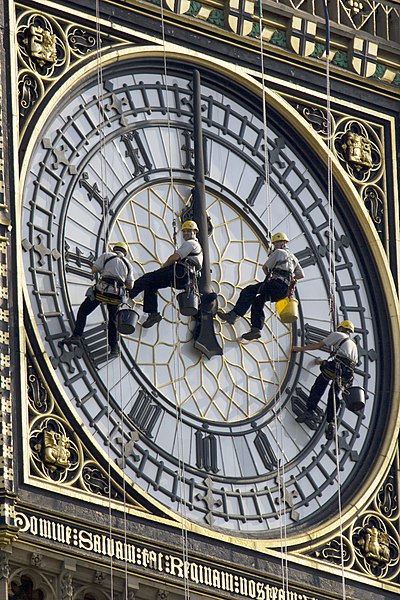
Big Ben celebrates 150 years this year. Big Ben is actually the nickname of the bell (the Great Bell) and not the clock (the Great Clock) itself nor the tower. The Clock Tower is sometimes referred to as St Stephen's Tower.

Most people think of Big Ben as the entire package.

The Great Clock told time from 31 May 1859 and the Big Ben, the Great Bell, first chimed on 11 July 1859.


cleaning of the clock faces of the Great Clock is always interesting


Big Ben - the Great Bell

28 October 2008

Gibraltar tunnel

Aside from scheduled and chartered flights, the only other way to travel between Spain and Morocco is by ferry. The ferry crossing from Algeciras to Tangier takes about 90 minutes.

In late 2003, Spain and Morocco agreed to build a 40 km tunnel between Spain and Morocco beneath the Straits of Gibraltar. Work on the tunnel may actually commence next year.

Linking the continents of Europe and Africa will be a major milestone.

Arriving in Tangier, whether by ferry or road/rail would still be a cultural awakening or shock for most people. I did not feel safe in Tangier when visiting during August 2000.

*******************
I still haven't finished de-cluttering and tidying.

30 July 2008

spun out

From TRAVEL + LEISURE magazine
You spin me round

Think the ferris wheel is just a ride for the kiddies? Think again. As Jane Parbury reports these gentle giants have grown-up and now no self-respecting metropolis would be seen without one.

No fair or show seems complete without a big wheel – and these days, no major redevelopment, or city seems entirely finished without one, either. From Berlin to Beijing and Orlando to Qingdao, giant observation wheels are running circles around cities.

The overnight success of the London Eye might have started the latest urban attraction revolution, but passenger-carrying wheels have been around since the 19th century, ever since engineer George W Ferris responded to a call from the organisers of the 1893 Chicago World Fair to devise an attraction to rival Paris’s Eiffel Tower.

Since then, the big wheel has enjoyed its ups and downs as a tourist attraction; right now, with the recent opening of the Singapore Flyer, its star is firmly in the ascendant.

There are new ferris wheels set to open in Melbourne, Beijing, Berlin and New York plus the Great Wheel Corporation, reportedly has plans for three more: a 185m whopper at Dubailand, Dubai; a 150m structure at Qingdao, China; and a comparatively modest 120m construction at Orange County, Orlando, in the US; while in Asia Japan is already a hotspot for big wheels, with several measuring over 100m.

Here are 10 of the world’s big wheels, including those that are due to open within the next year.

1. Name The London Eye
Where Southbank, London, UK
Opened 2000
Size 135m. 32 capsules; up to 800 passengers in total per revolution.
Ride 30 minutes
Views On a clear day, up to 40 kilometres along the Thames and across London's most famous landmarks, as far as Windsor Castle.
Claim to fame The biggest in the world when built. Achieved iconic status virtually overnight and now no postcard of London views is complete without it. Generally thought to have inspired the current big wheel - er, revolution.


2. Name Singapore Flyer
Where Marina Bay, Singapore
Opened 2008
Size 165m. 28 capsules; up to 28 passengers each
Ride 30 minutes
Views About 45 kilometres across the city, taking in sights such as Singapore River, Merlion Park and the CBD
Claim to fame Currently the world's largest, but set to be overtaken by its Beijing counterpart (see below).


3. Name Star of Nanchang
Where Nanchang, Jiangxi Province, China
Opened 2006
Size 160m. 61 capsules; up to 480 passengers in total.
Ride 30 minutes
Views Along its riverside location and across the city.
Claim to fame Briefly the world's largest, overtaking the London Eye before it was eclipsed, in turn, by the Singapore Flyer.


4. Name The Southern Star
Where Part of the Waterfront City development, Melbourne
Opening November 2008
Size Over 120m. 21 pods; up to 20 passengers each
Ride 30 minutes
Views All-round vistas over the city and Port Philip Bay
Claim to fame Melbourne has been the regular home-from-home of the travelling Giant Sky Wheel; the fixed Observation Wheel, which has a unique star construction, will top it – in physical terms at least – by some 70m.


5. Name Great Observation Wheel, Beijing
Where Chaoyang Park, Beijing, China
Opening late 2009
Size 208m. 48 capsules; up to 40 passengers each.
Ride 30 minutes
Views Some 60 kilometres, including the Great Wall of China to the north of the city
Claim to fame Will be the world's largest.

6. Name Great Berlin Wheel
Where Hertzallee, West Berlin, next to the Berlin Zoo
Opening Late 2009
Size 185m. 36 pods; up to 40 passengers each
Ride 35 minutes
Views Across greater Berlin
Claim to fame Will be the biggest in Europe and one of the tallest structures in the city.

7. Name Pepsi Globe
Where Meadowlands Xanadu sports and leisure complex, New Jersey, US
Opening Late 2009
Size About 85m. 26 pods; up to 20 passengers each
Ride 25 minutes
Views The New York city skyline
Claim to fame The largest big wheel in North America. It will be partially constructed from recyclable materials and powered by green energy. In common with the London Eye, it’s attracted a major sponsorship deal, in this case a soft drinks firm (London had British Airways).

8. Name The Texas Star
Where Dallas Fair Park, Dallas, Texas, US
Opened 1985
Size Just over 64m. 44 gondolas; about 260 passengers in total.
Ride About 15 minutes
Views On a clear day, across to the city skyline and to Fort Worth
Claim to fame The largest ferris wheel in north America since its opening, although likely to be eclipsed by the upcoming Pepsi Globe in New Jersey.


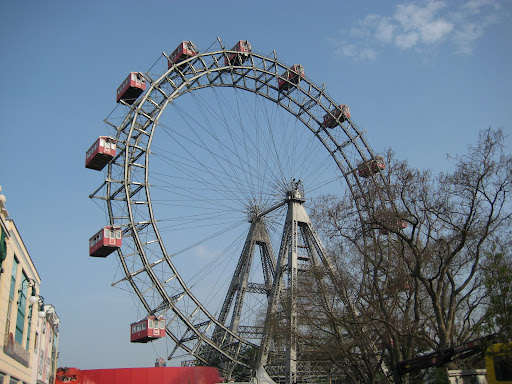
9. Name The Riesenrad (Giant Ferris Wheel), also known as the Prater
Where Prater Park, Vienna, Austria
Opened 1897
Size just over 64m. 15 cabins; up to 12 passengers each.
Ride around 5 minutes per revolution
Views The slightly seedy Prater funfair, the park around it and rather distant views of central Vienna.
Claim to fame One of the oldest giant ferris wheels in the world and probably the most famous. Substantially damaged in a fire in WW ll and subsequently rebuilt with fewer gondolas (15 instead of the original 30). Starring role in the 1949 film noir The Third Man, alongside Orson Welles and Joseph Cotton.

10. Name Tempozan Harbor Village Ferris Wheel
Where Osaka, Japan
Opened 1997
Size 112.5m. 60 cabins; up to eight people each.
Ride About 15 minutes
Views Unobstructed sightlines across Osaka Bay to the city, as far as Mount Rokko and Kansai International Airport.
Claim to fame One of several big wheels in Japan built around the same time, the Tempozan wheel’s particular appeal is in its night-time appearance, when a host of coloured lights illuminate the structure. This is prettiness with a purpose: the colour of the lights indicates the weather forecast for the following day. If they’re blue, for example, expect rain.

I'm more of a tower person myself.

*************
Emily came over tonight for dinner, which was a beef Madras curry.

20 June 2007

Le Viaduc de Millau - an engineering feat

One of the most amazing engineering marvels of the twenty-first century is the Viaduc de Millau located in southern France which spans over and across the Tarn Valley.


If it was over a harbour, it would be more famous.

********************
The sun was out today, but it was still cold.

03 April 2007

breaking news... a new world record

Associated Press has just reported that an experimental Train a Grande Vitesse (TGV), the V150 has just broken the world speed record for conventional trains reaching just more than 570 kph (354.1 mph).

The black-and-chrome train, the V150, had three double-decker cars.

The record was set on a 73km stretch of track between Paris and the eastern city of Strasbourg.

The previous record set 17 years ago for a traditional rail-based train of 515.3kph (320.2 mph) was set by an earlier version of the TGV.

The overall world train speed record is still 581kph (361 mph), reached in 2003 by a Japanese magnetic levitation, or Maglev, train.

The record took place just after 1100 GMT today (2100 local time, half an hour ago), about 200km from Paris.

France's TGV fast train is pictured on the new high-speed line built between Paris and Strasbourg on the eve of an attempt to break the world speed record.
Photo: AFP

**************************

Nothing much happened today. I really feel Keiser's absence. We were a great team Keiser and I.