The city of Reykjavik boasts foremost an outstanding literary history with its invaluable heritage of ancient medieval literature, the Sagas, the Edda and the Íslendingabók, Libellus Islandorum (Book of Icelanders). This longstanding tradition has naturally cultivated the city’s strength in literature education, preservation, dissemination and promotion.Reykjavik and the rest of Iceland have a very strong literary tradition dating back to the old Norse era. The first four cities of literature were English-speaking, so it is great to have a non-English-language city. It's just unfortunate that readers of the Icelandic-language probably number no more than 300,000 world-wide.
For a city of small population, approximately 200,000 habitants, Reykjavik is especially appreciated for demonstrating the central role literature plays within the modern urban landscape, the contemporary society and the daily life of the citizens. With the support of the central government of Iceland, the city continues to pursue its development plans in support of languages, translation initiatives as well as international literary exchanges.
The city’s collaborative approach through cooperation between various actors involved in literature, such as in publishing, in libraries, etc, in addition to the strong presence of writers, poets and children’s book authors is also noted to give the city a unique position in the world of literature.
With Reykjavik, the Creative Cities Network now has 29 members. As the fifth City of Literature, the city joins Edinburgh, Melbourne, Iowa City and Dublin in enriching the Network with its best literary practices.
Showing posts with label books. Show all posts
Showing posts with label books. Show all posts
10 August 2011
City of Literature 5
I previously wrote about Dublin becoming the fourth UNESCO City of Literature. UNESCO recently designated Reykjavik in Iceland as the fifth UNESCO City of Literature. From the UNESCO website


21 November 2010
Marching with the Devil

If a man tells you he has never dreamed of joining the French Foreign Legion he is a liar, has no imagination, or both.So begins David Mason's memoir of his five-year service in the French Foreign Legion.
I have known David for many years and had looked forward to the book finally being published. Many years ago, I read the first draft in loose-leaf form, unbound and held by a ribbon. It was an entertaining read and the original version was a light-hearted account, seen from a prism of good humour. David was quite surprised that I was able to recount that early draft from memory. It was actually quite good and had left an impression.
The version published by Hachett was not what I had expected. It was a completely new story, providing more insight, not only into David's experience in the Legion but also what he had thought about it all.
In the book, David's five years in the Legion are separated into 28 chapters, each described, under the chapter name, by a French phrase used within that chapter. Over the 28 chapters, we learn about the process of enlistment, training and eventual deployments to Djibouti between 1988 and 1993, all with David's critical analysis of his experience, probably with hindsight written many years later.
If you want to read an account of life in the French Foreign Legion with a view to enlisting, this is not the book to convince you. Rather, it is scathing of the processes used by the Legion during that period, from recruitment, training, day-to-day general duties to field operations. The benchmark for comparison used by David was his experience in the Australian Army Reserve. Having also served in the reserves, I can't help but feel that David may have been a little generous in that regard.
The most interesting aspect of the book wasn't about the French Foreign Legion itself but David's accounts of the human interactions and his attempt to understand why certain people behaved the way that they did in the situations that he describes. In the book, there were lots of bad behaviour from Legionnaire superiors to recruits, all trying to make what was possibly a bad situation for them, better at the expense of others.
No doubt, some Legionnaires who served with David may disagree with his retelling of his experiences, but knowing David, I suspect there is some truth in his tale.
During October 2010, Australia's SBS TWO channel also screened the four-part series of Bear Gryll's Escape to the Legion. It was a useful insight, albeit somewhat contrived. However, much of it supports David Mason's account of his time in the Legion.
Read it, or as David's Legionnaire colleagues would say "Je m'en fous".
29 September 2010
Banned Books Week
It's Banned Books Week this week in the United States (25 September to 2 October). From American Library Association.
No book in Australia had been banned since the 1970s, except for one about euthanasia, which was refused classification in 2007. Other books would be refused classification based on related laws on criminal activities, making them illegal.
It is timely then to remember what happened on 10 May 1933.
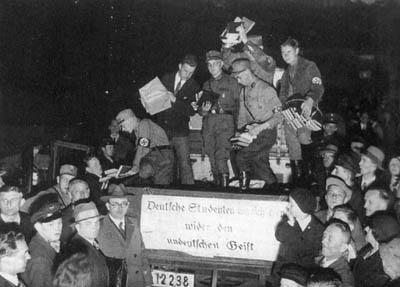
Nazi youth groups burned around 20,000 books from the Institut für Sexualwissenschaft and Humboldt University; including works by Thomas Mann, Erich Maria Remarque, Heinrich Heine, Karl Marx and H.G. Wells. Student groups throughout Germany also carried out their own book burnings on that day and in the following weeks.
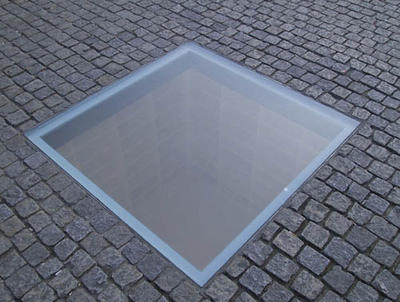
There is now a memorial/plaque at the site of the book burning (in Bebelplatz, Berlin).
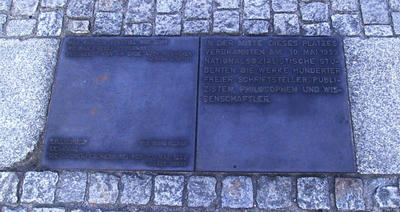
where books are burned, in the end people will burn - Heinrich Heine, 1820
I visited this site some years ago, which made me quite sad.
Banned Books Week (BBW) is an annual event celebrating the freedom to read and the importance of the First Amendment. Held during the last week of September, Banned Books Week highlights the benefits of free and open access to information while drawing attention to the harms of censorship by spotlighting actual or attempted bannings of books across the United States.The focus of the US Banned Books Week is probably more about local libraries making decisions to remove certain books that are not actually illegal.
Intellectual freedom—the freedom to access information and express ideas, even if the information and ideas might be considered unorthodox or unpopular—provides the foundation for Banned Books Week. BBW stresses the importance of ensuring the availability of unorthodox or unpopular viewpoints for all who wish to read and access them.
The books featured during Banned Books Week have been targets of attempted bannings. Fortunately, while some books were banned or restricted, in a majority of cases the books were not banned, all thanks to the efforts of librarians, teachers, booksellers, and members of the community to retain the books in the library collections. Imagine how many more books might be challenged—and possibly banned or restricted—if librarians, teachers, and booksellers across the country did not use Banned Books Week each year to teach the importance of our First Amendment rights and the power of literature, and to draw attention to the danger that exists when restraints are imposed on the availability of information in a free society.
No book in Australia had been banned since the 1970s, except for one about euthanasia, which was refused classification in 2007. Other books would be refused classification based on related laws on criminal activities, making them illegal.
It is timely then to remember what happened on 10 May 1933.
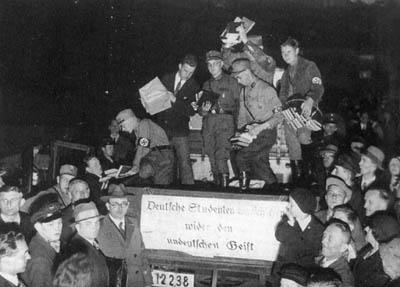
Nazi youth groups burned around 20,000 books from the Institut für Sexualwissenschaft and Humboldt University; including works by Thomas Mann, Erich Maria Remarque, Heinrich Heine, Karl Marx and H.G. Wells. Student groups throughout Germany also carried out their own book burnings on that day and in the following weeks.

There is now a memorial/plaque at the site of the book burning (in Bebelplatz, Berlin).

where books are burned, in the end people will burn - Heinrich Heine, 1820
I visited this site some years ago, which made me quite sad.
04 September 2010
book - finished reading

The Happiest Refugee by Anh Do (Allen & Unwin 2010)
From publisher's notes
Anh Do nearly didn't make it to Australia. His entire family came close to losing their lives on the sea as they escaped from war-torn Vietnam in an overcrowded boat. But nothing - not murderous pirates, nor the imminent threat of death by hunger, disease or dehydration as they drifted for days - could quench their desire to make a better life in the country they had dreamed about.
Life in Australia was hard, an endless succession of back-breaking work, crowded rooms, ruthless landlords and make-do everything. But there was a loving extended family, and always friends and play and something to laugh about for Anh, his brother Khoa and their sister Tram. Things got harder when their father left home when Anh was thirteen - they felt his loss very deeply and their mother struggled to support the family on her own. His mother's sacrifice was an inspiration to Anh and he worked hard during his teenage years to help her make ends meet, also managing to graduate high school and then university.
Another inspiration was the comedian Anh met when he was about to sign on for a 60-hour a week corporate job. Anh asked how many hours he worked. 'Four,' the answer came back, and that was it. He was going to be a comedian! The Happiest Refugee tells the incredible, uplifting and inspiring life story of one of our favourite personalities. Tragedy, humour, heartache and unswerving determination - a big life with big dreams. Anh's story will move and amuse all who read it.
About Anh Do
Anh Do is one of Australia's leading comedians. He has also acted in television series and films, written screenplays and is a sought-after keynote speaker.
Read the first chapter (download PDF) from Get Reading!
This was a very compelling read, by one of Australia's best known comedians.
Also listen to inteviews on radio 2UE and radio 702 ABC Sydney.
10 August 2010
There are 129,864,880 books in the world
As part of Google's attempt to digitize all the books in the world, they attempted to count how many there are. As at 8 August 2010, Google thinks there are nearly 130 million, or 129,864,880 to be more precise.
See Inside Google Books: Books of the world, stand up and be counted! All 129,864,880 of you.
Google should call this project Google Alexandria (after the Library of Alexandria).
Of the nearly 130 million books, I have probably read a few thousand. There is simply not enough time in a lifetime to read all the books in the world.
See Inside Google Books: Books of the world, stand up and be counted! All 129,864,880 of you.
Google should call this project Google Alexandria (after the Library of Alexandria).
Of the nearly 130 million books, I have probably read a few thousand. There is simply not enough time in a lifetime to read all the books in the world.
30 July 2010
City of Literature 4
I've previously written (twice) about Melbourne becoming the second UNESCO City of Literature. The first was Edinburgh and the third was Iowa City. UNESCO recently appointed Dublin as the fourth UNESCO City of Literature. From their website
While Dublin tourist guides attempt to coach visitors in the pronunciation of the eponymous Dublin greeting, ‘howaya?’ the equally common accompaniment to this – the enquiry, ‘what’s the story?’ reveals the remnants of an oral tradition which is alive and well, while also demonstrating Dubliners’ appetite for the world of books.Well deserved by a city with a rich literary heritage. Of course, the four are English-language-centric. Perhaps the home of Goethe may be also be deserving.
Ever eager for stories of themselves and others, Dubliners’ sensitivity to literary matters is acute, reinforced by an awareness of the works of the past as much as it is attuned to contemporary offerings – news of which is spread through the media, and through frequent readings, discussions and debates hosted by publishers, universities, libraries, literary organisations, book shops, pubs and cafes. The appreciation of writing and the richness of all its forms and genres is something that Dubliners display as a matter of course. Literary awareness is a form of currency in the capital, a bonding agent where pride is evident. Scepticism too fosters the famous ‘license with the Queen’s English’, for which the Irish are noted.
Writers in Dublin are not remote figures, out of step with the thrust of 21st century life but are part of the everyday landscape, much valued by Dubliners. The city has officially recognised writers by such diverse means as the conferring of the Freedom of the City, (George Bernard Shaw, Douglas Hyde and most recently, Thomas Kinsella) and through the Lord Mayor’s Awards, which in 2009 honoured the writer, Sebastian Barry. Further underlining the city’s literary credentials, the Man Booker International Prize was presented in Dublin for the first time in June 2009.
No less than four Nobel Prizes for Literature have been awarded to writers associated with the city: George Bernard Shaw, W.B. Yeats, Samuel Beckett and Seamus Heaney. Other illustrious Dublin writers of international repute include Jonathan Swift, Cardinal Newman, Oscar Wilde, Sean O’Casey, Denis Johnston, Flann O’Brien, Brendan Behan and Jennifer Johnston,
In more recent times, Dublin-based writers continue to receive international acclaim in fiction, drama and poetry. The Man Booker Prize has been conferred on Iris Murdoch, Roddy Doyle, John Banville and Anne Enright, and in 2009 Sebastian Barry received the Costa Book of the Year Award and the James Tait Black Memorial Prize for Fiction. In 2009, Colum McCann won the U.S. National Book Award for his novel 'Let The Great World Spin'. The novelist Anne Enright, has claimed that ‘In other towns, clever people go out and make money. In Dublin, clever people go home and write their books.’
20 July 2010
Christos' papou and yiayia
Christos Tsiolkas is an Australian author, whose book Dead Europe I am yet to finish so that I can begin reading The Slap. He wrote an interesting piece about his family in The Guardian on 10 July 2010, which was reprinted in the Sydney Morning Herald (Spectrum) on 17 July 2010. Excerpt
Christos is a great writer of fiction but the personal stories are always the most interesting.
Read more. Australia was built on immigration and many Australians born in Australia, while retaining language and culture, upon visiting the homelands of their forefathers, find that some of this have been preserved in time.I never met either of my grandfathers. My maternal papou had died when I was a toddler. It still remains a wounding regret of my mother's that she never had a chance to go back home to see him on his deathbed. But with a small child and my newly born baby brother, there was neither means nor opportunity for her to return. We have become so jaded with the ubiquity of air travel that we are apt to forget just how difficult, how expensive, how magical it once seemed. Dad did return to Greece to bury his father. He has returned once more, to bury his mother. After that visit, he said to me: "That's it, no more. It has finished. Greece doesn't exist for me any more."
I am grateful that I did have an opportunity to meet my grandmothers; once when I visited as a boy in 1975, and then again as a young adult in 1990. But even those encounters were made difficult by the limitations of my Greek and the overwhelming chasm of experience that separated myself, a privileged child of the developed world, and those two women, each born on the eve of the 20th century, in a peasant eastern Mediterranean world that was to be torn apart by two Balkan wars, two world wars, an occupation, two dictatorships, and a civil war. I remember sitting in a kitchen in Athens with my maternal grandmother, who was crying, wanting to know why her daughter had only visited her once in all the time she had been a migrant in Australia. I tried to explain the distances involved, the expense. Uncle Mitso, who was sitting with us, took me aside and explained that once in the early 70s he was driving his mother from the village to Athens when they came to a fork in the road. My giagia asked, "Mitso, if we turn left instead of right, can we go and visit Georgia in Australia?"
"You have to remember, Christo," my uncle said to me, "this is a woman born in a time when women were doomed to illiteracy and the shadows. Your giagia can't even read a map. And look at you, you are now a university student, you want to be a writer. You don't know how proud that makes us. But if you ever forget where you come from, fa se sfaxo [I will slaughter you]."
Though Dad was from a family of a dozen children and my mother from a family of eight, only one other of my father's siblings migrated to Australia. But my parents' friends all became part of my extended family – every adult was addressed as theo and thea, uncle and aunt. Even now as an adult travelling in Greece I will still use this form of address when speaking to an elder, and my Greek friends and cousins will laugh at me. "That is something only rural people do," they say. "Only the real hicks. Do you still use those terms in Australia? You guys are still stuck in the 50s."Italian Australians whose grandparents (nonna and nonno) had migrated, when visiting their grandparents' original village, have been told they speak old-fashioned Italian of the earlier generation.
Christos is a great writer of fiction but the personal stories are always the most interesting.
18 April 2010
Proofreading is more than just a spellcheck
Reported in The Age, publisher Penguin Books Australia has had to pulp 7000 copies of the cook book Pasta Bible at a cost of $20,000.
The publishing company was forced to pulp and reprint 7000 copies of Pasta Bible last week after a recipe called for "salt and freshly ground black people" — instead of pepper — to be added to the spelt tagliatelle with sardines and prosciutto.A lesson on proofreading. Surely it would have been cheaper to print an adhesive label to put over the error and less wasteful.
07 April 2010

22 February 2010
Vampire-lit
Margot Adler from NPR reported in All Things Considered that she had read 75 vampire novels in the last nine months
I certainly wouldn't be putting the Twilight series at the top of the list.
In any case, vampires don't need to be kissed. They should be staked. Right through the heart.
The vampire genre is hardly original and many of the more recent novels were written for teenagers, many of whom would probably find Anne Rice's series difficult to read with all the philosophical musings.... what I started noticing as I read all these novels and looked at all the recent television shows featuring vampires is that their near-immortality isn't the most interesting thing about them. Almost all of these current vampires are struggling to be moral. It's conventional to talk about vampires as sexual, with their hypnotic powers and their intimate penetrations and their blood-drinking and so forth. But most of these modern vampires are not talking as much about sex as they are about power.
Take the CBS show Moonlight, which aired for only one season in 2007-2008. Mick St. John is a private investigator who is also a vampire. In one scene, he's trying to reason with a violent rogue vampire by telling him, "We have rules."
The rogue responds, "There are no rules: I'm top of the food chain."
"This is the central question of so many vampire novels and films, " says Amy Smith, a professor of English at the University of the Pacific. "If you had power over people, how would you use it? 'We can do what we want' vs. 'We were human, how can you treat humans as if they were cattle?' "
People keep going back to these stories because they illustrate a tension that exists in real life, Smith says.
"For example, if you earn more money than someone else, you find that you have more power: How will you use it?"
Smith teaches courses on Jane Austen and the literature of war, as well as a course on vampires in literature. She says the issue of power is both personal and global.
"How do you treat someone you love, for example?" she says. "The core question is always: Does might make right?"
I certainly wouldn't be putting the Twilight series at the top of the list.
In any case, vampires don't need to be kissed. They should be staked. Right through the heart.
15 October 2009
Frankfurter Buchmesse ist nicht verboten

foto: DPA
The Frankfurter Buchmesse (Frankfurt Book Fair) is the largest book trade fair in the world. Over 7000 exhibitors from more than 100 countries take part. International sale rights and licences are negotiated.
This year's fair is from 14 to 18 October 2009 with China as this year's Guest of Honour.
Ironic, as the People's Republic of China bans some 600 books a year. Just like its 'great firewall', written work about the Tianenmen Square events of 1989 are unlikely to be published in China.
See Der Spiegel (Deutsch, Englisch) und Die Presse (Deutsch)
10 September 2009
book - finished reading

The Danihers: The story of football's favourite family as told to Adam McNicol (Allen & Unwin 2009)
From publisher's notes
I don't usually read biographies about sports people (the last one was James Hird's autobiography), but this one was an excellent read. Aside from the four brothers being absolute legends of the game, Adam McNicol's descriptions of Essendon Football Club a generation ago are amazing. Once upon a time after games, players would light up cigarettes in the change rooms or have a beer with the other team. They were different times then.On 1 September 1990, four brothers made Australian Rules history by playing together for the one team, the Essendon Football Club, something that is unlikely to ever happen again.
About Terry Daniher Neale Daniher Anthony Daniher Chris Daniher
Terry, Neale, Anthony and Chris Daniher grew up in a tiny Riverina town where they played footy on Saturdays and Rugby League after mass on Sundays. They reached the elite level in an era when tobacco sponsorship and a few beers with the opposition after a game were the norm. It was a time when Jim Daniher could throw a teenage son into a trade deal and Kevin Sheedy and Edna Daniher could conspire to make a dream come true. But it wasn't all plain sailing: injuries cut short a promising career, trading between clubs was largely unregulated, the Swans were shunted off to Sydney and coaching changed dramatically.
This is an action-packed story of the period when the national Aussie Rules competition emerged and football became big business, and an unassuming bunch of blokes from the bush endeared themselves to footy fans and became part of football folklore.
After a combined 752 VFL/AFL games, the Danihers continue to be involved in football. Since his playing and coaching days finished, Terry has excelled as a country football ambassador for the AFL. At the start of 2009, Neale took up the position of football operations manager for the West Coast Eagles, having coached the Melbourne Football Club for ten years. Anthony's professional life is the management of Daniher Property Services, and he keeps a keen eye on his son, Darcy, who was drafted to the Bombers in 2007 under the father-son rule. Following in his father's footsteps, Chris is farming and keeping Ungarie Football Club alive.
23 June 2009
book - finished reading

Breakout : how I escaped from the Exclusive Brethren by David Tchappat (New Holland 2009)
From publisher's notes
Imagine a life without television, music or freedom; imagine every minute of your spare time being spent attending church; imagine growing up believing swimming pools, cinemas and dancing were evil.A very interesting read from a personal perspective of a very secretive organisation. Exclusive Bethren received a lot of media attention during previous Australian federal election campaigns allegedly due to their political influence with the previous Australian prime minister and political donations, particularly given members of the organisation are forbidden to vote.
For members of the Exclusive Brethren, a strict religious sect, constraints such as these are normal. No member is allowed to eat in the same room as a ‘worldly’ person, they are forbidden from owning a pet and they are restricted from socialising with anyone outside of the Exclusive Brethren. Most members are so isolated within the sect that they can’t even imagine a life on the outside.
But not all members can live such a controlled existence. Once David Tchappat had a taste of the real world as a teenager, there was no going back despite the fact he knew he would be cruelly ostracised from his family, friends and the only life he had known.
Tchappat's autobiography is very honest and revealing.
More information on Exclusive Bethren.
They shun the conduits of evil communications: television, the radio, and the Internet.No equivalent of the Amish's Rumspringa.
02 April 2009
zombifying Jane Austen
Pride and Prejudice by Jane Austen is a classic. Not all readers would appreciate the witty 'dialogue', finding it rather boring. There is a solution. Rewrite the story and add in zombies. Seriously.

Personally, I think it might have worked better with vampires.

Personally, I think it might have worked better with vampires.
27 November 2008
moralising human nature
An interesting book review published in The Nation

cover of the book Passionate Uprisings (Amazon.com)
I love irony. Repress people's human nature and they will try to express it in an extreme manner.
*****************
Emily didn't come around for dinner last night, so I had baked beans on toast.
A few years ago, in the course of researching her dissertation on changing sexual mores in the Islamic Republic of Iran, a young Iranian-American anthropologist named Pardis Mahdavi stopped by the Ministry of Education in Tehran to inquire about the country's sex education curriculum. Another visitor happened to be there. An older woman named Mrs. Erami, she was covered head to toe in the most conservative form of Iranian hijab: the tentlike black chador, held in place by the wearer's teeth such that it obscures half the face. Under her chador, Mrs. Erami wore another voluminous layer of hijab, including a hoodlike head scarf and a long, loose coat. Hers was the uniform of the government faithful, the traditional-minded and the sexually puritanical--the very image of the older generation that Mahdavi's main research subjects, Tehrani youth, rebuffed with their outsized vanity and sexual libertinism.
But Mrs. Erami had come to the ministry on a mission related to Mahdavi's. She taught courses on health, puberty and relationships at a Tehran high school, and she had come to talk to the minister about her frustration with her students' unwillingness to discuss sexual matters frankly with her. In a country where premarital sex with multiple partners is increasingly common but remains culturally taboo and punishable under the law, this severe-looking, chador-clad woman was, at a glance, hardly the person in whom one might feel comfortable confiding one's illicit activities or seeking intimate advice. Mahdavi didn't even feel comfortable letting the older woman see her nail polish, which is illegal but commonplace in Iran. Nonetheless, Mrs. Erami could not understand her students' reticence. "They are so difficult," she told Mahdavi. "I can't get them to talk to me, but I know what they are doing and what they are not doing. I had a teenage daughter myself, and I know that they are having a lot of sex, but not doing it right. I just can't get them to talk to me about it."
Mrs. Erami, it turns out, is one of the more dramatic products of the generational upheaval in Iranian attitudes toward sex. A conservative Muslim, she was not sympathetic, some years before her encounter with Mahdavi, when her gay son came out of the closet. Her husband threw him out of the house. When their unmarried daughter announced that she had a boyfriend, Mrs. Erami slapped her and called her a prostitute. The daughter left home that day, never to return. And so the Eramis lost both of their children over their unwillingness to accept sexual behavior that had become the norm not only globally but even within many circles inside Iran. A year later Mrs. Erami's husband died, leaving his wife entirely alone and flooded with regret. That was when she devoted herself to sex education reform, both as a teacher and as a campaigner within Iran's education ministry.
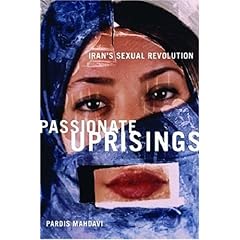
cover of the book Passionate Uprisings (Amazon.com)
I love irony. Repress people's human nature and they will try to express it in an extreme manner.
*****************
Emily didn't come around for dinner last night, so I had baked beans on toast.
24 November 2008
books - finished reading

The Islamist by Ed Husain (Penguin 2007)
A very insightful book that is also very well-written. It should be read by everyone, especially those who pigeon-hole all Muslims as potential terrorists. This is not the case. There are extremists in every religion - radical Christian fundamentalists do as much damage to society with their hate.
16 October 2008
De Civilitate Morum Puerilium Libellus
Desiderius Erasmus Roterodamus, a Dutch Renaissance humanist, wrote De Civilitate Morum Puerilium Libellus in 1536.
It was a best seller and translated into English by Robert Whittington in 1560 as De ciuilitate morum puerilium per des. Erasmum Roterodamum, libellus nunc primum conditus & editus. Roberto VVhitintoi interprete. A lytle booke of good maners for chyldren, now lately compiled and put forth by Erasmus Roterodam in latin tongue, with interpretation of the same into the vulgare englyshe tongue, by Robert VVhittinton poet laureat.
A new translation by Eleanor Merchant has just been published (amazon.co.uk). From the publisher description
I wonder if Mr Thackery used the book (in To Sir With Love).
***************
I mowed the back lawn after work.
It was a best seller and translated into English by Robert Whittington in 1560 as De ciuilitate morum puerilium per des. Erasmum Roterodamum, libellus nunc primum conditus & editus. Roberto VVhitintoi interprete. A lytle booke of good maners for chyldren, now lately compiled and put forth by Erasmus Roterodam in latin tongue, with interpretation of the same into the vulgare englyshe tongue, by Robert VVhittinton poet laureat.
A new translation by Eleanor Merchant has just been published (amazon.co.uk). From the publisher description
When did you last tell your children to put their hand over their mouth when they yawn? When did you last suggest that when they are introduced to someone they should look them in the eye? Do you remind them that they should wait until everyone is served before they start eating? And not hoover up the best bit? Do you think that the children of today have disgraceful manners? Unlike, of course, when you were young? Well, that's what Erasmus of Rotterdam thought in 1530 when he published 'de Civilitate Morum Puerilium Libellus: A Handbook on Good Manners for Children'. After all, as William of Wykeham memorably said in the 1350s, Manners Makyth Man'. A Handbook on Good Manners for Children is considered to be the first treatise in Western Europe on the moral and practical education of children. It was a massive bestseller - indeed the biggest selling book of the sixteenth century - going into 130 editions over 300 years and being translated into 22 languages. In it, Erasmus concerns himself with matters such as how to dress, how to behave at table, how to converse with one's elders and contemporaries, how to address the opposite sex and much else. For example:'It's just as rude to lick greasy fingers as it is to wipe them on your clothing; use a cloth or napkin instead'. 'Some people, no sooner than they've sat down, immediately stick their hands into the dishes of food. This is the manner of wolves'. 'Making a raucous noise or shrieking intentionally when you sneeze, or showing off by carrying on sneezing on purpose, is very ill-mannered'. 'To fidget around in your seat, and to settle first on one buttock and then the next, gives the impression that you are repeatedly farting, or trying to fart'. The advice is as relevant today as it was 500 years ago.Indeed.
I wonder if Mr Thackery used the book (in To Sir With Love).
***************
I mowed the back lawn after work.
02 March 2008
Chinese food in America
I liked this book review in Newsweek

Jennifer 8 Lee also wrote an interesting article in the New York Times about the invention of the fortune cookie.
Chinese restaurants in Australia have a similar history. There is a Chinese restaurant in nearly every small town in Australia. Annette Shun Wah wrote a brilliant history of Chinese food in Australia called Banquet: Ten Courses to Harmony, whose launch I attended a number of years ago.

Thankfully, we have an abundant supply of authentic Chinese restaurants in Australia. The tip is to go to a place where there are lots of Chinese people and where they also have a separate menu written in Chinese.
***********
This morning, Kim, Jacki and Jordon dropped over - Jordan stayed while Kim and Jacki left to go to the Hall Markets. I helped Jordon with his trigonometry homework; more explaining what his assignment questions meant which he was able to complete.
This afternoon, two young (Down's Syndrome) girls knocked on the door saying they were lost and asked for help. After a few questions, they knew exactly which way to return, but probably needed adult supervision. I took them home after they recognised their brown gate, but nobody was home. Finally, their parents returned and I explained where they were found. I gathered the parents would be worried.
However, I didn't understand the mother's appreciation, telling me that I had done my "good deed for the day" and that they were lucky I was "a nice guy", which I found rather condescending. I can understand her concern about the risk of child abduction etc etc, but a "good deed for the day"?
Surely there is no daily quota for "good deeds". Do people stop helping others after they have fulfilled their quota of one good deed for the day?
Lo Mein Street, U.S.A.
Americans love Chinese food. The problem is, most of what we're eating doesn't really come from China.
By Jennie Yabroff | NEWSWEEK
Mar 10, 2008 Issue
In the United States, there are more Chinese restaurants than McDonald's, Burger Kings and KFCs combined. Chances are, you've got your own favorite wonton spot. The Presidents Bush—41 and 43—do: the Peking Gourmet Inn in Falls Church, Va., which has installed bulletproof glass in front of table N17, just for them. In Iraq, homesick American troops frequented the two Chinese restaurants in Baghdad's Green Zone until they were shut down. Even at the American scientific outpost in Antarctica, every Monday is Chinese-food night (though good luck getting it delivered). Beyond peanut-butter-and-jelly sandwiches or a burger and fries, there may be no food that's more American than Chinese. The boardinghouse where John Wilkes Booth planned the assassination of President Lincoln? It's now an eatery called Wok 'n' Roll. But as Jennifer 8. Lee writes in her book "The Fortune Cookie Chronicles: Adventures in the World of Chinese Food," the irony is that much of what we think of as Chinese food isn't Chinese at all. Chop suey is an American creation. Fortune cookies were invented in Japan. And get this: Kari-Out, the largest Chinese restaurant supplier in the United States, uses no soybeans in its soy sauce.
So what, exactly, are we dousing with all that non-soy soy sauce? And if it's no more authentic than a pair of fake ivory chopsticks, why do we even bother to eat it? Lee, a reporter for The New York Times, says the cuisine's appeal lies in its dual nature: Chinese food is at once regional and universal, foreign and familiar. It has been a way for Americans to safely dabble in exoticism while holding on to their own cultural traditions. "In the 1950s," she says, "if you ate Chinese food, China itself seemed a lot less threatening." Although Chinese restaurants abound in other areas—Korea, Peru, India, Japan, Mexico and Jamaica—with large numbers of Chinese immigrants, Americans have them all beat. According to Lee, Thanksgiving is the only slow day in the Chinese-restaurant business, which is why so many waiters and cooks use that day to get married. It makes sense that we are obsessed with this "ethnic" food that has no true ethnicity: from its roots in a flood of immigration that evolved into a mix of cultural contradictions, the story of Chinese food in America is in many ways the story of America itself.
The stream of Chinese immigrants to America has been constant since the Gold Rush in the 1840s and '50s, slowed only briefly by the Chinese Exclusion Act of 1882. Prejudice drove the unwelcome immigrants from jobs in the mines and on the railroads, but, as Lee writes, "cooking and cleaning were both women's work. They were not threatening to white laborers." Which is why in 1885 New York City had six Chinese restaurants, but 20 years later there were more than 100. Today, Lee writes, if the immigrants are here illegally and cannot speak English, there's a good chance they'll wind up in New York's Chinatown, where employment agencies post listings from Chinese restaurants around the country. "To these Chinese restaurant workers, who can barely read English, the United States is not a series of towns," Lee writes. "It is a collection of area codes, almost all of which have dozens upon dozens of Chinese restaurants looking for help." Many of these illegal immigrants will have paid a smuggler as much as $70,000 to get them to this country. Such was the case of the 286 illegal immigrants aboard the Golden Venture, a ship that crashed into New York's shore in 1993. Fifteen years later, 90 percent of the immigrants still in the United States were in the Chinese-food business.
They must be shocked by the food they're serving. When you eat out with Lee, you see how dishes have been adapted for American palates. Perusing the menu of a Shanghai-style Chinese restaurant in Manhattan, she asks the waiter about traditional whole-fish dishes. But when the plate arrives smeared with unnaturally bright red sauce studded with chunks of pineapple, she says, "Oh, I guess it's just sweet and sour." Authentic Chinese food often involves bones, shells and eyeballs, "more vegetables, less meat, less oil," she writes—and, one presumes, no fluorescent sauces. But Lee hesitates to label restaurants authentic or inauthentic. "Authenticity is a function of time and place," she says. "I prefer traditional Chinese food. But that wasn't always the case. My taste evolved after I went to China."
But it shouldn't matter if pineapples aren't found in China. Chinese food, whether Cantonese, Hunan, Sichuan or from Beijing, is remarkably adaptive, which explains how it's survived in the trenddriven U.S. restaurant world. In Louisiana, Lee sampled Sichuan alligator and soy vinegar crawfish. In Rhode Island she tried chow mein sandwiches: fried noodles on Wonder Bread. [Editor's note: yuck.] Chop suey has been replaced by beef with broccoli and General Tso's chicken, though in China more people are probably familiar with the colonel's chicken recipe than the general's. So the prevalence of restaurants will likely grow. In the three years Lee spent researching her book, the number of Chinese restaurants in the United States rose from 40,000 to 43,000. Whether the coming years see a surge in popularity of traditional Chinese-style fare or further interpretations of the cuisine (cheesesteak eggrolls, anyone?), Chinese food will continue to represent food for thought about our identity as Americans.
© 2008 Newsweek, Inc.

Jennifer 8 Lee also wrote an interesting article in the New York Times about the invention of the fortune cookie.
Chinese restaurants in Australia have a similar history. There is a Chinese restaurant in nearly every small town in Australia. Annette Shun Wah wrote a brilliant history of Chinese food in Australia called Banquet: Ten Courses to Harmony, whose launch I attended a number of years ago.
Thankfully, we have an abundant supply of authentic Chinese restaurants in Australia. The tip is to go to a place where there are lots of Chinese people and where they also have a separate menu written in Chinese.
***********
This morning, Kim, Jacki and Jordon dropped over - Jordan stayed while Kim and Jacki left to go to the Hall Markets. I helped Jordon with his trigonometry homework; more explaining what his assignment questions meant which he was able to complete.
This afternoon, two young (Down's Syndrome) girls knocked on the door saying they were lost and asked for help. After a few questions, they knew exactly which way to return, but probably needed adult supervision. I took them home after they recognised their brown gate, but nobody was home. Finally, their parents returned and I explained where they were found. I gathered the parents would be worried.
However, I didn't understand the mother's appreciation, telling me that I had done my "good deed for the day" and that they were lucky I was "a nice guy", which I found rather condescending. I can understand her concern about the risk of child abduction etc etc, but a "good deed for the day"?
Surely there is no daily quota for "good deeds". Do people stop helping others after they have fulfilled their quota of one good deed for the day?
01 March 2008
books - finished reading
The Historian by Elizabeth Kostova
I was impressed by the multi-layered narratives in this re-telling of Dracula. Another in my vampire lore collection.
26 January 2008


Subscribe to:
Comments (Atom)