Heston Blumenthal (from The Fat Duck) shows us how to cook perfect roast potatoes, from the BBC cookery show 'In Search of Perfection'.
I would have left the skin on.
Showing posts with label recipe. Show all posts
Showing posts with label recipe. Show all posts
20 August 2010


03 August 2010
Australia's most famous dessert
On 25 July 2010, around 3.9 million Australians watched two contestants prepare a dessert in their bid to be MasterChef 2010.
Consequently, the dessert called Snow Egg, created by Peter Gilmore of Quay restaurant in Sydney is now the most famous in Australia. Reported in Sydney Morning Herald
Components
* poached meringue
* maltose tuilles
* guava puree
* guava granita
* custard apple ice cream
* vanilla custard base
* vanilla cream
* guava fool
Poached Meringue
* 300g egg white
* 300g sugar
Maltose Tuilles
* 200g liquid maltose
* 100g sugar
* 20g flaked almonds
Guava Puree
* 175g sugar
* 250ml water
* ½ vanilla bean
* 375g strawberry guava flesh
Guava Granita
* 500ml water
* 100g sugar
* 400g strawberry guavas, peeled
* 100g fresh strawberries
Custard Apple Ice Cream
* 6 egg yolks
* 200g sugar
* 200ml milk
* 300ml clear custard apple juice
* 100ml single cream
Vanilla Custard Base
* 400ml single cream
* 2 vanilla beans
* 1 whole egg
* 3 egg yolks
* 80g sugar
Vanilla cream
* 100g vanilla custard base
* 100g double cream
Guava Fool
* 400g guava puree
* 200g vanilla cream
The full recipe can be found at Lifestyle Food Channel or MasterChef.
Consequently, the dessert called Snow Egg, created by Peter Gilmore of Quay restaurant in Sydney is now the most famous in Australia. Reported in Sydney Morning Herald
It looks stunning.After its starring role in the MasterChef final, Sydney restaurant Quay's snow egg is arguably the most famous dessert in the country.
“We've had to put extra people on [the section] to help make it,” Quay general manager John Fink says of the stratospheric demand over the past week for the dessert (pictured).
“We've had people phone up asking if we do it as takeaway,” he says.
Components
* poached meringue
* maltose tuilles
* guava puree
* guava granita
* custard apple ice cream
* vanilla custard base
* vanilla cream
* guava fool
Poached Meringue
* 300g egg white
* 300g sugar
Maltose Tuilles
* 200g liquid maltose
* 100g sugar
* 20g flaked almonds
Guava Puree
* 175g sugar
* 250ml water
* ½ vanilla bean
* 375g strawberry guava flesh
Guava Granita
* 500ml water
* 100g sugar
* 400g strawberry guavas, peeled
* 100g fresh strawberries
Custard Apple Ice Cream
* 6 egg yolks
* 200g sugar
* 200ml milk
* 300ml clear custard apple juice
* 100ml single cream
Vanilla Custard Base
* 400ml single cream
* 2 vanilla beans
* 1 whole egg
* 3 egg yolks
* 80g sugar
Vanilla cream
* 100g vanilla custard base
* 100g double cream
Guava Fool
* 400g guava puree
* 200g vanilla cream
The full recipe can be found at Lifestyle Food Channel or MasterChef.
08 July 2010
07 March 2010
Lemon curd
When Martin was a back neighbour in Lil's house, he'd give me buckets of lemons off the tree and I would make Moroccan style preserved lemons with them, using rock salt, bay leaves, cinnamon sticks, cloves and peppercorns. I never thought to make something sweet with the lemons.
Nigel Slater writes for the Guardian/Observer and his lemon curd recipe looks delicious
I love lemon curd. Rather than maple syrup on pancakes, I would spread lemon curd on it. I also like it with lemon juice sprinkled lightly with sugar.
Nigel Slater writes for the Guardian/Observer and his lemon curd recipe looks delicious
LEMON CURDWith all that sugar in it, it should last a couple of months. Nigel Slater also has a recipe for lemon curd and orange parfait.Most lemon curd recipes instruct you to stir the mixture with a wooden spoon. I find that stirring lightly with a whisk introduces just a little more lightness into the curd, making it slightly less solid and more wobbly.
Makes 2 small jam jars
zest and juice of 4 unwaxed lemons
200g sugar
100g butter
3 eggs and 1 egg yolk
Lemon Curd. Photograph: Jonathan LovekinPut the lemon zest and juice, the sugar and the butter, cut into cubes, into a heatproof bowl set over a pan of simmering water, making sure that the bottom of the basin doesn't touch the water. Stir with a whisk from time to time until the butter has melted.
Mix the eggs and egg yolk lightly with a fork, then stir into the lemon mixture. Let the curd cook, stirring regularly, for about 10 minutes, until it is thick and custard-like. It should feel heavy on the whisk.
Remove from the heat and stir occasionally as it cools. Pour into spotlessly clean jars and seal. It will keep for a couple of weeks in the refrigerator.
I love lemon curd. Rather than maple syrup on pancakes, I would spread lemon curd on it. I also like it with lemon juice sprinkled lightly with sugar.
05 March 2010
Grow your own drugs

Ethnobotanist James Wong, presenter of BBC's Grow Your Own Drugs was featured on NPR's All Things Considered speaking to Melissa Block about his book of the same name
From NPR article
James Wong thinks you should grow your own drugs.Read more for recipes (Amazon listing)
No, we're not talking about the illicit kind. We're talking about a living pharmacy of plants from your own backyard: fennel and rose hips; echinacea and dandelion; horse chestnuts and nettles.
Wong is an ethnobotanist. He trained at the Royal Botanic Gardens in London, and he's written a medicinal recipe book called Grow Your Own Drugs, an offshoot of his BBC television series.
Plant Prejudice
In his book, Wong looks at plants as bright chemical factories.
"I think so many people have this stereotyped idea of what herbal medicine is," Wong tells NPR's Melissa Block.
He adds, "I think they've very much got a big black line in their minds that separates serious, conventional, tested, scientific medicine on one side and slightly airy, fairy, away-with-the-hippies — you know — natural-but-probably-doesn't-work, plant-based medicine on the other."
But that "black line," Wong says, is a cultural idea — not a scientific one.
"To me as a scientist, whether a chemical is found within a pill or the cells of plant is really irrelevant — that's just packaging," he said.
Hijacking Plant Weapons
The recipes in Wong's book offer remedies for a wide range of ailments — from sore throats to hot flashes to head lice.
"As with all herbal remedies, they don't necessarily come with guarantees. And if you've tried conventional stuff and it hasn't [worked], I don't think there's any harm in giving it a go," Wong says.
Wong says humans have been battling with insects for only a few thousand years. Plants, however, have been at war with insects for millions of years.
"Over that huge period, there's been time for them to evolve all sorts of unusual strategies, many of which are natural chemical weapons — insecticides — that exist in the environment that can be used in all manner of ways," he says.
In his recipes, Wong says he hijacks what plants have evolved for themselves, and he uses that to treat humans and animals.
Be A Responsible Experimenter
Wong offers a few caveats: Know what plants you're using. Also, don't self-diagnose.
"There are all sorts of interesting solutions that are found in the plant world, but you need to be responsible. You need to make sure that you have a proper diagnosis," he says.
Wong is not against conventional medicine. In fact, he says he has no qualms popping aspirin. But he says people can consider herbal medicine as part of the solution.
"It's very much not about abandoning conventional medicine," Wong says. "It's almost like a useful complement to it."
I enjoyed watching the show a few months ago. I am so over these television celebrity chefs. The antidote is a television celebrity scientist who cooks!
From the 2009 Christmas special - making anti-anxiety saffron egg nog
(BBC - producer Lucy Hooper, executive producer Dan Adamson)
Recipe for the anti-anxiety saffron egg nog from BBC
500ml whole milk
2 bay leaves
36 threads / 3 pinches saffron
2 strips orange rind
3 tbsp golden syrup
200ml single cream
3 eggs
150ml white rum
Grated fresh nutmeg, to serve
1. Pour the milk, bay leaves, saffron, orange rind, golden syrup and cream into a pan, and simmer gently for 10 minutes. Strain through a sieve.
2. Break the eggs into a glass heat-proof bowl, then slowly whisk in the hot milk mixture.
3. Place the bowl above a pan of boiling water and heat gently, stirring, until the mixture thickens to a custardy consistency. Then take it straight off the heat.
4. Whisk in the rum, then pour the mixture into a jug. Cool, then leave to stand in the refrigerator for at least 8 hours before serving.
5. Serve over ice with grated nutmeg.
USE: Drink no more than 1 wineglass a day.
CAUTION: Contains alcohol.
STORAGE: Keep in the refrigerator. Will last for 2 weeks.
Aside from the cooking, he's really cool to watch when he gets really excited in the gardenYou can read his blog with the Royal Horticultural Society My Garden online community. James Wong is also a partner in Amphibian Designs.
17 December 2008
Black Forest cake
When I lived on campus at university, it was a time when most of us turned 21. Somehow, I ended up making birthday cakes for several friends. It was Black Forest cake, or a variation of it, using packet mix chocolate cake. I became quite renown for my triple layer twenty-first birthday Black Forest cakes.
I've now found a great recipe that was shown on tonight's Food Safari on SBS. Recipe by Martin Boetz

For my own 21st birthday, a friend made a carrot cake for me - still one of my favourites.
****************
I returned to the dentist this morning for the fitting of my ocular splint. Dental care has now become an important part of my daily routine.
I've now found a great recipe that was shown on tonight's Food Safari on SBS. Recipe by Martin Boetz
Legendary around the world, the Black Forest cake epitomizes Germany’s love for a huge selection of indulgent cakes! Layers of buttercake, chocolate cake, morello cherries, cream, chocolate custard and kirsch make this a decadent dream-come-true for all cake lovers.

Ingredients
Butter Cake
300g butter
300g caster sugar
300g flour
6 eggs
1 ½ tsp baking powderChocolate Cake
250g chocolate
250g sugar
1 ½ cups flour
6 eggs
180g butterChocolate Mousse
4 egg yolks (80g)
200g unrefined caster sugar
100ml whole milk
150g top quality dark chocolate
Generous pinch of table salt
200ml whipping creamChocolate Ganache
95ml whipping cream
1 tsp glucose syrup
Pinch of table salt
95g top quality dark chocolate
20g unsalted butterCherries
1 jar of whole sour cherries (Morello)
1 vanilla bean
1 tbsp sugarTo Build Your Black Forest Cake
All of the above - ie. 2 x butter cake, 2 x chocolate cake, the chocolate mousse, cherries, cherry syrup and the chocolate ganache plus:
Freshly whipped cream
Shards of dark or milk chocolate (this is your ‘forest’)
10 whole fresh cherries that have been soaked in Kirsch for 1 weekPreparation
Butter Cake
Cream the butter and sugar. Add eggs one by one and fold in flour and baking powder. Pour into a greased baking tin & bake at 180°C for 55 minutes.
Chocolate Cake
Melt chocolate and butter together, then beat the eggs and sugar together and fold the cool chocolate mix through. Sift the flour and fold into the chocolate mix.
Pour into a greased baking tin and bake at 180°C for 1 hour.
Chocolate Mousse
Beat the egg yolks with the sugar for 5 minutes, or until stiff. A food mixer with a paddle attachment can be used for this.Gently warm the milk in a small pan. Remove it from the heat and stir in the beaten egg yolks. Return to a medium heat and cook for a further 2-3 minutes, stirring frequently. Use a digital probe to monitor when the temperature of the mixture reaches 80°C and remove from the heat.
Finely chop the chocolate and place it in a medium sized bowl. Pour the warm milk and the eggs over the chocolate and stir until the chocolate has melted. Add the salt and leave to cool.
Whip the cream until soft peaks form. Fold the cream into the cooled chocolate mixture.
Chocolate Ganache
(Martin uses the mousse recipe from the Heston Blumenthal book but any basic mousse recipe is fine to use.)
Gently heat the cream, glucose syrup and salt. Break the chocolate into a bowl then stir in the warm cream. When the chocolate has melted entirely, add the butter and stir until that too has melted. Spoon the mixture into a piping bag and place it in the fridge for at least an hour to stiffen.Cherries
Let set and settle for 3-6 hours.
Drain a jar of whole sour cherries (morello cherries), keeping the juice in a saucepan. Add a vanilla bean and sugar and reduce to a syrup.
To Build Your Black Forest Cake
Start with a layer of butter cake (one half of the butter cake cut across the diameter)
Splash cake with Kirsch
Pipe a layer of mouse around the outside of the cake (you are building a wall to keep in the cherries)
Add the cherries within the confines of your ‘mousse wall’
A layer of chocolate cake
A layer of cream
Another layer of butter cake
Pipe on another layer of the Mousse Wall and then add cherries
Another layer of chocolate cake
Another splash of Kirsch
Then another layer of cream
Another layer of butter cake
Topped with another layer of mousse (but this time fill the mousse over all the cake – no wall and no cherries)
Final layer of chocolate cake
Pour ganache over the top
Add topping of chocolate shards and whole cherries (preferable fresh ones that have been soaked in kirsch for 1 week)


For my own 21st birthday, a friend made a carrot cake for me - still one of my favourites.
****************
I returned to the dentist this morning for the fitting of my ocular splint. Dental care has now become an important part of my daily routine.
01 October 2008
eating kangaroo to save the planet
Reported in The Australian, the Australian government's chief climate change adviser has suggested we eat kangaroo to fight climate chang
*********************
Midweek.
Eat kangaroo to help combat climate change: Ross GarnautAnd a recipe was also included in the article
Samantha Maiden and Christian Kerr | October 01, 2008
AUSTRALIANS should replace beef and lamb on the dinner table with kangaroo to fight climate change, Kevin Rudd's chief climate change adviser says.
Professor Ross Garnaut has suggested in his final report on climate change that the nation's farmers should switch to the low-emission meat.
He also suggests Australian families should give up beef and eat more kangaroo.
"Sheep and cattle production is highly vulnerable to the biophysical impacts of climate change, such as water scarcity," he says.
"Australian marsupials emit negligible amounts of methane from enteric fermentation. This could be a source of international comparative advantage for Australia in livestock production.
"For most of Australia's human history of around 60,000 years, kangaroo was the main source of meat. It could again become important."
Professor Garnaut notes there are some barriers to this change, including livestock and farm-management issues, consumer resistance and the gradual nature of change in food tastes.
Michael Mulligan, president of the Kangaroo Industry Association, told the Taste of Kangaroo symposium at Sydney's Parliament House earlier this week that the national symbol had become a "more and more accepted everyday meat".
Professor Garnaut notes that researchers have modelled the potential for kangaroos to replace sheep and cattle for meat production in Australia's rangelands, where kangaroos are already harvested.
"They conclude that by 2020, beef cattle and sheep numbers in the rangelands could be reduced by seven million and 36 million respectively, and that this would create the opportunity for an increase in kangaroo numbers from 34 million today to 240million by 2020," he says.
But matters may be complicated by the treatment of agriculture under the proposed emissions trading scheme.
While Professor Garnaut has said agriculture should be included in an ETS as soon as possible, the Government's own Carbon Pollution Reduction Scheme green paper says it will not be covered until at least 2015.
SPICY THAI KANGAROO SALADKangaroo is a very tasty meat. During cooking, the smell is a bit strong though.
INGREDIENTS
1 tablespoon oil
400g kangaroo fillet, sliced thinly
2 eschalots, chopped finely
1 green onion, chopped
2 tablespoons lime juice
2 tablespoons fish sauce
2-3 teaspoons ground red chilli
2 tablespoons Oz Lemon
2 teaspoons sugar, or to taste
1/3 cup mint leaves
1/3 cup Thai basil leaves
Lettuce cups
Steamed jasmine rice
Khao koor
3 tablespoons uncooked jasmine rice
METHOD
Heat oil in a wok; cook kangaroo so that it seals but is still medium. Remove from heat and place in a bowl with the onions, lime juice, fish sauce, chilli, Oz Lemon, sugar and herbs; toss to combine. Serve with lettuce cups or jasmine rice and sprinkle with khao koor (ground toasted rice). To make khao koor, heat a wok until fairly hot; add uncooked jasmine rice. Toss rice until it starts to turn golden brown. Remove from heat and allow to cool. Grind to a fairly coarse powder with a mortar and pestle or a blender.
Serves 2-4
MIX & MAX
For this thrillingly flavoured 'roo dish, you need a red with bold personality, heaps of spiciness, perfume and a rich, almost sweet fullness - a Barossa grenache or a shiraz viognier blend.
*********************
Midweek.
25 September 2008
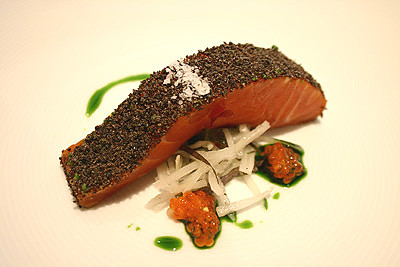
Tetsuya's confit of ocean trout
Tetsuya's is considered one of the world's best restaurants.

(picture from flickr - earlier posted picture removed due to copyright infringement)
His signature dish is confit of ocean trout (pictured above). In the (sydney) magazine, monthly supplement of the Sydney Morning Herald, Matthew Evans wrote about the journey of the fish and he gave away the secret (also multimedia).
**************
We are moving offices tomorrow, to a new building across the road. There was a lot of packing today.
(picture from flickr - earlier posted picture removed due to copyright infringement)
His signature dish is confit of ocean trout (pictured above). In the (sydney) magazine, monthly supplement of the Sydney Morning Herald, Matthew Evans wrote about the journey of the fish and he gave away the secret (also multimedia).
So the trick of cooking oily fish like salmon or ocean trout is to use very low heat.In the beginning, Wakuda would often cure the fish a little, particularly if the texture was soft, by salting it briefly, and he has experimented with cooking oils, timing and temperature. "The recipe has changed - over four times," he says. "The fish is more consistent now. We don't cure it any more. No need."
The trout is simply cooked in a light olive oil mixed with grapeseed oil. The fish is immersed in the oil mixed with lightly crushed garlic and herbs, covered with plastic film and cooked for 25 minutes in an oven at about 50-55C, then left to cool. The ends of each fillet tend to become overcooked and are used at staff meals; the remainder provides five to six portions per side. The slices are dipped in konbu (dried kelp) and served on finely shredded fennel with daikon (long radish) and shiso cress. The white plate is dotted with ocean trout roe flavoured with sake and soy. The end result is a dish that mixes salty, silky, crisp and sweet elements.
**************
We are moving offices tomorrow, to a new building across the road. There was a lot of packing today.
14 March 2008
Char Kway Teow and Sago Pudding
I love noodles and one of my favourites is the Malaysian Char Kway Teow. I've never tried to make it, but the recipe from SBS Food Safari looks great. Recipe by chef Jess Ong.

I also love sago pudding, but had never found a recipe for it, until now. Also from SBS Food Safari.

South east Asian cuisines are amongst the world's best.
****************
My main work output today was finalising a draft media release. We had a work lunch to farewell the head of our section who is leaving before Easter to undertake a PhD. It was at a new Balinese restaurant. Indonesian food is so underrated. Gado Gado is a fantastic salad.
I am so looking forward to the weekend.
It is very important to have all the ingredients ready and chopped before you start. The pan must be very hot as this dish is cooked very quickly over a high heat. A good tip is to heat the noodles first (if they are cold from the fridge) – easily done in the microwave and only cook enough for one person at a time to avoid the ingredients ‘stewing’ in the pan. - Jess Ong
INGREDIENTS
1 tbsp oil
½ Lup Cheong sausage, sliced
4 fish balls, sliced
2 shallots, sliced
2 cloves garlic, chopped
1½ handfuls of fresh rice noodles (allow approximately 300 to 400g per person)
1 tsp dark soy sauce
1 tsp light soy sauce
6 green prawns, peeled
1 egg, beaten
Handful bean sprouts
1 tbsp chopped garlic chives
DIRECTIONS
1. Add oil to hot pan or wok. Fry sausage, fish balls, shallots and garlic for a few minutes.
2. Add warm rice noodles (especially if cold from the fridge) and this is easily done in the microwave. Stir and then add soy sauces. Make space at the side of the pan and cook the prawns.
3. Add egg and cook until nearly set at side of pan, gently fold into noodles.
4. Add bean sprouts and garlic chives. Serve immediately.

I also love sago pudding, but had never found a recipe for it, until now. Also from SBS Food Safari.
Sago Gula Melaka (Sago Pudding)
Susanne Goh
INGREDIENTS
300g sago
1 egg white
200g palm sugar, chopped
½ cup water
4 tbsp white sugar
1 can coconut milk
DIRECTIONS
1. Bring a large pan of water to the boil and when boiling, add sago. Stir frequently as the water returns to the boil, to avoid them sticking. The sago will float to the surface and be transparent when cooked. Strain and rinse with cold water a couple of times to remove the starch.
2. In a clean bowl beat the egg white until soft peaks form. Add sago, stir to combine and pour into a jelly mould. Chill until set, about 1 hour.
3. Stir palm sugar and water over medium heat until sugar has dissolved. Stir in white sugar. Stir until completely dissolved and then strain through a fine sieve into a ring jelly mould and refrigerate for approximately 1 hour.
4. Turn sago out onto a serving plate, Cut into wedges and serve topped with a little of the coconut milk and syrup.

South east Asian cuisines are amongst the world's best.
****************
My main work output today was finalising a draft media release. We had a work lunch to farewell the head of our section who is leaving before Easter to undertake a PhD. It was at a new Balinese restaurant. Indonesian food is so underrated. Gado Gado is a fantastic salad.
I am so looking forward to the weekend.
29 January 2008
Duck Legs Braised With Red Wine and Lime
From the New York Times magazine (27 January 2008), a recipe from Daniel Patterson, chef at COI Restaurant in San Francisco
*****************
Back to work today after yesterday's public holiday for Australia Day (if Australia Day falls on a weekend, the following Monday is a public holiday). It was also a very warm day.
Sue B came over with me after work to check out the gardening work (after all, she had been nagging about one particular weed that was taller than a person).
Duck Legs Braised With Red Wine and LimeApparently, Chef Patterson made up this recipe, especially the saucing technique to make up for braising without stock.
4 duck legs
Salt and freshly ground black pepper
2 tablespoons olive oil
4 medium yellow onions, peeled and sliced
Peeled zest of 2 limes, pith removed and cut into thin strips
2 teaspoons minced serrano chili
1 cup red wine
2 teaspoons lime juice, more as needed
1 tablespoon chopped cilantro (coriander)
1. Preheat the oven to 250 degrees F (120 C). Season the duck with salt and pepper. Place a stew pot over medium-high heat, and add the oil. When hot, add the duck, skin side down, and cook until golden brown. Rotate the legs and cook for 30 seconds more; transfer to a plate.
2. Turn the heat to medium-low, add the onions and a little salt and cook covered, stirring occasionally, until they are softened, about 15 minutes. Stir in the lime zest and serrano chili. Add the red wine, ½ cup of water and a pinch of salt. Nestle the duck legs, skin side up, on top of the onions. Bring to a boil, and then cover, place in the oven and cook until the duck is tender but still toothsome, about 1 1/2 to 2 hours.
3. Transfer the duck and 1/2 cup of the onions to a plate; cover to keep warm. Purée the remaining onions, the cooking liquid and lime juice in a blender. Adjust to taste with salt and lime juice. Stir in half of the cilantro.
4. Mound the reserved onions in the centers of 4 plates. Put a duck leg on top of each, and pour the sauce around the duck. Sprinkle the remaining cilantro over each plate. Serve as a hearty appetizer. Serves 4. Adapted from “Aroma,” by Mandy Aftel and Daniel Patterson.

This is quite puzzling to me though. I've always braised duck or chicken in red wine without stock - coq au vin for example. I reduce the braising liquid which always thickens. Also, 1 cup of red wine is really not enough. Use the whole bottle!I had forgotten, though, having lived in California for 15 years, the wasteland that is an upstate New York supermarket in February. The produce section, filled with distressed-looking vegetables from South America and limp West Coast greens, was less than inspiring. I felt sorry for local vegetarians.
Fortunately we were an omnivorous group, so I turned my attention toward the meat counter, where I found some nice duck legs. I bought red wine, onions, limes, cilantro and serrano chilies to cook them with, imagining kind of a coq au vin by way of Vietnam.
What I failed to imagine was the resulting dark, watery and oily cooking liquid, which rather unpleasantly put me in mind of the Exxon Valdez. I’m usually pretty good at predicting what will happen during any given cooking process, but as I stood in our friend’s kitchen eyeing the pot, it was clear that the limpid, viscous sauce that I was going for had not materialized.
So I did something that I’d never done with a stew. I strained the liquid and then blended it with some of the onions, chilies and lime zest from the pot to thicken it into a sauce, which I seasoned with lime juice and cilantro. I flinched a bit as I did it; having been trained in French technique, with its long-cooked stocks and slow reductions, this seemed like a cheap shortcut. But there was no arguing with the sauce’s dynamic flavor or its smooth texture.
The basic technique is simplicity itself: use some of the vegetables that cooked with the meat to emulsify the cooking liquid into a sauce, much like making a soup. The softened fiber of the vegetables thickens the sauce and binds the free fat, capturing all of the flavor of the braise. Herbs, spices or other aromatics added to the blender can refresh the long-cooked flavors, and a little acidity, like cultured cream, citrus or vinegar, balances its richness.
A water braise is slightly different from a stock braise. It’s especially important to brown the meat well, developing crusty bits on the bottom of the pan that will flavor the cooking liquid. And don’t remove the fat! The fat is what will give the stew its flavor and the resulting sauce its silky texture. Once the sauce is made, don’t bring it to a vigorous boil, which can cause it to break.
*****************
Back to work today after yesterday's public holiday for Australia Day (if Australia Day falls on a weekend, the following Monday is a public holiday). It was also a very warm day.
Sue B came over with me after work to check out the gardening work (after all, she had been nagging about one particular weed that was taller than a person).
23 December 2007
Recipe - lamb Rogan Josh
As demonstrated by Shahena Ali, of the Maharaja restaurant in Benfleet, Essex.
Ingredients
* 600g (1 lb) lamb , chopped into 2.5 inch pieces
* 3 Tbsp garlic and ginger paste
* 3 Tbsp oil
* 2 tsp salt
* 1 tsp turmeric powder
* 3 tsp garam masala
* 2 tsp coriander powder
* 2 tsp ground cumin
* 2 Tbsp plain yoghurt
* 1 tsp chilli powder
* 2 medium onions , finely chopped
* ¾ tin of peeled plum tomatoes
* fresh coriander , to garnish
* 1 saucepan with lid
* 1 metal or wooden spoon to stir
Step 1:
Fry onion
Add oil into a saucepan and heat on a high heat until it is very hot. Now add in the finely chopped onions and stir fry until the pieces soften and become translucent.
Step 2:
Add pastes
Then add the garlic and ginger paste and keep stir-frying for 3 minutes to prevent burning and until the mixture turns light golden.
Add all of the ground spices and keep stirring whilst continuing to fry on a high heat.
Step 3:
Add the meat
Then add the lamb and stir into the mixture; fry on a high heat for 5 minutes until the meat has fully browned.
Step 4:
Add tomatoes
Add in the tinned tomato and mash the tomatoes into the mixture with a spoon, taking care to ensure that the plum tomatoes do not remain in chunks and stir into the meat mixture.
Step 5:
Stir in yoghurt
Allow to cook uncovered for 5 minutes before adding the yoghurt. Stir this in and then cook on a high heat to bring this to the boil.
Now cover the pan with a lid simmer on a very low heat for 30 minutes. After this, take the lid off and give the mixture a stir.
Step 6:
Simmer and stir every 30 minutes
Replace the lid back on the pan and let it simmer for another 30 minutes. Repeat this for around one and half hours - and you will notice that the consistency of the mixture is a bit thicker – the meat is very tender and the colour of the sauce is redder/browner.
Serve hot (with rice), garnished with fresh coriander.
VideoJug is fantastic - check it out.
**********************
Sunday, and a busy day today.
Devi dropped over in the morning for a cup of tea. After all these years, she finally told me that one can remove the canvas from director chairs, including the piece of wood where it joins the seat, and wash them! Duh!
I went over to Klaudia's place for a really nice lunch with her family and friends.
Afterwards I returned home and had a nap.
Ingredients
* 600g (1 lb) lamb , chopped into 2.5 inch pieces
* 3 Tbsp garlic and ginger paste
* 3 Tbsp oil
* 2 tsp salt
* 1 tsp turmeric powder
* 3 tsp garam masala
* 2 tsp coriander powder
* 2 tsp ground cumin
* 2 Tbsp plain yoghurt
* 1 tsp chilli powder
* 2 medium onions , finely chopped
* ¾ tin of peeled plum tomatoes
* fresh coriander , to garnish
* 1 saucepan with lid
* 1 metal or wooden spoon to stir
Step 1:
Fry onion
Add oil into a saucepan and heat on a high heat until it is very hot. Now add in the finely chopped onions and stir fry until the pieces soften and become translucent.
Step 2:
Add pastes
Then add the garlic and ginger paste and keep stir-frying for 3 minutes to prevent burning and until the mixture turns light golden.
Add all of the ground spices and keep stirring whilst continuing to fry on a high heat.
Step 3:
Add the meat
Then add the lamb and stir into the mixture; fry on a high heat for 5 minutes until the meat has fully browned.
Step 4:
Add tomatoes
Add in the tinned tomato and mash the tomatoes into the mixture with a spoon, taking care to ensure that the plum tomatoes do not remain in chunks and stir into the meat mixture.
Step 5:
Stir in yoghurt
Allow to cook uncovered for 5 minutes before adding the yoghurt. Stir this in and then cook on a high heat to bring this to the boil.
Now cover the pan with a lid simmer on a very low heat for 30 minutes. After this, take the lid off and give the mixture a stir.
Step 6:
Simmer and stir every 30 minutes
Replace the lid back on the pan and let it simmer for another 30 minutes. Repeat this for around one and half hours - and you will notice that the consistency of the mixture is a bit thicker – the meat is very tender and the colour of the sauce is redder/browner.
Serve hot (with rice), garnished with fresh coriander.
VideoJug is fantastic - check it out.
**********************
Sunday, and a busy day today.
Devi dropped over in the morning for a cup of tea. After all these years, she finally told me that one can remove the canvas from director chairs, including the piece of wood where it joins the seat, and wash them! Duh!
I went over to Klaudia's place for a really nice lunch with her family and friends.
Afterwards I returned home and had a nap.
19 July 2007
Recipe: Pot au poulet
Here is a recipe from The Age's Epicure supplement by Brigitte Hafner
************************
Emily came over after work. In fact, she was driving along the road I was walking along and she kidnapped me.
I cooked t-bone steak for dinner, served with mashed potato and broccoli.
I must try this recipe sometime.One of my favourite variations [of pot au feu] is the simple pot au poulet - chicken in a pot.
When I cooked this dish recently I added a pinch of dried mushrooms because I like the colour and subtle flavour. I used a corn-fed chicken from the Barossa, which cost $26. Not cheap, I know, but the flavour was superb and when it comes to simple poached chicken it's essential to use the best. I served the tender chicken in a deep dish surrounded by the vegetables, with some fried sourdough bread rubbed with garlic and a sprinkling of freshly chopped parsley, and a bowl of creme fraiche boosted with a big spoonful of horseradish. It was fantastic.
The leftover broth became an onion soup later that week, replete with some of the flaked leftover meat, carrots, potatoes and grilled bread topped with gruyere cheese.
Considering I fed four people twice from this simple dish, the $26 was well spent.
A French friend from Lyon told me his grandmother used to make a simple country dish called poule au riz - a favourite meal, which he still requests on visits home. She cooks a poule au pot and then makes a rice pilaf using some chicken livers fried in a little garlic and parsley, and the broth from the pot. The pilaf is laid out alongside the chicken and vegetables.
Pot au poulet
INGREDIENTS
1 corn-fed chicken
2 leeks, young pale part only, cut into large rounds
2-3 carrots, peeled and cut into large pieces
3 turnips, peeled and quartered (or whole baby turnips)
bouquet garni of 2 thyme sprigs, 10 parsley stalks, 1 fresh bay leaf
1 tbsp dried mushrooms soaked in 1/4 cup warm water
3 garlic cloves, cut in half
4-6 waxy potatoes such as nicola or kipfler
inside young leaves and stems of a celery
1 cup white wine
2 litres water or chicken stock
sea salt
1 tsp peppercornsMETHOD
Put everything into a pot, cover with cold water or stock and simmer gently for 1 1/2 to 2 hours.
Serve with creme fraiche mixed with horseradish and salt, and sourdough slices fried in butter and rubbed with garlic and sprinkled with chopped parsley.
Brigitte Hafner's pot au poulet recipe. Food preparation and styling by Caroline Velik, pot from Ex Libris.
Photo: Marina Oliphant

************************
Emily came over after work. In fact, she was driving along the road I was walking along and she kidnapped me.
I cooked t-bone steak for dinner, served with mashed potato and broccoli.
Subscribe to:
Comments (Atom)