Showing posts with label international relations. Show all posts

20 May 2012

Obama and Hollande: cheeseburger and French fries

On 18 May 2012, ahead of the G8 summit at Camp David and the NATO meeting in Chicago, French President François Hollande and US President Barack Obama held a bilateral meeting at the Oval Office at the White House. At the bilateral meeting, President Obama expressed an interest in President Hollande's views on cheeseburgers in Chicago. See remarks.
Obama
I was interested, when I was reading the President's biography, that he actually spent some time in the United States in his youth, studying American fast food -- (laughter) -- and although he decided to go into politics, we'll be interested in his opinions of cheeseburgers in Chicago. (Laughter.)

Hollande (translated)
And I would like to thank President Obama for the knowledge he has of my life before I took office. I will say nothing against cheeseburgers, of course.

Obama
I just want to remember that cheeseburgers go very well with French fries. (Laughter.)
Seemingly trivial, the exchange was not unnoticed in media reporting.

See for example, BFMTV (in French) or via YouTube


In Le Nouvel Observateur, Sylvain Courage provided some context to the exchange (my emphasis in bold)
Il sait que le jeune Hollande est venu, dès 1974, étudier le business américain du "fast food". Du coup, il attend avec impatience son jugement concernant les "cheeseburgers" de Chicago sa bonne ville où se tiendra, ce week-end, un sommet de l’Otan. L’allusion est rituelle. Combien de leaders mondiaux ont dû faire l’éloge du petit pain rond garni de steack haché pour s’attirer le lumineux sourire de Barack

La blague finaude souligne la dette culturelle et gastronomique du premier des frenchies. Naguère Sarkozy avait confié son admiration naïve pour Marilyn Monroe, John Wayne et l’inspecteur Colombo… Cette fois, le président français passe pour un accro du "Big Mac" et du "sundae fraise".
and finally
Pour conclure l’entretien préliminaire, Obama lance une dernière plaisanterie : les cheeseburgers de Chicago vont très bien avec les "french fries", ces frites que l’Amérique bushienne avait conspuées par francophobie post-irakienne… Hollande qui goûte autant la friture que la métaphore se garde "de faire tout commentaire." Pas de doute, pour tous les experts ès-diplomatie, le couple franco-américaine a remis le couvert.
The food metaphor signalled unchanged strengthened Franco-American relations.

See full exchange on White House YouTube complete with translators

02 May 2011

Superman, world citizen

In issue #900 of Action Comics published on 27 April 2011, Superman discusses his intention to renounce his American citizenship.


This has generated considerable discussion - see NPR, Reuters, The Weekly Standard, io9, Wired, etc

Associated Press report


Clark Kent may have a fake birth certificate and fake adoption papers arranged by Jonathan and Martha Kent. Surely Clark Kent's real persona Kal-El would not have an equivalent birth certificate from Krypton and then a naturalization certificate and nor would his alter ego Superman.

Questions need to be asked about how Superman, as an alien, became a naturalized US citizen. As a super human of non-Earth origin with special abilities, he must be above politics.

08 February 2011

Egypt and Tunisia: Being caught unaware

The most startling revelation about the unrest in Egypt and the Tunisian revolution were the admissions by the governments of the United States and France that they were caught unaware. Understandably, resources tend to be prioritised based on strategic importance. A country like Tunisia, comprising a comparatively small population of 10.5 million, with a stable though dictatorial government and secular society with a proven record of controlling what it considered an Islamist threat would appear to be of lower importance.

The US State Department were certainly aware of the events unfolding in Tunisia, but may have underestimated how it would turn out, such as President Ben Ali's sudden and unexpected flee out of the country. Perhaps embassy staff, whose main interlocutors tend to be host government officials, were too comfortable with a long-term understanding of the intentions of the Ben Ali government, instead of listening to public mood. They would have found the blog by The Guardian's Brian Whittaker interesting reading. His columns in The Guardian are also worth a read.

More surprising is France's admission, given there was so much reporting and analysis by the French media including access to much content on Twitter by participants (labelled with hashtag #sidibouzid) written in French. Literacy levels are high in Tunisia and many speak French in addition to, and often in preference, to Arabic.

Even during the events of Tunisia, there were already low-scale levels of unrest in a number of countries in north Africa (Maghreb) and the Middle East over similar concerns. It should not have been a surprise that Egypt would be next in terms of the scale of protest activity. Egypt already had a 'martyr' to the cause since 13 June 2010, which has provided a focus for mobilisation, particularly through the internet. The protest planned for 25 January 2011 was known in advance but it was the strength of the larger protest on Friday a few days later that seemed to take many by surprise.

Analysis by some tried to compare Egypt with Tunisia. The BBC even went so far as deeming the "contagion spreading to Egypt" unlikely due to lower literacy and lower internet penetration. Of course, early analysis of what took place in Tunisia over-emphasised the role of the internet and social media, in particular Twitter and facebook. Out of a total population of about 80 million, 17 million internet users might be be considered low penetration. However, this analysis did not consider the possibility that many of the internet users themselves may reside in greater Cairo with an estimated population of nearly 10 million people. It only takes a few million well connected people, along with word of mouth to mobilise.

Amidst skepticism and misreading of the situation, Professor Amin Saikal, Director of the Centre for Arab and Islamic studies at the Australian National University, had suggested Egypt as being the next most vulnerable following Tunisia as early as 17 January 2011 while I had picked it a day earlier.

Lastly, public mood was largely misread. Egyptians, like others around the world except those in China and other countries practicing censorship, had also witnessed what happened in Tunisia. It became a driving force for political action.

This post was also published in Crikey on 7 February 2011.

11 December 2010

The empty chair

Reported by PBS Newshour of the 2010 Nobel Peace Prize Award ceremony


In the speech by Thorbjørn Jagland, Chairman of the Norwegian Nobel Committee, Oslo, 10 December 2010.
"The Norwegian Nobel Committee has decided to award the Nobel Peace Prize for 2010 to Liu Xiaobo for his long and non-violent struggle for fundamental human rights in China. The Norwegian Nobel Committee has long believed that there is a close connection between human rights and peace. Such rights are a prerequisite for the "fraternity between nations" of which Alfred Nobel wrote in his will."

This was the first paragraph of the Norwegian Nobel Committee’s announcement on the 8th of October of the award of this year’s Peace Prize.

We regret that the Laureate is not present here today. He is in isolation in a prison in north-east China. Nor can the Laureate’s wife Liu Xia or his closest relatives be here with us. No medal or diploma will therefore be presented here today.

This fact alone shows that the award was necessary and appropriate. We congratulate Liu Xiaobo on this year’s Peace Prize.

There have been a number of previous occasions when the Laureate has been prevented from attending. This has in fact been the case with several awards which have proved in the light of history to have been most significant and honourable. Even when the Laureate has come, he or she has several times been severely condemned by the authorities of his or her own country.

Read more

In an analysis for BBC News, John Simpson suggested that China should have thought through its reaction.

An alternative Chinese award, the Confucius Peace Prize, seemingly hurriedly created, has failed to win any credibility. See report by Steven Jiang of CNN.

11 November 2010

Frau Gillard

A G20 summit is currently being held in Seoul, Korea. The event also coincides with the Seoul Lantern Festival where Cheonggye Stream is lit up by some 27,000 lanterns.  To commemorate the summit, one of the installations at the lantern festival is a wedding cake-shaped structure with dolls of G20 leaders in national dress.

Photo: AFP via Sydney Morning Herald
Australian Prime Minister Ms Julia Gillard was unfortunately depicted in a red costume from Austria, despite holding an Australian flag. The Sydney Morning Herald (Michelle Grattan) reported that "Australian authorities complained to Seoul counterparts, with a metropolitan government official saying he planned to change the doll's outfit today".

My source has reported that the Korean Embassy in Canberra, Australia is in "damage control".  No doubt, a very apologetic letter would have been sent by the Korean Ambassador.

It seems that it is not only Americans who confuse Australia with Austria, so much so that a t-shirt with a sign reading "no kangaroos in Austria" is now a common tourist souvenir.

Given the strong bilateral relations between Australia and Korea, particularly since the 1980s when both countries worked together to establish APEC, such a blunder would have come as a surprise.

During Ms Gillard's visit to Korea, a free trade agreement (FTA) is expected to be concluded.  As part of an expression of contriteness, there might be an opportunity for Australia to export kimchi to Korea, given the recent cabbage shortages there.

However, Korea's faux pas could be Austria's gain. A presentation by the Austrian Ambassador to Ms Gillard of a correctly measured and made dirndl, declaring her an honorary Austrian, together with an invitation to the Austrian Embassy's national day celebrations would gain incredible mileage in an otherwise low-key bilateral relationship.

The Australian Prime Minister in Austrian dress? This I would like to see. Given her inability to demonstrate any Welsh singing ability, there is an unlikelihood that she would carry the honour of being an 'Austrian' further by singing a few bars of Edelweiss (1). Still, we could be thankful for being spared the image of Mr Tony Abbott dressed in lederhosen.

(1) Contrary to popular belief, the song Edelweiss was only written by Rogers and Hammerstein for The Sound of Music and it has no connection to any Austrian folk song, nor is it the Austrian national anthem.

04 November 2010

Joseph Nye on global power shifts

Joseph Nye, Dean Emeritus of the Kennedy School, Sultan of Oman Professor of International Relations at Harvard University, is still one of the world's foremost thinkers on international relations. He coined the term 'soft power' some twenty years ago.

Here, he spoke at Oxford University in July 2010 about global power shifts including about China.

27 October 2010

Über Alles nicht

Reported in Der Spiegel
10/26/2010

Diplomatic Gaffe

Chilean President Wrote 'Deutschland Über Alles' in German Guest Book

In a gesture of thanks for Germany's help in rescuing the 33 Chilean miners, President Sebastián Piñera wrote the historically charged slogan 'Deutschland Über Alles' into the guest book of German President Christian Wulff last week. Now Wulff's office is pondering how to remove the words.

Chilean President Sebastián Piñera has apologized for writing the words "Deutschland Über Alles," a phrase frowned on in Germany because of its association with the Nazi era, into the official guest book of German President Christian Wulff during a visit to Berlin last week.

Media reports claimed Piñera had said on Monday that he had learned the slogan in school in the 1950s and 1960s and understood it to be a celebration of German unification in the 19th century under Chancellor Otto von Bismarck. He said he was unaware that it was "linked to that country's dark past."

The first verse was dropped from the anthem after World War II because it is deemed too nationalistic. Piñera had been on a European trip to thank countries for their help in freeing the 33 Chilean miners. A spokesman for Wulff's office played down the gaffe on Monday, saying the president had no doubt intended to express something positive about Germany.

Bild's Loser of the Day

Piñera isn't the only one to have unwittingly broken the taboo. Even experienced Europeans have done so. Last year, the French presidential office was so excited at the prospect that Chancellor Angela Merkel would attend the official celebrations to mark the French victory in World War I, the first German leader ever to do so, that its press department announced that the choir of the French army would sing "Deutschland Über Alles" at the event, the Frankfurter Allgemeine Zeitung newspaper reported at the time.

The mistake was spotted in time and the choir confined itself to singing the third verse which has been officially used since the end of World War II, starting with the unoffensive words: "Unity and justice and freedom for the German fatherland!"

Bild, Germany's best-selling tabloid newspaper, responded to the faux pas by declaring Piñera as its loser of the day, a regular item on its front page, on Tuesday. "He's better at rescuing miners," the paper declared.

Meanwhile, "Deutschland Über Alles" continues to sully the pages of Wulff's guest book. Wulff's office now plans to discuss the matter with the Chilean embassy in Berlin. Piñera may get a chance to revise his entry.

cro -- wire reports
Most people making this error would be unaware of the sensitivity despite the offensive stanza no longer being used since 1952 and again confirmed upon German reunification in 1990.

Perhaps educating this fact could be part of Germany's usual international public diplomacy.

A timely reminder indeed.

26 September 2010

Earth ambassador to greet extra terrestrials

The Daily Telegraph (UK) and Sunday Times (UK, reprinted in The Australian) reported that the United Nations may appoint an ambassador as a point of contact for visiting intelligent extraterrestrial lifeforms.

Ms Mazlan Othman, director of the United Nations Office for Outer Space Affairs (UNOOS) based in Vienna is expected to discuss details of the proposed new role at a meeting of the Royal Society in early October. This would then be subject to debate at the United Nations General Assembly.

Apparently, the proposal was prompted by the recent discovery of hundreds of planets orbiting other stars, increasing the likelihood of discovering extraterrestrial life.

Interesting logic, considering that those hundreds of planets have always been there despite not being previously detected by humans.

04 July 2010

UNEGEEW... UN Women

On 2 July 2010, the United Nations General Assembly (UNGA) established a 'entity' to progress women's empowerment. Press release

United Nations, New York, 2 July 2010 — In an historic move, the United Nations General Assembly voted unanimously today to create a new entity to accelerate progress in meeting the needs of women and girls worldwide.

The establishment of the UN Entity for Gender Equality and the Empowerment of Women — to be known as UN Women — is a result of years of negotiations between UN Member States and advocacy by the global women’s movement. It is part of the UN reform agenda, bringing together resources and mandates for greater impact.

“I am grateful to Member States for having taken this major step forward for the world’s women and girls,” said Secretary-General Ban Ki-moon in a statement welcoming the decision. “UN Women will significantly boost UN efforts to promote gender equality, expand opportunity, and tackle discrimination around the globe.”

UN Women merges and will build on the important work of four previously distinct parts of the UN system which focus exclusively on gender equality and women’s empowerment:

“I commend the leadership and staff of DAW, INSTRAW, OSAGI and UNIFEM for their commitment to the cause of gender equality; I will count on their support as we enter a new era in the UN’s work for women,” said Secretary-General Ban. “I have made gender equality and the empowerment of women one of my top priorities — from working to end the scourge of violence against women, to appointing more women to senior positions, to efforts to reduce maternal mortality rates,” he noted.

Over many decades, the UN has made significant progress in advancing gender equality, including through landmark agreements such as the Beijing Declaration and Platform for Action and the Convention on the Elimination of All Forms of Discrimination Against Women. Gender equality is not only a basic human right, but its achievement has enormous socio-economic ramifications. Empowering women fuels thriving economies, spurring productivity and growth.

Yet gender inequalities remain deeply entrenched in every society. Women in all parts of the world suffer violence and discrimination, and are under-represented in decision-making processes. High rates of maternal mortality continue to be a cause for global shame. For many years, the UN has faced serious challenges in its efforts to promote gender equality globally, including inadequate funding and no single recognized driver to direct UN activities on gender equality issues.

UN Women — which will be operational by January 2011 — has been created by the General Assembly to address such challenges. It will be a dynamic and strong champion for women and girls, providing them with a powerful voice at the global, regional and local levels. It will enhance, not replace, efforts by other parts of the UN system (such as UNICEF, UNDP, and UNFPA) that continue to have responsibility to work for gender equality and women’s empowerment in their areas of expertise.

UN Women will have two key roles: It will support inter-governmental bodies such as the Commission on the Status of Women in their formulation of policies, global standards and norms, and it will help Member States to implement these standards, standing ready to provide suitable technical and financial support to those countries that request it, as well as forging effective partnerships with civil society. It will also help the UN system to be accountable for its own commitments on gender equality, including regular monitoring of system-wide progress.

Secretary-General Ban will appoint an Under-Secretary-General to head the new body and is inviting suggestions from Member States and civil society partners. The Under-Secretary-General will be a member of all senior UN decision-making bodies and will report to the Secretary-General.

The operations of UN Women will be funded from voluntary contributions, while the regular UN budget will support its normative work. At least US$500 million — double the current combined budget of DAW, INSTRAW, OSAGI, and UNIFEM – has been recognised by Member States as the minimum investment needed for UN Women.

“UN Women will give women and girls the strong, unified voice they deserve on the world stage. I look forward to seeing this new entity up and running so that we — women and men — can move forward together in our endeavour to achieve the goals of equality, development and peace for all women and girls, everywhere,” said Deputy Secretary-General Asha-Rose Migiro.

The General Assembly resolution creating UN Women also covers broader issues related to UN system-wide coherence, laying out a new approach to the funding of UN development operations, streamlining the work of UN bodies, and improving methods of evaluating reform efforts.

It is not an organization, commission or office, unlike other UN bodies but an 'entity'. One would have thought that the term 'agency' would have been more useful.

The New York Times reported that "the problem with finding a good name, diplomats said, is that they ran out of time".

One comment... eew.

19 June 2010

Aung San Suu Kyi's 65th birthday


photo by AFP via ABC

The last birthday I mentioned was Nelson Mandela's 90th in 2008. In keeping with the theme of mentioning the birthdays of significant people, today was Aung San Suu Kyi's 65th birthday, celebrated under continuing house arrest. She was leader of a political party that was democratically elected 20 years ago as the majority, chosen by the Burmese people to form government. They never did and Daw Aung was not allowed to be prime minister.

US President Obama issued the following statement yesterday
I wish to convey my best wishes to Aung San Suu Kyi, the world’s only imprisoned Nobel Peace Laureate, on the occasion of her 65th birthday on June 19. Her determination, courage, and personal sacrifice in working for human rights and democratic change in Burma inspire all of us who stand for freedom and justice. I once again call on the Burmese government to release Aung San Suu Kyi and all political prisoners immediately and unconditionally and to allow them to build a more stable, prosperous Burma that respects the rights of all its citizens. Towards this end, I encourage all stakeholders in Burma to engage in genuine dialogue towards national reconciliation, a vital step to set Burma on a more positive course for the future.
Of course President Obama's use of the name Burma is consistent with practice by the US State Department.
The Union of Burma is ruled by a military regime called the "State Peace and Development Council" (SPDC). The SPDC changed the name of the country to "Myanmar," but some members of the democratic opposition and other political activists do not recognize the name change and continue to use the name "Burma." Out of support for the democratic opposition, the U.S. Government likewise uses "Burma."
This is also the practice by other like-minded countries including the United Kingdom, Australia and Canada.

The British Foreign Minister (and junior portfolio ministers) also made a statement


As international relations is the domain of governments, it is quite interesting that some media outlets continue to use the name "Myanmar" despite government practice - including Reuters, CNN, AFP and Associated Press.

04 March 2010

Greek tragedy

Greece is suffering from a massive debt burden and facing bankruptcy. It is likely that Germany will need to support a large scale bail out. There is also a suggestion that Greece give up something in return, like a few islands at least. From Bild
Auch wenn es vielleicht verrückt klingt: Wenn wir den Griechen doch noch mit Milliarden Euro aushelfen müssen, sollten sie dafür auch etwas hergeben – z. B. ein paar ihrer wunderschönen Inseln. Motto: Ihr kriegt Kohle. Wir kriegen Korfu.
Tongue in cheek, but an interesting thought.


28 February 2010

Misunderstanding Israel

The UK Daily Telegraph and ITN have reported on the Israeli Ministry of Publicity's latest campaign - asking Israeli citizens to act as ambassadors to correct misconceptions about Israel


One would think that with the ongoing conflict in the Middle East, they would have some notion of the concept of soft power. Of course, Mossad stuff ups don't exactly help.

19 February 2010

High level, low level, unofficial official meeting...

Statement issued by White House Press Secretary Robert Gibbs
The President met this morning at the White House with His Holiness the XIV Dalai Lama. The President stated his strong support for the preservation of Tibet’s unique religious, cultural and linguistic identity and the protection of human rights for Tibetans in the People’s Republic of China. The President commended the Dalai Lama’s “Middle Way” approach, his commitment to nonviolence and his pursuit of dialogue with the Chinese government. The President stressed that he has consistently encouraged both sides to engage in direct dialogue to resolve differences and was pleased to hear about the recent resumption of talks. The President and the Dalai Lama agreed on the importance of a positive and cooperative relationship between the United States and China.
One official photograph of the event was publicly released, which is why all media reports are using the same picture.


Official White House photo by Pete Souza

The meeting was held in the Map Room, not the Oval Office, to play down the status of the meeting. There was no official welcome (or fanfare) and no media witnesses to the 'private' 70 minute meeting.

As expected, Beijing responded sternly. Assistant Foreign Minister Cui Tiankai, summoned Jon Huntsman, the US Ambassador to China, and “lodged solemn representations”. Foreign Ministry Spokesperson Ma Zhaoxu issued a very strongly worded statement about US President Obama's Meeting with the Dalai Lama
On February 18, 2010 (EST), the US side bent on arranging the meeting between President Obama and Dalai in the Map Room of the White House in disregard of the repeated solemn representations from the Chinese side. The US Secretary of State Hillary Clinton also met with Dalai on the same day. The action of the US side has seriously interfered in China's internal affairs, seriously hurt the national feelings of the Chinese people, and seriously undermined China-US relations. Chinese Vice Foreign Minister Cui Tiankai has summoned the US Ambassador to China Jon Huntsman for solemn representations.

Tibet is an inseparable part of the sacred Chinese territory and Tibet-related issues are purely China's internal affairs. China is firmly opposed to any meeting with Dalai by leaders or government officials of any country in whatever form. China is also resolutely opposed to the interference in China's internal affairs by any country or person under the pretext of Dalai-related issues. The words and deeds of Dalai in the past several decades have shown that he is not purely a religious figure, but a political exile engaged in long-term anti-China splittist activities under the disguise of religion. The approval of Dalai's visit to the US and the arrangement of meetings with the US leader and other government officials have severely violated the basic norms governing international relations, undermined the principles enshrined in the three China-US Joint Communiqués and China-US Joint Statement, and gone against the commitment of the US Government on different occasions that Tibet is a part of China and the US does not support "Tibet Independence". China hereby expresses its strong dissatisfaction and firm opposition.

The Chinese Government and people stand steadfast in their resolve to safeguard national sovereignty and territorial integrity. Any attempt from any person to interfere in China's internal affairs under the Dalai issue is doomed to failure. China requests the US side to take China's position seriously, take prompt and effective measures to remove the malign impact, stop the connivance and support of the anti-China splittist forces for "Tibet Independence", and stop the interference in China's internal affairs by taking concrete actions to maintain the healthy and stable development of China-US relations.
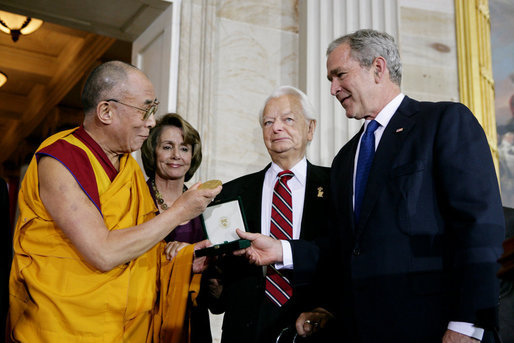
Beijing should perhaps take some comfort in the fact that this visit was very much a low key affair compared to the last time.


President George W. Bush, joined by U.S. Senator Robert Byrd and House Speaker Nancy Pelosi, presents the Congressional Gold Medal to The Dalai Lama at a ceremony Wednesday, Oct. 17, 2007 at the U.S. Capitol in Washington, D.C.
(photo by Chris Greenberg, then employed at the White House)


So the diplomatic dance begins again.

Here is a good analysis from PBS Newshour

22 December 2009

official languages of the United Nations

The United Nations (UN) uses six official languages. From UN Department of General Assembly and Conference Management on official languages

An international organization must have effective ways to overcome language barriers to avoid becoming a Tower of Babel. Since almost every country in the world is represented at the United Nations, it is not an exaggeration to say that the United Nation is a microcosm of the world. The Organization uses six official languages in its intergovernmental meetings and documents, Arabic, Chinese, English, French, Russian and Spanish; the Secretariat uses two working languages, English and French.

Statements made in an official language at a formal meeting are interpreted simultaneously into the other official languages of the body concerned by United Nations interpreters. If a delegation wishes to speak in a language that is not an official language, it must supply an interpreter to interpret the statement or translate it into one of the official languages. It is then rendered into the other languages by a relay system.

Documents are produced in the six official languages and are issued simultaneously when all the language versions are available.

(last paragraph in Arabic, Chinese, French, Russian and Spanish)

ويتم إنتاج الوثائق باللغات الرسمية الست وهي تصدر معا عندما تتوافر بهذه اللغات جميعا.

文件用六种正式语文印制,在所有语文版本备齐后同时分发。

Les documents sont produits dans les six langues officielles et publiés une fois que toutes les versions linguistiques sont disponibles.

Работая нередко «за кулисами», сотрудники ДГАКУ вносят негромкий, но существенный вклад в работу Организации Объединенных Наций.

El personal del Departamento, que suele desempeñar su tarea de manera discreta entre bastidores, realiza una aportación fundamental para la labor de las Naciones Unidas.

The BBC has reported that the Bangladeshi government and the West Bengal assembly of India are seeking to have Bengali made an official language of the UN.

How many people in Bangladesh and parts of India would be interested in reading UN documents, apart from government? In any case, even the governments of Bangladesh and the state of West Bengal use English themselves, so they may be missing the point.

The number of total speakers seems like a logical argument, but when that language is restricted to very few countries or parts of countries, then it wouldn't be efficient to translate every UN document into yet another language when only five per cent of documents would be of any used, particularly when those governments already function in English.

Hindi, more widely spoken, is not an official language. Portuguese, spoken in more countries, is not an official language.

In any case, nobody has missed out on the action so far, so the push to add Bengali is more aiming for recognition and pride, than anything bureaucratically necessary.

23 October 2009

games of former empires

The Commonwealth Games are held every four years (in between Olympic Games years), with participant nations and territories from the Commonwealth members participating (71 teams from 53 members). Most were formerly part of the British Empire or constitutionally linked with members who were, with Mozambique being the only exception. The Commonwealth Games evolved from the British Empire Games which began in 1930.

Just recently this year (27 September to 6 October), the French Jeux de la Francophonie was held. Participants were members of Organisation internationale de la Francophonie (56 member nations, 3 associate members and 14 observers). Many were former French colonies, but most united by the French language. Mozambique is an observer. The games were first hosted in 1989 in Rabat and Casablanca in Morocco.

Only a few months earlier this year, the Portuguese Jogos da Lusofonia was held. Participants were members of Comunidade dos Países de Língua Portuguesa (11 members). Most were former Portuguese colonies and united by the Portuguese language. Mozambique is definitely a member. The games were first hosted in 2006 in Macau, China.

Unusually, Spain, former members of the Spanish Empire and Spanish-speaking nations have not yet united to hold their own games in this manner. Should they do one day, Mozambique would probably also want to participate.

20 October 2009

125 years of the Prime Meridian

In October 1884, an international conference was held in Washington DC for the purpose of fixing a prime meridian and universal day.

The result was the conference agreed the prime meridian (at longitude 0° 0' 00") would be located at Greenwich, United Kingdom.

The conference also agreed Greenwich Mean Time (GMT) would be used as the standard for the world, with the day beginning at midnight at Greenwich and counted on a 24-hour clock.

Read more at BBC News

This was at the height of the British Empire, a great sea-faring nation, so it was not surprising. Imagine if this was on the agenda at the United Nations today. It would be a complete debacle as national egos come into play.

09 October 2009

Why President Barack Obama was awarded the Nobel Peace Prize

No doubt conservatives are thinking up a response to this. So far, the best some can come up with is "go figure".
This is the announcement from the Norwegian Nobel Committee

The Nobel Peace Prize for 2009

The Norwegian Nobel Committee has decided that the Nobel Peace Prize for 2009 is to be awarded to President Barack Obama for his extraordinary efforts to strengthen international diplomacy and cooperation between peoples. The Committee has attached special importance to Obama's vision of and work for a world without nuclear weapons.

Obama has as President created a new climate in international politics. Multilateral diplomacy has regained a central position, with emphasis on the role that the United Nations and other international institutions can play. Dialogue and negotiations are preferred as instruments for resolving even the most difficult international conflicts. The vision of a world free from nuclear arms has powerfully stimulated disarmament and arms control negotiations. Thanks to Obama's initiative, the USA is now playing a more constructive role in meeting the great climatic challenges the world is confronting. Democracy and human rights are to be strengthened.

Only very rarely has a person to the same extent as Obama captured the world's attention and given its people hope for a better future. His diplomacy is founded in the concept that those who are to lead the world must do so on the basis of values and attitudes that are shared by the majority of the world's population.

For 108 years, the Norwegian Nobel Committee has sought to stimulate precisely that international policy and those attitudes for which Obama is now the world's leading spokesman. The Committee endorses Obama's appeal that "Now is the time for all of us to take our share of responsibility for a global response to global challenges."

Oslo, October 9, 2009
Perhaps they should put more analysis into figuring out why George W Bush was never considered. 20 years ago, the Nobel Peace Prize was awarded to the 14th Dalai Lama, Tenzin Gyatso.

When Mr Obama collects his award in Oslo, previous laureates would be invited to attend. Surely China could not object to a meeting between the Dalai Lama and Mr Obama in this context.

30 September 2009

Ending caste discrimination

The Indian Constitution prohibits discrimination on the grounds of religion, race, caste, sex, place of birth basis. It also abolished the practice of "untouchability". Unfortunately, the caste system still exists. Discrimination based on the caste system also still exists.

The United Nations Human Rights Council has now drawn attention to India's caste system, much to the embarrassment of the Indian government. From Times of India
UN set to treat caste as human rights violation

NEW DELHI: If the recent genome study denying the Aryan-Dravidian divide has established the antiquity of caste segregations in marriage, the ongoing session of the UN Human Rights Council in Geneva looks set to recognize caste-based discrimination as a human rights violation. This, despite India's opposition and following Nepal's breaking ranks on the culturally sensitive issue.

Nepal has emerged as the first country from South Asia -- the region where untouchability has been traditionally practiced -- to declare support for the draft principles and guidelines published by UNHRC four months ago for ``effective elimination of discrimination based on work and descent'' -- the UN terminology for caste inequities.

In a side-event to the session on September 16, Nepalese minister Jeet Bahadur Darjee Gautam said his county welcomed the idea mooted by the UNHRC document to involve ``regional and international mechanism, the UN and its organs'' to complement national efforts to combat caste discrimination. This is radically different from India's stated aversion to the internationalization of the caste problem.

Much to India's embarrassment, Nepal's statement evoked an immediate endorsement from the office of the UN high commissioner for human rights, Navanethem Pillay, a South African Tamil. Besides calling Nepal's support ``a significant step by a country grappling with this entrenched problem itself'', Pillay's office said it would ``like to encourage other states to follow this commendable example''.

The reference to India was unmistakable especially since Pillay had pressed the issue during her visit to New Delhi in March. Pillay not only asked India to address ``its own challenges nationally, but show leadership in combating caste-based discrimination globally''. The granddaughter of an indentured labourer taken to South Africa from a village near Madurai, Pillay recalled that in 2006, Prime Minister Manmohan Singh had compared untouchability to apartheid.

Adding to India's discomfiture, Sweden, in its capacity as the president of the Europeon Union, said, ``caste-based discrimination and other forms of discrimination based on work and descent is an important priority for EU''. If this issue continues to gather momentum, UNHRC may in a future session adopt the draft principles and guidelines and, to impart greater legal force, send them for adoption to the UN General Assembly.

The draft principles specifically cited caste as one of the grounds on which more than 200 million people in the world suffer discrimination. ``This type of discrimination is typically associated with the notion of purity and pollution and practices of untouchability, and is deeply rooted in societies and cultures where this discrimination is practiced,'' it said.

Though India succeeded in its efforts to keep caste out of the resolution adopted by the 2001 Durban conference on racism, the issue has since re-emerged in a different guise, without getting drawn into the debate over where caste and race are analogous.
See also - (UK) Daily Telegraph

UN webcast on 16 June 2009


Of course it is a human rights issue.

29 September 2009

G-20 now bigger than G-8

The Leaders' Statement at the Pittsburgh Summit of G-20 of 25 September 2009 stated that
Today, we designated the G-20 as the premier forum for our international economic cooperation. We have asked our representatives to report back at the next meeting with recommendations on how to maximize the effectiveness of our cooperation.
G-8 will now focus more on security.

How long before G-20 becomes G-25?