Showing posts with label transport. Show all posts

02 July 2011

A marathon of a bridge

Built by Shandong Gaosu Group or Shandong Hi-Speed Group Corporation (SDHS) 山东高速集团有限公司, the world's longest sea bridge opened to traffic on 30 June 2011. From SDHS
On June 30, 2011, the world longest cross-sea bridge Shandong Hi-speed Jiaozhou Bay Bridge which is invested and operated by SDHS is officially open to traffic. Jiang Yikang, the secretary of the CPC Shandong Provincial Committee and director of the Standing Committee of the People's Congress of Shandong Province, Jiang Daming, the deputy secretary of the CPC Shandong Provincial Committee and governor of Shandong Province, general Wang Dengping, the political commissar of North China Sea Fleet, Li Qun, member of the Standing Committee of CPC Shandong Provincial Committee and secretary of CPC Qingdao Municipal Committee, Sun Liang, the Party secretary and chairman of board of SDHS as well as other members of the leadership lineup of SDHS are present at the opening ceremony.

At 10:08 in the morning, accompanied by the martial music, the opening ceremony of Shandong Hi-speed Jiaozhou Bay Bridge grandly begins. Sun Liang and Li Qun deliver speeches in succession. At 10:30, Jiang Yikang announces the bridge is open to traffic. Immediately, the fireworks rise from all directions with doves flying into the sky. The cordial atmosphere floats over Jiaozhou Bay.

As the longest cross-sea bridge in the world, Shandong Hi-speed Bay Bridge is 41.58 Km long, whose opening to traffic realizes the dream of the people over the years in Qingdao, Huangdao and Hongdao and safeguards the economic development of Qingdao City. In addition, the construction of the bridge shows the strenth of SDHS and promotes the awareness and influence of SDHS.
No doubt, the Chinese language version sounds even more 'official' and 'lofty'.

(photo from SDHS)

Some interesting facts from UK Daily Telegraph
Length: 26.4 miles (almost 3 miles longer than the previous record holder)

Width: Six-lane expressway

Capacity: Expected to carry over 30,000 cars a day

Tensile strength: Able to withstand earthquakes of 8.0 magnitudes on the Richter scale, strong typhoons and the impact of a 300,000 tonne vessel

Made up of: 450,000 tonnes of steel and 2.3 million cubic metres of concrete, supported by 5,200 columns

Built by: More than 10,000 workers

Built in: Four years

Importance: Reduces the distance between Quingdao city and the Huangdao district by around 18 miles
Further information from SDHS on construction features and other details.

Channel 4 News


Crossing 41.58km (26.4 miles) in open sea above the water? It might seem like running a marathon.

19 October 2010

Not the Eurostar

In late 1994, the first direct rail service between London (Waterloo Station) and Paris (Gare du Nord) and Brussels (Midi/Zuid) commenced. Named Eurostar, the train travelled under the English Channel through the newly built Channel Tunnel.

Since, then the Eurostar service has had a monopoly in the use of rail services through the tunnel with the London terminus switching to St Pancras Sation.

New EU legislation has opened up the route to competition with Germany's Deutsche Bahn (DB) rail operator pushing to compete with Eurostar.

An ICE (Inter City Express) train arrived at St Pancras Station today on a test run.

ICE alongside Eurostar at Waterloo (photo from dpa via Der Speigel)
DB hopes to offer services in time for the London Olympics in 2012, with regular services from 2013. A journey from London to Frankfurt would take five hours.

See
- Deutsche Welle
- Daily Mail

Having travelled on Eurostar from London to Brussels, I am looking forward to the London-Frankfurt route on ICE.

16 October 2010

The world's longest railway tunnel

AlpTransit Gotthard AG, a wholly-owned subsidiary of the Swiss Federal Railways (SBB-CFF-FFS), is currently building the world's longest railway tunnel. From their communiqué of 15 October 2010
World record on the Gotthard: The longest railway tunnel in the world has become a reality. On 15 October 2010 in the east tunnel, 30 km from the north portal and 27 km from the south portal, the final breakthrough of the Gotthard took place. At about 14:30, the tunnel boring machine, drilling from Faido, broke through the last metre of rock on the route to Sedrun.

The tunnel breakthrough was highly accurate. At 8 cm horizontally and 1 cm vertically, the deviation was very small. In his speech, Federal Councillor Moritz Leuenberger expressed pleasure, but was also moved by this important milestone on the Gotthard: “This breakthrough is a symbol of what policy can do, when we make it together,” he said. The new base tunnel will make Swiss – and also European – transport policy more sustainable. Renzo Simoni, Chief Executive Officer of AlpTransit Gotthard AG, singled out the numerous miners in his thanks. “Through their years of tireless commitment, they have made this world record possible. The miners are the heroes of today’s celebrations.”

Guests and miners are very happy

At the breakthrough point deep inside the mountain, a little over 6 km south of Sedrun, about 200 people, including Transport Minister Moritz Leuenberger and other guests of honour, witnessed the breakthrough by the tunnel boring machine. About 3500 miners and others involved in the project, including current and former engineers, planners, geologists and surveyors, followed the breakthrough on big screens at various venues: the Sedrun workshop, the Faido multifunction station, the north portal in Erstfeld, and the KKL in Lucerne. Swiss TV broadcast the event live throughout Switzerland and internationally

Importance for transport policy

The 57 km Gotthard base tunnel traverses the Alps, connecting the north portal in Erstfeld (Canton Uri) with the south portal in Bodio (Canton Ticino). With a rock overburden of up to 2500 m, the Gotthard base tunnel is also the most deeply set rail tunnel in the world. Together with the 15.4 km Ceneri base tunnel, the Gotthard base tunnel will provide a level track through the Alps. The base tunnel through the Gotthard is the core of the new rail connection. It is planned to become operational by the end of 2017. This will markedly improve passenger and freight transport at the heart of Europe: it will favour the shift of north-south freight traffic from road to rail, and shorten the journey time from Zurich to Milan from 3 hours 40 minutes to 2 hours 50 minutes. With the New Rail Link through the Alps (NRLA) on the Gotthard and the Lötschberg, Switzerland is contributing significantly to bring the people of Europe together – something the EU acknowledges.

Building the Gotthard base tunnel

The Gotthard base tunnel consists of two parallel single-track tubes, which are connected every 325 m by 40 m galleries. Overall, the tunnel system of the Gotthard base tunnel, including all tubes, shafts and galleries, measures 151.8 km. One and two thirds of the way along, at Faido and Sedrun, there are multifunction stations, which serve as emergency stopping points and places to change track. The Gotthard base tunnel was built simultaneously in five sections: Erstfeld, Amsteg, Sedrun, Faido and Bodio. The first works were carried out back in 1993, with the Piora exploratory boring, and from 1996 to 1998 with the blasting of the access shafts in Sedrun, Faido and Amsteg. Since 2001, the main lots have been constructed. The final breakthrough in the west tube is planned to take place in April 2011.
The previous longest railway tunnel was the undersea Seikan Tunnel at 53.85 kilometres (33.46 miles) linking the Japanese islands of Honshū and Hokkaidō.

Images by Reuters via PicApp
A visitor stands at the Erstfeld-Amsteg section of the NEAT Gotthard Base Tunnel October 5, 2010. With a length of 57 km (35 miles) crossing the Alps, the world's longest train tunnel should become operational at the end of 2017.  REUTERS/Arnd Wiegmann (SWITZERLAND - Tags: BUSINESS CONSTRUCTION TRANSPORT TRAVEL IMAGES OF THE DAY)

REFILE - CORRECTING TYPO A miner stands in front of the drill machine 'Sissi' after it broke through the rock at the final section Faido-Sedrun, at the construction site of the NEAT Gotthard Base Tunnel October 15, 2010. With a length of 57 km (35 miles) crossing the Alps, the world's longest train tunnel should become operational at the end of 2017.      REUTERS/Christian Hartmann (SWITZERLAND - Tags: TRANSPORT BUSINESS BUSINESS CONSTRUCTION POLITICS IMAGE OF THE DAY TOP PICTURE)

See AP reporting (video)


In comparison, the Channel Tunnel (under the English Channel) is 50.45 kilometres. The proposed Gilbraltar tunnel linking Europe to Africa (via Spain and Morocco) would be 40 kilometres.

Travelling through the mountainous Swiss Alps by rail or car is a wonderful experience, through tunnels that are marvellous feats of engineering. 

10 July 2010

Tell you where to go, Yoda can.

Automotive navigation systems using Global Positioning System (GPS) technology have been in use for around ten years, an adaptation of military technology for civilian use, to guide drivers.

Devices are typically attached to dashboards or the inside of windscreens of automobiles and display an electronic map along with audio from a voice narrator. The most well-known voice is that of Australian Karen Jacobsen. She tells people where to go!


Tomtom, a Dutch manufacturer of automative navigation devices, recently acquired different voices for use in its devices. From Yoda and Darth Vader.

It seemed both Yoda and Darth Vader had trouble keeping to the script during voice recordings.


Just as fun would be Mio's Knight Rider GPS.

06 July 2010

Stories of the Paris Métro

I've previously written about metros, and in particular, the Berlin U-Bahn. NPR recently broadcast a brilliant story about the Paris Métro. Extract of transcript
Few cities in the world are more identified with their subway systems than Paris. One of the busiest metro systems in the world, it carries more than 4 million riders a day on some 16 lines to 300 stations. To ride it is a visual carnival, a living history, an urban love story about the chemin de fer, or "path of iron."
Click on the NPR link above, then click on "Listen to the Story", it is worth the 14 minutes.

Jacki Lyden speaks to some interesting characters including an 11-year-old with a great passion, whose favourite Line is 14 (the dark purple one).

Personally, I like Line 1 (yellow). The neighbourhood between Bastille and St-Paul is wonderful.

22 March 2010

Our strange fascination with metro maps

I've previously written about metros and in particular, the Berlin U-Bahn. Die Welt recently had two superb articles about metro maps, 'Die seltsame Faszination von U-Bahn-Plänen' (The strange fascination of metro plans).
Ihre Farben sind fast überall gleich: Rot, Grün, Blau, Gelb. Sie erinnern an Teller voller Spaghetti, an kämpfende Würmer oder äußerst wirre Grafiken und weisen uns doch den Weg. U-Bahn-Pläne aus verschiedenen Städten üben große Anziehungskraft aus – auch wenn man gerade nicht in der Bahn sitzt.
translation
Their colors are almost the same everywhere: red, green, blue, yellow. They remind us of plate of spaghetti, with fighting worms or extremely confused graphics and show us the way yet. Metro plans of various cities exert great attraction - even when not sitting in the train.
See also part 2.

Metro maps are indeed fascinating. We would be lost in the maze of platforms if it were not for the maps. We need to know before boarding a metro train the direction of travel, where to change trains and how many stops before our desired destination.

Lots of subway maps can be found at Amadeus.

08 September 2009

switching left... on the road

At 6.00am yesterday, the drivers of Samoa switched from driving on the right side of the road to the left side. This was mandated by the government to bring Samoa in line with Australia and New Zealand, where it is cheaper to import appropriate sided vehicles (steering wheel and driver on the right) compared to those from Europe and the United States.

Also, while the population of Samoa is nearly 185 000, some 170 000 expatriates live in Australia and New Zealand.

Here is some raw vision from Associated Press (associated article)


The last time countries made the switch was Iceland and Sweden in the 1960s, and Nigeria, Ghana and Yemen in the 1970s.


(except Samoa is now left/yellow - from BBC News magazine)

There is an interesting article in Wikipedia that explains the origin of why particular countries drive on their sides. Fascinating!

10 August 2009

U55 - does not connect

The Berlin U-Bahn is one of the best (mostly) underground metros in the world. Line U5 runs eastward from Alexanderplatz station to Hönow station. There are plans to extend the line westward from Alexanderplatz to the new main railway station Berlin Hauptbahnhof.

On 8 August 2009, line U55 was opened. U55 is an extension to line U5 but doesn't actually join it yet. There are only three stations from Hauptbahnhof to Brandenburger Tor (Brandenburg Gate).


(photo from Der Spiegel)


The very short line took 14 years to build, at a cost of €320 million. The three stops only runs 1.8 kilometres (1.1 mile) and only takes around three minutes. It will cost an additional €433 million to extend the U55 to Alexanderplatz, as planned with a completion date of 2017.

See Der Spiegel (auf Deutsh) und Der Spiegel (English), which was rather critical in its report.

The Berlin U-Bahn is one of my favourite metros in the world and along with the S-Bahn, covers most of Berlin public transport.

17 June 2009

the best public transport

Ben Groundwater writes a brilliant travel 'blog' (column really) for the Sydney Morning Herald and has tackled the world's best (and worst) public transport

Most of the world's major cities have sorted out their public transport by now. Most have vast networks of underground trains, buses that seem to just materialise when you need them, and taxis that are affordable enough to qualify as public transport.

Sydney has none of those things.

It must bug the hell out of tourists. A public transport system can change the way you see the city your visiting - for the better, or worse.

Sydney's not alone. LA has next to no public transport that you'd ever want to set foot in - most locals will tell you that not having a car in LA is like not having a 4WD on the North Shore. You might as well not even be there.

Rome's not great either - for a huge city to only have two Metro lines is not ideal. Still, most things you'll want to see there are within walking distance of each other, which makes life a lot easier.

But enough of the bad news. Here are the cities around the world with the best public transport. It's cheap, it's fast, it's frequent, and it's easy to use. You listening, Clover? [Clover Moore is the Lord Mayor of Sydney and a member of the NSW state parliament - Daniel]

Seoul, Korea
Seoul's a nightmare of a place to walk around - the streets are badly signed, and the numbering system defies comprehension. But the city's Metro system is something else. Every trip, no matter how far, costs the equivalent of a dollar. A new train seems to arrive the minute the old one pulls out. All stations have maps of the surrounding area, and clearly numbered exits for you to get your bearings. Couldn't be easier.

Paris, France
It may not smell the best, but you can't fault the Paris Metro's frequency, and the areas of the city it manages to cover. Assuming no one's on strike, you can get around with ease. Admittedly, I haven't given the buses a whirl - anyone fill us in on that?

Shanghai, China
Like Seoul's system, the Shanghai Metro is cheap and easy to use, with plenty of signs in English, and maps around to help you out. The city also boasts the Maglev, the new train that whips you out to Pudong Airport from the city at 430km/h, and costs about 10 bucks. (Seriously, it really does go that fast.) Taxis are frightening, but cheap, and can even be paid for with the swipe card you get for the Metro.

New York, USA
I was freaked out by the subway at first. I'm not sure why - all those colours and dots I guess (I'm slightly colour blind, cut a brother some slack). But once you get the hang of things, the subway's a dream. There seems to be a station on just about every city block, and if you stand around looking confused for more than a few seconds, someone will offer to help you. Beats paying for cabs.

Amsterdam, Netherlands
Most people learn about Amsterdam's public transport the hard way - by almost getting run over by it. The city's trams are notoriously silent killers, creeping up on you and warning you with a "Ding!" seconds before impact. On the bright side though, they're cheap and easy to use - as is the train system that connects the 'Dam with neighbouring cities like Haarlem and Zandvoort. Best way to get around, though, is to do like the Dutchies do, and ride a bike.

London, UK
The downside: London transport is damn expensive. If you don't have an Oyster card, a single trip through one zone on the Tube will cost you the equivalent of $10. That's insane. Plus, riding the Tube in summer is about as much fun as cancer. The upside is that the trains are frequent, easy to use, and once you have that Oyster card, you can use it to pay for pretty much everything. Buses run all night too, which is handy, given the outrageous price of catching taxis...

Metro (underground train) systems are awesome, even New York's Subway and the London Underground. The quaintest is the Budapest Metro. I love the Paris Metro - the trains run on rubber tyres.

04 April 2009

better than public transport

From Sydney Morning Herald, a great article about 'public' bicycles

Power to the pedal

Life cycles ... Paris's Velib scheme has been a huge success.

Life cycles ... Paris's Velib scheme has been a huge success. Photo: AP

April 4, 2009

The rise of public cycling schemes is a boon for travellers, writes Brigid Delaney.

From Barcelona to Paris, European cities are becoming greener with the expansion of low-cost bicycle schemes.

Paris's Velib program, with its 20,000 bicycles, has proved wildly popular with tourists and locals.

The scheme, launched in July 2007, provides racks of heavy-framed bicycles around the city and all you need to access them is a credit card with a chip.

A EUR150 (A$297) deposit is held in case you lose or damage the bike. It is free for the first half-hour and costs EUR1 for an additional 30 minutes, EUR2 for another 30 minutes and EUR4 every 30 minutes after, making them cheaper than the Metro and more efficient than crossing the city on foot. When you reach your destination, the bike can be returned to one of about 750 Velib stands around the city.

So popular is the scheme, the bikes were rented out 24 million times in the year to June last year. Nearly 130,000 people use them a day.

Other cities have launched their own low-cost bike schemes, including Lyon and Rennes in France, Pamplona in Spain and Dusseldorf in Germany. Cities previously considered unfriendly to cyclists - with their narrow streets and aggressive drivers - such as Rome, have successfully trialled schemes.

The initiative started in cycle-friendly cities such as Copenhagen, where old bikes were scattered around, before moving to coin-operated bikes and now to smart technology, which is often sponsored by companies in return for advertising on the bicycle.

In Germany and Austria, members receive a text message with a code to unlock the bikes, with a fee debited from the riders' bank accounts. In Barcelona, users buy a yearly membership for about EUR24. The first 30 minutes are free, with a charge of 30 cents for each subsequent half-hour.

Such is the success of the program there, bikes in popular places (such as near stations) are often unavailable in peak hour, while some users have had trouble parking their bikes as all the central docks are being used.

Paris cyclists reported similar problems, with many riding down hills and using public transport to climb them, resulting in a surplus of bikes at the bottom of places such as Montmartre. The French Velibs do not come with helmets, so bring your own if you have safety concerns.

Berlin, Frankfurt and Cologne have a scheme known as Call A Bike, where you register online (callabike.de). You are given a number and charged EUR5. You then call the number to receive a code to release a bike from its dock and phone the centre when you have finished to say where you have left it.

Some of the schemes exclude tourists who haven't set up accounts or registered. But those in Paris and Lyon admit anyone with a credit card.

Not all free or low-cost bike schemes have worked. Cambridge in England started one in the 1960s and revived it in 1993 - only to find that all 300 bikes were stolen on the first day.

A free scheme for London is being considered by bike-riding Mayor Boris Johnson.

A superb idea for travelling within city limits. It would work very well in Melbourne and with a bit more work, probably Sydney.

27 January 2009

airline food on the ground

A Taiwanese restaurant is cashing in on the new Airbus A380 by offering 'simulated in-flight' dining. From Reuters
Everything but the turbulence at Taipei airline diner
Fri Jan 23, 2009 1:06am EST

By Ralph Jennings

TAIPEI (Reuters Life!) - Imagine boarding a plane without security checks or even tickets and more importantly, there's more than just fish or chicken for dinner.

Set in a dull commercial building in central Taipei, the A380 In-Flight Kitchen looks and functions like an airline in many ways, expect that it serves a regular restaurant menu of Western food, sometimes in plastic trays.

Since November, the restaurant has been packing in wannabe passengers, who sit in soft speckled blue seats with headrests covered in white napkins and under oval-shaped windows. Locked white baggage compartments hang overhead.

Waitresses dressed as flight attendants take meal orders for filet mignon or waffles, as well as the customary fish and chicken. Staff say "welcome aboard" to customers and issue boarding passes to those who must wait for a table.

Of the 84 seats, 20 are "first class" or set aside for groups with advanced bookings, and the place is often overbooked, said business operations manager Emily Lu.

"There are customers who come in and say 'is this real airline food? Airline food doesn't taste good,'" Lu said, adding that they had turned a profit.

The restaurant, in Taipei's university quarter, opened after owner Yang Mao-hui figured that he could ride some of the Airbus A380's recent fame in the aviation industry by offering a simulated experience, Lu said.

The diner decor cost about T$7 million ($209,000), she added.

"The kids like flying, so coming here gives them that experience," said regular customer Wu Shu-hua, 44.

"It looks exactly like an airplane, but the food should be a bit more extensive here," added first-time lunch customer Vivian Mo, 14, who had just ordered a soup and salad.

The Airbus A380, billed as the most spacious passenger aircraft in the world, began flying commercially in October 2007.

Airbus has no actual stake in the restaurant, Lu said.

Taiwan has a smorgasboard of theme diners, including one modeled after a hospital ward, one that holds puppet shows and two that seat customers on toilet bowls.

(Editing by Miral Fahmy)


Anybody who romanticises the notion of airline food, particularly in economy class hasn't travelled enough.

The smaller portions are a good idea though. Perhaps an airline food diet would be a good idea - small portions of inedible stuff.

Anybody used to good food in business or first class, just would not be seen in such an establishment.

29 August 2008

save fuel, ditch passengers

Due to soaring fuel costs, airlines are trying to cut down on weight.

Emirates Airlines will not provide its inflight magazine Open Skies and has banned onboard paper on A380 flights. Air Canada's regional carrier Jazz is removing its life jackets.

AirAsia X, which is expanding its routes in Australia, is considering additional charges for overweight passengers.

Perhaps it is time to ditch passengers altogether. After all, they weigh the most.

**************
I had the day off work today but didn't do anything at all. Sometimes, doing nothing is the best way to spend a day. I wonder if watching a marathon session of GRΣΣK counts as doing nothing.

12 March 2008

good airports

Terminal 5 at Heathrow Airport is about to open, in its reporting, BBC News wrote about five features of good airports

SIGNAGE

Sign at Stansted
Black text on yellow began at Schiphol and spread to the UK

Orientation is always among the top demands by customers, says Paul Mijksenaar, whose company by the same name has designed the signs for airports in Amsterdam, Frankfurt and Athens.

"The first requirement is reliability, that once you are looking for something that you find it on a sign close by and you are sure it will direct you all the way to reach your destination. A lot of sign systems are not good and sometimes the trail is lost and it stops."

Charles De Gaulle airport is particularly bad, he says, because it uses too many figures and jargon.

There are so many services in airports that it's difficult to direct people to everything, so it's best to point out "clusters" like a food court or shops.

Sign at Charles de Gaulle and Schiphol
Charles de Gaulle and Schiphol have contrasting styles
Colour coding saves reading time by a third, he says. It's common to use black text on yellow background for flying information (departures, arrivals), yellow text on black for bathroom facilities, green for exits and blue for food and retail.

"Passengers don't even realise it. People use a system like that but an hour afterwards, you can ask them and they have no idea. It's very intuitive."

Pictograms should only be used for services easily imaged like taxis and phones and all signs at one airport should use just one font (his favourite is Gill sans serif).

"What would be fantastic for a passenger is to fly from London to, say, Hong Kong, and you find the same pictograms, colour coding and nomenclature.

"It helps enormously and makes you feel at home. Airports like to be different but airport signage is not the tool to be different, it should be in harmony."

Tell that to the architects, who commonly prefer signs to be discreetly placed and understated.

BUILDING DESIGN

An architect's key aim is trying to reduce passenger stress, says Simon Smithson of Rogers, Stirk Harbour and Partners.

He was project architect of the new terminal at Barajas in Madrid, which won the architectural Oscar, the Stirling Prize, and he thinks a building's design can go a long way to easing traveller tensions.

Roof at Barajas
The wavy roof in Madrid is calming
"The most obvious is being able to understand how the building is organised. Some of the worst cases like Gatwick or Schiphol, you enter the building and you have no idea what your route is."

Out with corridors and enclosed areas, in with space, daylight and views.

Barajas has a high, wavy roof that makes the space feel airy and unconstrained, he says, and the roof almost floats, as if looking at the water surface while snorkelling. The glass walls are like "great big curtains" and give views of the planes outside.

Airports are the new plazas, the new town squares, he says, and should try to be a public space rather than a building.

"The visual and acoustic onslaught of advertising spaces and announcements is very wearing.

"Your foreground is a riot of information and conflicting objectives - 'Buy, buy, sell, sell, go here, go there'.

"As architects we recognise that we have little control over that foreground but we have control over the container."

Terminal 5
T5, yours for £4.3bn
Travel editor of the Independent, Simon Calder, picks Marseille's budget "mp2" airport as a model of simplicity.

"Flying is a simple pleasure instead of the ghastly experience it is at Gatwick and Heathrow.

"Marseilles is industrial-feeling in design, bare concrete and steel, nothing extra. It's extremely efficient and a model of airport design, unlike Terminal 5, which is all very well but I can think of better ways to spend £4.5bn."

TRANSPORT LINKS

No matter how snazzy an airport building, a fraught journey getting there will put passengers in a dark mood.

The forecourt connection between air side and land side modes of transport - the space in front of the building - is most innovative
Simon Smithson
Rogers, Stirk Harbour and Partners
The luxury and speed of the Heathrow Express, for example, comes at a high price (£15) compared to the often overcrowded Tube.

Driving to Terminal 4 can be stressful too, says Mr Smithson. But Terminal 5, with which he was once involved, is a huge improvement and recognises that airports are major transport hubs.

"The forecourt connection between air side and land side modes of transport - the space in front of the building - is most innovative.

"If you come out of an airport you can feel you are nowhere but you exit there and feel you are in a street space. It is setting a precedent."

That's great if you want to get a taxi, but it's still the slow and crowded Piccadilly line for people who need the Tube.

Fewer problems at Birmingham, where the long-term car park is a short walk from the terminal building.

Or at Hong Kong, where the Airport Express train takes passengers from downtown into the heart of the airport in 20 minutes.

NO QUEUES

There are lines for check-in, then passport check, then security, then the gate, then your seat on the aircraft and then baggage reclaim and immigration at the other end.

No queues at Denver airport
If only all airports were like Denver
It's not all the fault of the airport or airline - the Immigration Service and the government rules on security play their part, says Rod Fewings, who lectures in airport design at Cranfield University. But Birmingham can offer lessons in how it's done.

"Birmingham security is very quick and efficient. The airport has expanded its terminal building piecemeal but they seem to have got the balance right and baggage reclaim is pretty quick."

Other top performers, he says, include Munich, Helsinki and Luton.

Online and self-service check-in is becoming more common to speed things up, and there are plenty of kiosks at T5 for this purpose, he says. But it's no good if the bag drop-off is under-staffed, as it was once in his experience at Madrid.

The processing of people may be beyond the control of architects but a good design can ease the trauma of queuing, says Mr Smithson.

"The actual function of the building and the perception of the passengers is to some degree out of our hands but the quality of the space in which we are waiting - the views, the acoustics and daylighting - can make an experience either good or bad.

"Ten minutes in a horrible space can feel like half an hour but in a nice space can pass relatively fast."

RETAIL

Air passengers need to be entertained and ever since Shannon, Ireland's second airport, opened the world's first duty-free shop in 1947, retail has become a big earner for airport authorities.

Suvarnabhumi airport
Shops at Suvarnabhumi Airport, Bangkok, blend in
This week Ferrovial, which owns BAA, sold its World Duty Free shops to Italy's Autogrill for £546.6m ($1.10bn), partly to pay off Ferrovial's debts.

Shopping is now fundamental to the passenger experience, says Robbie Gill, president of The Design Solution and an expert on retail architecture.

"The danger is that too many airports are beginning to look the same and the challenge for the smartest airports is to integrate with local flair the well-known national brands and the international powerhouses."

This is something that Rome Fiumicino and Barcelona demonstrate well, he says.

But there is an ongoing tension between retail planners and architects, he says, because the latter treat the commercial activities as very much secondary to the "architectural dream".

No passengers like to feel overwhelmed or pressured into buying, says Mr Smithson, and one way Barajas tries to avoid this "invasion of space" is by maintaining outside views.

I have been through a lot of aiports, and my favourites, where I do not mind spending time there waiting for a flight, include
Still, airports are quite boring.

*****************
My dear friend Malgosia (we used to work together) told me today that her dog Jack died yesterday. He had a great life with Malgosia.

Today was quite warm. It was a busy day at work, even if I didn't produce much.

Emily came over this evening for dinner and tv. I made teriyaki marinated roast pork belly.

03 March 2008

a plane to nowhere

I found this article in The Age interesting
Indians queueing for their first flight
March 2, 2008

Bewitched by air travel, Indians are queueing for their first flight - on a plane that never even leaves the ground.

Teenager Josman T. Jose fastens her seatbelt, listens to the pilot's instructions, is served lunch by an air hostess and two hours later jumps out the emergency door of an airbus.

It is the first time the schoolgirl has seen an aircraft from inside and her excitement is palpable, even though the jet is in fact a decommissioned plane parked on a plot of land near New Delhi's domestic airport.

"It's a great experience and will be very useful when I fly in future," Josman says of her time on the plane, which every week draws scores of schoolchildren and curious onlookers who have never seen a plane up close.

Of the 55 schoolgirls who took a "flight", only three had flown before, despite a boom in air travel.

Industry experts say nearly 100 million Indians are likely to travel by plane this year - compared with fewer than 50 million in 2003-04 - but still only a small percentage of the country's population of 1.1 billion.

"Most people in India have not seen an aircraft," the plane's owner Bahadur Chand Gupta, a retired aircraft engineer, said.

"I have been flooded with requests. I was the first aircraft engineer in my village. Back in 1980, I was treated as if I were the prime minister by the village folks who all wanted to see a plane."

His company, Aeroplanet, now provides an on-the-ground in-flight experience to those who cannot afford to fly. His office staff double up as cabin crew, serving snacks and helping customers put on their oxygen masks, while the former engineer tells his audience about air pressure and aircraft speed.

"It's very informative," passenger Tanya Malhotra, 14, says.

Mr Gupta, now an entrepreneur, bought the old plane from an insurance company in 2003, rebuilt it and it now sits in a Delhi suburb where people pay 150 rupees ($4) per "trip" so they can experience what it must be like to fly.

There are six crew members on the plane, which is missing a wing and a chunk of the tail. Mr Gupta plays the role of captain, while his wife serves drinks and trays of airline food to the passengers alongside the other stewardesses.

Mr Gupta's wife, Dr Nirmal Jindal, teaches political science at university in her "other job". She says the experience is also about showing people how flying is done.

"We want to orient them about aviation manners," she told Time magazine. "People have money but they do not know how to behave. We want to acquaint them with the cost of a plane, the safety aspects, how to treat the hostesses."

As the passengers listen to Mr Gupta's announcements regarding turbulence and the descent into Delhi, the fact the bathrooms are out of order, the air-conditioning is powered by a generator and they are still seeing the same view out of the window does not faze them a bit.

While a small percentage of Indians have experienced plane travel for real, Mr Gupta's virtual flight, which includes a safety demonstration, has a huge impact on his employees and customers.

After he bought the plane, he cut it up into four pieces to make transportation easier. Two pieces of the hulk were joined, engine and expensive instruments removed, a smaller wing attached, and the original front landing gear replaced by a cement structure.

"This is what we call an assembling job, Indian-style," he says, beaming. "Nowhere in the world will you find something like this."

The engine and other equipment are now housed at another facility, where Mr Gupta runs an aviation school for aspiring pilots and aircraft engineers.

"I even put together the emergency slide for $100 only. It would take several thousand dollars to buy a new one."

He launched the business three years ago after a deluge of requests by passers-by to board the aircraft.

Now he entertains schoolchildren three times a week, offering the facility free to charities that want to bring along poor children.

Weekend rides are also free for those who cannot afford to pay. Magic shows and dancers are thrown in as entertainment for larger bookings.

"The guard has instructions to let anyone who wants to have a look come in," he says.

"I can understand because I come from a small village myself."

Regardless of status, background or job, all visitors go through typical boarding procedures.

Passengers check in, get boarding passes and climb a staircase to enter.

One student asked if there was a horn to tell other planes to get out of the way in traffic, a magazine reported.

Mr Gupta says he and his crew are catering to people's dreams.

"We are fulfilling life wishes," he says. "We want people to have a good time, to inspire them, so that kids see that if they study hard they might become a pilot."

In the end, however, it's the dreams that bring most passengers. The airbus is "beautiful to sit in", one mother, who took time out from her domestic duties, says.

"When we have more money, then we'll go on a real plane."

AFP, Reuters
The story was originally covered by SBS (television) on 20 February. Click on the link to watch the video and/or read the transcript.


Most of us take air travel for granted, but it is still a dream for many of the world's people. As for "aviation manners", some passengers should pass a course before they are allowed to fly in an aircraft.

****************
I spent most of today with Kane, returning home after a morning at work. Despite the sad circumstances, it was great to meet the rest of his human family.

I telephoned Sue I (not Sue B or Sue D) tonight and we had not caught up for a long time. I was sorry to hear that her Golden Retriever Belle passed away a few weeks ago. I never managed to meet Belle. It is always too late. It is worth phoning friends regularly and often.

02 February 2008

not the rain in Spain...

Sometimes a newspaper comes up with a gem of a headline. From The Guardian
Train in Spain sets out to beat the plane

Madrid-Barcelona link is part of 220mph network taking on the airlines

Paul Hamilos in Madrid
Saturday February 2, 2008
The Guardian

The Ave S103 train at Santa Justa Station, Seville
The Ave S103 train at Santa Justa Station, Seville. Photograph: Alamy

Delays and disruption, disgruntled passengers left standing on platforms, accusations of political incompetence and financial mismanagement: the development of the Spanish railway system has a number of things in common with its British counterpart. But when the new high-speed link between Madrid and Barcelona sets off later this month, those complaints will be set aside as the super-slick Ave S103 service carves its way through the Spanish countryside at speeds of nearly 220mph.

The Ave S103 is the kind of train that British commuters can only dream of, and forms the centrepiece of plans to make Spain a model for the rest of Europe, and the world leader in high-speed trains by 2010.

Its 200-metre aluminium chassis carries 404 passengers, whose reclining chairs - which can swivel to face the direction of travel - are fitted with video and music players.

"They are the future of travel in Spain and show that the train is anything but obsolete," said Aberlado Carrillo, the director general of the state rail operator Renfe's high-speed service. "Trains will again be the dominant mode of transport in this country."

In its first term in office, the socialist government of José Luis Rodríguez Zapatero has spent €21bn (£15.7bn) as part of a 15-year €108bn project to transform the rail network. Around 70% of this will be spent on the Ave (short for Alta Velocidad Española, or Spanish high speed).

The aim is to have 10,000km (6,200 miles) of high-speed track in Spain by 2020, meaning that 90% of the population will be no more than 30 miles from a station through which the train passes.

The Barcelona line is to be extended to Perpignan in France, making the Catalan capital just four-and-a-half hours from Paris. Work to join Madrid and Lisbon is under way.
...

The success of the Madrid-Seville corridor - the first high-speed link, which opened in 1992 - is partly a result of its pricing policy, with affordable tickets that help to keep demand high and trains full. The 290-mile journey takes two-and-a-half hours, and costs between €28.90 (£21.60) and €72.20 (£53.95) - prices that might make British travellers green with envy.

It will be the Madrid-Barcelona connection, though, that will test the high-speed service. Business people in Spain's two largest cities, with a combined population of 10 million, have been crying out for the Ave for decades. But its development has not been without problems. The inauguration was delayed by landslides that brought chaos to Barcelona's commuter service, as contractors rushed to finish the line at the end of last year.

When it finally gets running, the S103 will cover the 410 miles to Barcelona in two hours and 35 minutes, taking two hours off the journey time. But it will face stiff competition from the highly successful air-shuttle, with a route that is one of the busiest in the world.

The "air bridge" operated by Iberia airlines allows passengers to turn up at the airport, buy a ticket, and board, within 20 minutes. Iberia alone has 60 flights a day, carrying 8,000 people.

Antonio Mayo, who is in charge of the service, is not worried by the train. "We have faced competition from other airlines before, and we welcome the fight with the Ave," he says.

"We can offer one thing they cannot - time. In normal circumstances, a businessman can get from his house in Madrid to a meeting in Barcelona in under two-and-a-half hours. The train cannot do this."

Mayo accepts that Iberia will take a hit in the first few months, but he believes that an executive who needs to be in a meeting at 9am will always choose to fly.

Carrillo argues that the comparison between train and plane is a false one. "Time spent in a train is time won, while in a plane it is wasted," he says. "In a train you can work, read, talk, use the internet, eat, or simply relax and enjoy the journey. With a plane, the only objective is to arrive.

"Personally, I am not bothered if the plane arrives 20 minutes earlier than the train. The question is how that time has been used."

The fact that more than 80% of travellers choose the Ave over the plane on the route between Madrid and Seville supports his argument.

There is also the environmental question: trains produce at least four times less carbon dioxide per mile than planes, and even less when compared with short-haul flights. Spain is preparing itself for a future in which there may be limits on the number of flights a person is allowed to take, particularly within the EU.

In the end, says Carrillo, it will come down to the quality of the service: "What we are offering is unavailable in the rest of Europe in terms of comfort, speed and punctuality."

Look away now if you are a British commuter used to mind-numbing delays: if an Ave train arrives more than five minutes late, passengers are reimbursed the full price of their ticket. And the only problem for those hoping to get their money back is that the trains are nearly 98% reliable.

The train from Madrid to Barcelona currently takes four and a half hours and is far too long for the distance covered. Madrid to Seville is an excellent high speed service, which was built for the 1992 Expo. If I remember correctly, we were even given hot cotton face towels.

More from railway-technology.com, especially about a future high speed link between Madrid and Lisbon.


Of course, some slow trains are about the journey, like the Andalucia Express, which is one of the world's great train journeys. I quite enjoyed it in 2000.

*****************
I've just been watching episodes of Angel and Hex.

10 November 2007

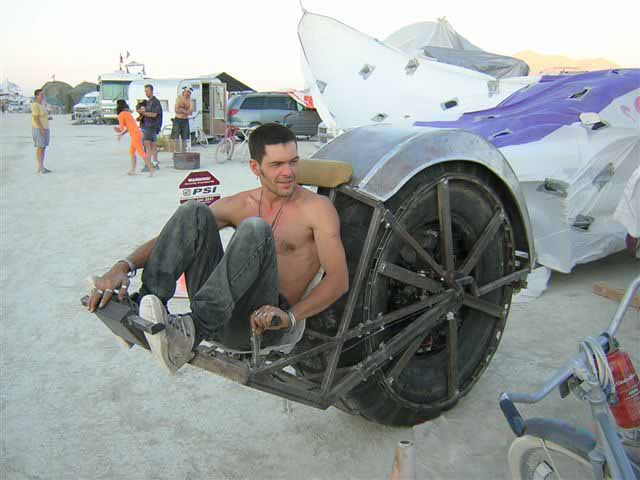
RIOT Wheel

The RIOT Wheel is a huge, heavy motorized single-wheel vehicle, originally
built for Burning Man, the natural home of deviant vehicles. Click on the link for more details.

It's a RIOT but actually, "Re Invention Of The" Wheel.


What a riot!

*****************
Oh dear! I meant to do a lot today, but didn't do much... again. There is always tomorrow!

Tonight, I'm watching Children of Men on DVD.

25 October 2007

A380 - superjumbo lands in Sydney

Today was a significant date in aviation history.

The first commercial flight of the Airbus A380 superjumbo, a Singapore Airlines flight aptly coded SQ380 landed in Sydney today in its first inaugural (maiden?) flight from Singapore.

All seats were sold by auction with the proceeds going to charity.

Sydney Morning Herald articles
- A380 lands in Sydney
- A-one service in seat 1A of Airbus superjumbo
- Superjumbo ticket 'worth every penny'
- Now you can hop on a double-decker bus to Sydney

Singapore Airline's private cabin class will replace first class on the A380. The price of a suite is estimated to be about $A12,564 on the Singapore-Sydney route.
Beyond First Class

The double suites class seats converted into a doublebed inside the Singapore Airlines superjumbo Airbus A380.
Also... Mile High Class

The Singapore Airlines Airbus A380 superjumbo comes in for a landing at Sydney Airport.
perhaps it should be nicknamed the Blimp

Airport workers crowd around the superjumbo after its arrival at Sydney Airport.

**********
It finally rained today and I got to use my umbrella after work. It was just a light sprinkle in the end, until later tonight.

02 September 2007

St Pancras

I have only just found out that Eurostar will be moving from Waterloo to St Pancras station on 14 November 2007. This was announced in November last year. I must have missed the announcement. The trip from London to Paris will only be 2 hours and 15 minutes.

St Pancras is a pretty cool station and much more central - it is linked to Kings Cross and a number of underground lines.

I used to call it St Pancreas as in the organ that produces insulin.

**********************
I sort of did some housecleaning today, but need to do more.

I went over to Margaret and Mary's place for dinner. Mary made a rare roast lamb with roast pumpkin and sweet potato, and a green salad. Momo was being a crazy puppy. I can now get him to sit.

03 April 2007

breaking news... a new world record

Associated Press has just reported that an experimental Train a Grande Vitesse (TGV), the V150 has just broken the world speed record for conventional trains reaching just more than 570 kph (354.1 mph).

The black-and-chrome train, the V150, had three double-decker cars.

The record was set on a 73km stretch of track between Paris and the eastern city of Strasbourg.

The previous record set 17 years ago for a traditional rail-based train of 515.3kph (320.2 mph) was set by an earlier version of the TGV.

The overall world train speed record is still 581kph (361 mph), reached in 2003 by a Japanese magnetic levitation, or Maglev, train.

The record took place just after 1100 GMT today (2100 local time, half an hour ago), about 200km from Paris.

France's TGV fast train is pictured on the new high-speed line built between Paris and Strasbourg on the eve of an attempt to break the world speed record.
Photo: AFP

**************************

Nothing much happened today. I really feel Keiser's absence. We were a great team Keiser and I.