Showing posts with label nature. Show all posts

27 January 2011

Upright locomotion by Western Lowland gorilla

From Aspinall Foundation's Port Lympne Wild Animal Park in Kent (South East of England), a male silverback Western Lowland gorilla named Ambam was shown walking upright as filmed by Johanna Watson. See 'Gorilla Walks Like A Man' (Aspinall Foundation)


According to keeper Phil Ridges
Ambam's father Bitam used to display the same behaviour if he had handfuls of food to carry. Ambam also has a full sister, Tamba, and a half sister at Howletts, who also sometimes stand and walk in the same way. All gorillas can do it to some extent but we haven't got any who do it like Ambam and he is quite a celebrity at the park.

We think he might use it to get a height advantage to look over the wall when keepers come to feed him and standing up can also help him in looking for food generally in his enclosure as it gives him a better vantage point. Ambam can also carry a lot more food if he stands and uses both hands and walking on two feet also means he doesn't get his hands wet when it is raining!
Channel 4 News has reported that Ambam has become an internet celebrity.

Gorillas have short legs.

26 October 2010

Amazing Amazon's new discoveries

The 10th Conference of the Parties of the Convention on Biological Diversity (CBD) is currently being held in Nagoya, Japan (18-29 October 2010).

To coincide with the event, WWF - World Wide Fund for Nature today launched Amazon Alive!: A Decade of Discoveries 1999-2009, which listed new species including 637 plants, 257 fish, 216 amphibians, 55 reptiles, 16 birds and 39 mammals.

See media release.

New species also included spiders, such as this very attractive one


Avicularia braunshauseni (photo by Karl Csaba for WWF)

02 October 2010

Seeing the forest for the trees

The Curtain Fig Tree (strangler fig species Fichus virens), just outside the small township of Yungaburra on the Atherton Tableland near Cairns (in north Queensland, Australia) has been a tourist attraction for many generations.

(photo from Tropic Wings, a great tour company)

It might seem strange to travel some distance to view one tree but many people appreciate natural beauty.

Just outside San Francisco is Muir Woods, another attraction, which is a tree-lovers paradise.

15 August 2010

Giant salamanders

From National Geographic's channel on YouTube
Giant salamanders, some growing up to 5-feet in length, face a barrier of dams in Japan, built to control flooding. Now it's hoped a new system will help these giant amphibians get upstream past the dams to lay their eggs.


Amazing creatures and an innovative way to save them.

See also breeding program at Smithsonian's National Zoo (report by National Geographic).

27 April 2010

grand theft octo

A San Franciscan now living in New Zealand was had his video camera stolen by an octopus whilst diving. See YouTube clip by Victor Huang
April 15, 2010while trying to get video of a wild octopus, it suddenly dashed towards me and rips my shiny new camera from out of my hands, then swims off, all while the camera is recording! he swam away very quickly like a naughty shoplifter. after a 5 minute chase, I placed my speargun underneath him and he quickly and curiously grabbed hold of the gun as well, giving me enough time to reach in and grab the camera from out of his mouth. I didn't feel threatened at all during the whole ordeal. he seemed to be fixated on the shiny metallic blue digital camera. the only confusing behavior was how he dashed off with it like a thief haha. cheeky octopus.
See also reporting by CBS News


Watch CBS News Videos Online

The octopus is lucky it doesn't live in the coastal waters of Greece. It would have ended up as dinner.

24 March 2010

Nature by Numbers

An awesome movie by Cristóbal Vila, inspired by numbers, geometry and nature.


Also check out the theory behind the movie at Etérea.

10 February 2010

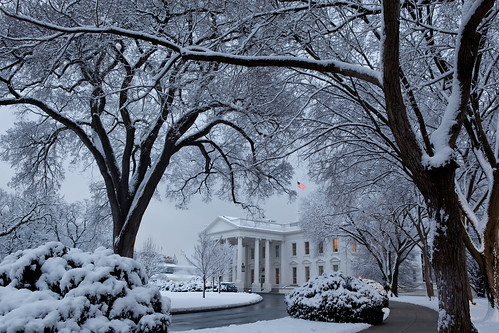
Snowmaggedon

Recent heavy snowfalls in Washington DC have been dubbed 'snowmaggedon' by residents including President Obama.

It does make a nice postcard picture though.


From the White House's Flickr stream. Thanks to Miles Fisher for the tweet.

16 December 2009

Octopus tools

Early last year, I wrote about Louis the Octopus who was attached to his toy Mr Potato Head.

Museum Victoria, based in Melbourne, has researched and reported about the Veined Octopus using tools. From MV news
Tool use in Veined Octopus
15 December, 2009

Click here to view larger image.
Veined Octopus in coconut shell shelter
Image: Roger Steene
Source: Courtesy of Current Biology

Museum Victoria’s Julian Finn and Mark Norman have recorded the first case of tool use – sophisticated behaviour generally limited to mammals and birds – in an invertebrate.

The Veined Octopus, Amphioctopus marginatus, uses foreign objects for shelter, which is common in octopuses and is not itself considered tool use. However the Veined Octopus goes a step further and prepares, manipulates and carries coconut shells up to 20 metres to reassemble its shelter elsewhere.

Julian and Mark spent more than 500 hours diving in Indonesian waters to observe and film these animals. They watched octopuses dig out coconut shells from the ocean floor, empty shells with jets of water, stack two empty shells hollow-side up, and carry the shells in a unique gait they call ‘stilt-walking’. This series of actions are among the most complex ever recorded in an octopus.

The Veined Octopus probably evolved this behaviour using clam shells as shelter. However once humans began discarding large numbers of coconut shells, they inadvertently created a steady supply of lightweight octopus tools.


Julian and Mark’s paper ‘Defensive tool use in a coconut-carrying octopus’, was co-authored by Tom Tregenza. It was published in the journal Current Biology on 15 December.
I am hoping that one day, scientists will discover a species of octopus that build houses, exchange some form of money for food, goods or services, and keep crabs as pets. Still, many will continue to end up barbecued.

10 May 2009

smarter than some humans

Orangutans are intelligent. From Associated Press (10 May 2009) and widely reported
Orangutan makes a run for it at Australian zoo

ADELAIDE, Australia (AP) — A zoo in Australia was evacuated Sunday after an "ingenious" 137-pound orangutan short-circuited an electric fence and hopped a wall surrounding her enclosure.

The ape, a 27-year-old female named Karta, jammed a stick into wires connected to the fence and then piled up debris to climb a concrete and glass wall at the Adelaide Zoo.

Zoo curator Peter Whitehead told reporters Karta sat on top of the fence for about 30 minutes before apparently changing her mind about the escape and climbing back into the enclosure.

"I think when she actually got out and realized where she was ... she's realized she shouldn't be there so then she's actually hung onto the wall and dropped back into the exhibit," Whitehead said.

Karta came within a few yards (meters) of visitors, who were the first to notice the animal's escape bid.

Whitehead said the animal was not aggressive, but the zoo was cleared as a precaution, and veterinarians stood by with tranquilizer guns in case of trouble.

"You're talking about an animal that's highly intelligent," Whitehead said. "We've had issues with her before in normal day-to-day operations where she tries to outsmart the keepers. She's an ingenious animal."

Officials at the zoo in the southern city of Adelaide would conduct a "thorough review" of the escape bid and it was likely some vegetation that could be used in a future try for freedom would be removed from Karta's enclosure.

Der Spiegel reports about Ujian at Heidelberg Zoo, who whistles
05/08/2009 12:48 PM
JUST PUT YOUR LIPS TOGETHER
Heidelberg Zoo's Whistling Orangutan Releases CD

An orangutan in Heidelberg Zoo has attracted attention after teaching himself to whistle. Now the 14-year-old ape has recorded his first CD.

Although somewhat underrated as a musical technique, a spot of whistling can often add a certain something to a song. Who can forget Otis Redding's poignant whistling on the soul classic "(Sittin' on) the Dock of the Bay" or the haunting whistle refrain on the fall-of-the-Wall rock anthem "Wind of Change" by Germany's Scorpions?

PHOTO GALLERY: GOING APE OVER UJIAN

Click on a picture to launch the image gallery (9 Photos)

Now a whistling orangutan at Heidelberg Zoo in Germany is set to release his first CD. Entitled "Ich Bin Ujian" ("I Am Ujian"), the CD single by Ujian, a 14-year-old orangutan, will go on sale at the zoo in June. Proceeds will go toward the extension and renovation of the zoo's ape house.

The song, a jaunty pop-rock number with reggae elements, features Ujian's melodic whistling as a background element. The lyrics, sung by Tobias Kämmerer, follow a similarly self-aggrandizing stance as the classic "I Wan'na Be Like You" sung by the orangutan King Louie in the animated movie "The Jungle Book," with the chorus including the lines: "I am Ujian the orangutan, I am so cool, man, I'm a star."


Local musician Christian Wolf, who was one of the producers of the song, was passing Ujian's enclosure one day during a visit to the zoo with his son. He stopped in amazement in front of Ujian's cage when he heard the animal whistling.

He returned with a digital recording device. With the help of Bernd Kowalsky, who is responsible for apes at the zoo, they recorded five hours' worth of audio, from which they gathered enough of Ujian's whistling for the song.

Ujian apparently taught himself to whistle last summer. According to the newspaper Stuttgarter Nachrichten, Ujian was inspired to start whistling after a vegetable delivery man was late coming to his cage. Ujian let out an exasperated whistle in a bid to get him to hurry up. From simple notes, the gifted ape soon graduated to melodic phrases.

But Ujian is not only talented musically. Along with fellow Heidelberg Zoo orangutans Puan and Grisella, he paints and has produced a number of abstract works. The zoo has been holding an auction of their paintings to raise money, with Thursday marking the closing date for bids.

Orangutans are highly intelligent creatures and many zoos around the world have animals who paint or draw. However only a handful of orangutans have been known to whistle. Bonnie, an orangutan in the National Zoo in Washington, D.C., recently attracted attention when she taught herself to whistle. Researchers believe she was trying to imitate the sounds of whistling zookeepers.

The song "Ich Bin Ujian" can be heard on the Stuttgarter Nachrichten Web site.

dgs -- with wire reports

Definitely smarter than some politicians.

21 March 2009

the lion man

I wrote about Kevin Richardson back in July 2007.

Here is some recent vision from Associated Press


Kevin Richardson may be crazy, but the lions probably consider him to be a member of their pride.

13 September 2008

billabong bugs... better than sea monkeys

I was always curious about the sea monkeys advertised in old comic books. They always looked too small and never resembled the illustrations.

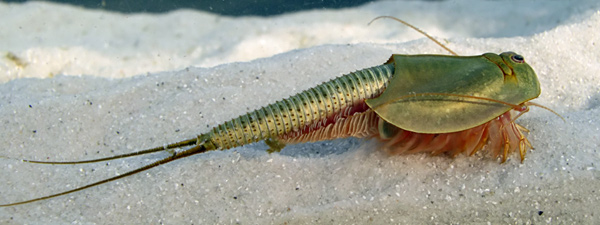
Triops australiensis, a species of Notostraca and sometimes referred to as tadpole shrimp, has been packaged as aquarium pets called Billabong Bugs.


I think they look really cool.

It seems we are only now catching the Triops fad already in the US.

I wonder if Triops would eat sea monkeys.

***************
Didn't do much today.

12 September 2008

Okapi

Rare photos of the okapi taken in the wild has been widely reported in the media worldwide.


From the Zoological Society of London
First ever pictures of Africa’s 'unicorn'
Wednesday 10 September 2008

The okapi, an African animal so secretive it was once believed to be a mythical unicorn, has been caught on camera in the wild for the first time by ZSL.
A glimpse of the mysterious okapi © ZSL

Camera traps set up by ZSL and the Congolese Institute for Nature Conservation (ICCN) in the Democratic Republic of the Congo (DRC) have captured landmark pictures of the mysterious okapi in Virunga National Park - proving that the species is still surviving there despite over a decade of civil conflict.

Dr Noelle Kumpel, ZSL’s Bushmeat and Forests Conservation Programme Manager, said: 'To have captured the first ever photographs of such a charismatic creature is amazing, and particularly special for ZSL given that the species was originally described here over a century ago. Okapi are very shy and rare animals - which is why conventional surveys only tend to record droppings and other signs of their presence.'

The new ZSL-led survey has not only captured the first pictures of okapi roaming in the wild, but has also revealed the presence of a previously unknown population on the east side of the River.

Thierry Lusenge, a key member of ZSL’s DRC survey team, added: 'The photographs clearly show the stripes on their rear, which act like unique fingerprints. We have already identified three individuals, and further survey work will enable us to estimate population numbers and distribution in and around the Park, which is a critical first step in targeting conservation efforts.'

The exact status of this secretive species is unknown as access to the forests of DRC is limited by civil conflict and poor infrastructure, making survey work difficult. Okapi are only known to inhabit three protected areas, of which Virunga National Park is one.

However even Virunga’s newly-discovered and still largely unknown population is under threat from poaching. Okapi meat, reportedly from the Park, is now regularly on sale in the nearby town of Beni. The ZSL survey team has warned that if hunting continues at this rate, okapi could become extinct in the Park within a few years.

Together ZSL and ICCN plan to continue researching the species’ status in these little-known forests. ZSL scientists believe the okapi population in and around Virunga National Park needs urgent attention; they are currently looking for additional funds for a more comprehensive, community-based project to conserve this threatened population in the long-term.

video from National Geographic

Truly exciting.

**************
So glad the work week is over.

03 September 2008

salmon or venison?

According to a study published in BMC Ecology, wolves prefer salmon to venison.  Also reported in New Scientist

Venison's fine, but wolves prefer salmon

  • 00:01 02 September 2008
  • NewScientist.com news service
  • Gursharan Randhawa

Wolves are not quite the red-blooded hunters we thought they were. It appears they prefer to dine on a nice piece of salmon rather than deer.

Ecological studies into predator-prey relations have traditionally shown that wolves feed on hoofed animals like deer, elk and moose, particularly during the spring and summer. However, ecologists have recently noticed that the fanged animals can capture and eat salmon in the autumn when the fish swim upriver.

The suggestion has been that wolves fall back on salmon as an alternative food source when deer are scarce. But Chris Darimont and colleagues at University of Victoria and Raincoast Conservation Foundation, British Columbia, Canada, have shown that wolves actually prefer salmon, whether or not deer are on the menu.

Darimont and colleagues spent four years studying the feeding habits of eight packs of wolves in the Great Bear Rainforest region of British Columbia.

Seasonal snack

Spawning salmon are unavailable for most of the year. They leave rivers at the start of spring the size of a human finger and spend up to five years growing in the ocean. When they return to their native streams in the autumn, often the size of a five-year-old child, they offer a huge pulse of nutrients to predators that can harvest the creeks.

Salmon is rich in fat compared to deer, containing four times the amount of caloric energy per bite. Combined with the fact that they are predictable, spatially constrained in creeks and don't fight back like deer do, salmon is an ideal food resource.

Darimont and his team used genetic tests to analyse over 2000 droppings and 60 hair samples to determine their wolves' dietary habits.

"Hair is metabolically inert, so it records what that wolf was eating during that time of hair growth," explains Darimont.

The results show a seasonal shift in diet from deer in spring and summer to salmon in the autumn, even when deer is readily available – suggesting the availability of salmon is driving the change in feeding.

Easing exploitation

This means, says Darimont, if commercial salmon fishing continues at the rate it is now, the implications for wolves and other species could be disastrous.

Although wolves have deer as a fallback, other species like mink and grizzly bears rely heavily on salmon. The ability of female grizzlies to bear young is completely dependent on salmon availability, as is breeding and lactation in mink.

For these reasons, human exploitation of salmon must be scaled down, says Darimont. He supports the Canadian government's Wild Salmon Policy, which aims to put the needs of the ecosystem ahead of those of the fishing industry when managing salmon stocks.

Duh! Wolves are quite intelligent.  If it is easier to catch salmon than hunt dear, why wouldn't they?

****************
Today was cold, even though spring is in the air.

27 August 2008

Crows and magpies know who you are

I was surprised by this report in the New York Times
August 25, 2008
Friend or Foe? Crows Never Forget a Face, It Seems

Crows and their relatives — among them ravens, magpies and jays — are renowned for their intelligence and for their ability to flourish in human-dominated landscapes. That ability may have to do with cross-species social skills. In the Seattle area, where rapid suburban growth has attracted a thriving crow population, researchers have found that the birds can recognize individual human faces.

John M. Marzluff, a wildlife biologist at the University of Washington, has studied crows and ravens for more than 20 years and has long wondered if the birds could identify individual researchers. Previously trapped birds seemed more wary of particular scientists, and often were harder to catch. “I thought, ‘Well, it’s an annoyance, but it’s not really hampering our work,’ ” Dr. Marzluff said. “But then I thought we should test it directly.”

To test the birds’ recognition of faces separately from that of clothing, gait and other individual human characteristics, Dr. Marzluff and two students wore rubber masks. He designated a caveman mask as “dangerous” and, in a deliberate gesture of civic generosity, a Dick Cheney mask as “neutral.” Researchers in the dangerous mask then trapped and banded seven crows on the university’s campus in Seattle.

In the months that followed, the researchers and volunteers donned the masks on campus, this time walking prescribed routes and not bothering crows.

The crows had not forgotten. They scolded people in the dangerous mask significantly more than they did before they were trapped, even when the mask was disguised with a hat or worn upside down. The neutral mask provoked little reaction. The effect has not only persisted, but also multiplied over the past two years. Wearing the dangerous mask on one recent walk through campus, Dr. Marzluff said, he was scolded by 47 of the 53 crows he encountered, many more than had experienced or witnessed the initial trapping. The researchers hypothesize that crows learn to recognize threatening humans from both parents and others in their flock.

After their experiments on campus, Dr. Marzluff and his students tested the effect with more realistic masks. Using a half-dozen students as models, they enlisted a professional mask maker, then wore the new masks while trapping crows at several sites in and around Seattle. The researchers then gave a mix of neutral and dangerous masks to volunteer observers who, unaware of the masks’ histories, wore them at the trapping sites and recorded the crows’ responses.

The reaction to one of the dangerous masks was “quite spectacular,” said one volunteer, Bill Pochmerski, a retired telephone company manager who lives near Snohomish, Wash. “The birds were really raucous, screaming persistently,” he said, “and it was clear they weren’t upset about something in general. They were upset with me.”

Again, crows were significantly more likely to scold observers who wore a dangerous mask, and when confronted simultaneously by observers in dangerous and neutral masks, the birds almost unerringly chose to persecute the dangerous face. In downtown Seattle, where most passersby ignore crows, angry birds nearly touched their human foes. In rural areas, where crows are more likely to be viewed as noisy “flying rats” and shot, the birds expressed their displeasure from a distance.

Though Dr. Marzluff’s is the first formal study of human face recognition in wild birds, his preliminary findings confirm the suspicions of many other researchers who have observed similar abilities in crows, ravens, gulls and other species. The pioneering animal behaviorist Konrad Lorenz was so convinced of the perceptive capacities of crows and their relatives that he wore a devil costume when handling jackdaws. Stacia Backensto, a master’s student at the University of Alaska Fairbanks who studies ravens in the oil fields on Alaska’s North Slope, has assembled an elaborate costume — including a fake beard and a potbelly made of pillows — because she believes her face and body are familiar to previously captured birds.

Kevin J. McGowan, an ornithologist at the Cornell Laboratory of Ornithology who has trapped and banded crows in upstate New York for 20 years, said he was regularly followed by birds who have benefited from his handouts of peanuts — and harassed by others he has trapped in the past.

Why crows and similar species are so closely attuned to humans is a matter of debate. Bernd Heinrich, a professor emeritus at the University of Vermont known for his books on raven behavior, suggested that crows’ apparent ability to distinguish among human faces is a “byproduct of their acuity,” an outgrowth of their unusually keen ability to recognize one another, even after many months of separation.

Dr. McGowan and Dr. Marzluff believe that this ability gives crows and their brethren an evolutionary edge. “If you can learn who to avoid and who to seek out, that’s a lot easier than continually getting hurt,” Dr. Marzluff said. “I think it allows these animals to survive with us — and take advantage of us — in a much safer, more effective way.”

I was surprised Dr Marzluff had to test the birds. Surely it is common knowledge that these birds remembers who annoys them. Notice that the NY Times article did not source a published study in an academic journal.

Our neighbourhood has a large magpie population. Some people claim they have been swooped during spring, when nesting magpies protect their young. I have never been swooped as I actually talk to the birds and they remember me and that I mean them no harm.

The magpies were building nests last month. Some even came into the deck area to take Kane's fur (which I'd been pulling off from the brush and leaving over the edge of the deck). Hopefully they will recognise Kane by smell when we go walking.

******************
I stayed home today. There is a some bug going around the office and today became my turn. Most of the day was spent on the couch.

24 May 2008

crocodiles... the new jaws

From the Northern Territory News
Battle of the Titans
MATT CUNNINGHAM

23May08

THERE'S no need to be scared of sharks when you're in the Territory -- the crocs usually get to them first.

NEWSBREAKER Paul van Bruggen snapped these amazing pictures of a 2.5m saltie dining out on a shark on the banks of the Daly River.

"We went past one section of the river and we heard some splashing,'' he said.

"We looked across and saw a shark's tail coming up out of the water and then a crocodile's head came up and grabbed it.'' Mr van Bruggen said the crocodile knew exactly what it was doing, dragging the shark on to unfamiliar dry land before finishing off its prey.

"How smart is the crocodile? It if was you or me it would be dragging you in to drown you, but it takes the shark up on dry land,'' he said.

The fisherman, who was on the Daly River last Friday for the Barra Classic, said the crocodile definitely wanted shark for dinner.

"We were about 15 metres away and it didn't bat an eyelid,'' he said.


Now if the shark was as big as the crocodile, which would come out worse off? Maybe Hollywood will make a movie one day similar to Alien vs Predator.

****************
I meant to clean the house today, but didn't. There is always the morning before visitors arrive.

30 October 2007

a bearcat is neither bear nor cat

A bearcat recently escaped from Melbourne Zoo. Bearcats are neither bears nor cats, but a funny looking animal called binturong, native to the rainforests of Vietnam, Malaysia, Indonesia and Palawan Island..

A bearcat like the one that briefly tasted freedom today.

Thankfully, the bearcat was found. It could have ended up as a snack for one of the big cats (lions) nearby.

************
Happy Tuesday.

08 May 2007

chicken-eating spider

I'm not scared of spiders and leave large Huntsman spiders inside the house, which certainly freaks out some people.

Now the Chicken-eating spider is a totally different matter.

From PBS Nature
Chasing the Chicken-Eating Spider

In NATURE's DEEP JUNGLE: MONSTERS OF THE FOREST, spider expert Martin Nicholas travels to South America's Amazon in search of a spider known as the chicken-eating spider. He heard from a friend about a giant spider that can kill a hen, and he wants to see if these tall tales are true. With the help of a tiny "spider cam" that can see down spider holes, Nicholas comes face-to-face with a huge spider (possibly new to science) that is nearly a foot across and could easily eat a chicken. NATURE recently spoke with Nicholas at his home in Great Britain.

A chicken-eating spider
A chicken-eating spider with young. Photo by Martin Nicholas
How did you get involved in spider hunting?

Martin Nicholas: I've always been interested in spiders. When I grew up outside of London, the other kids were pulling the legs off insects, but I was the one feeding flies to spiders and studying their behavior. It just grew on me.

But you are not a full-time spider researcher.

No, I sell commercial water treatment plants for a living. Once or twice a year I get out for an expedition, to see something new. I've been to Vietnam, South America, all over. Every time I go out, I learn something new. I've even discovered a couple of new species ... one is a small, brown, stripey tarantula that builds the most incredible tube webs. It is going to be named after me.

How did you get interested in the chicken-eating spider?

It started a few years back with a letter from a friend in Peru who built power plants. He heard this story of a chicken-eating spider. I love those kinds of stories, they are irresistible. So I had to go to Peru and see if it was true.

The spider cam allowed you to see some remarkable behavior, including some young tarantulas in the same burrow with what appeared to be a parent. ...

Yes, there were some real surprises. Seeing the big mama tarantula with the young was remarkable. Most tarantulas are in no way gregarious. In fact, they often cannibalize their own young. So seeing that was very unusual. But it may make sense. It looks like when they go out at night as a group, they can catch and kill larger prey by working together. We also discovered that those spiders appeared to be keeping a pet. There was a little frog that lived down in the hole with the spiders. It may offer some sort of service to spiders, like sweeping up ants that might bother the spiders.

You believe that mother spider was about 10 inches across. How big are the biggest tarantulas?

I believe the record is 11.8 inches, held by the Goliath spider of Venezuela.

Is the chicken-eating spider a new species?

We don't know yet. I would like to get it properly identified. There are two or three other large black tarantulas that live in the area.

Where would you like to go spider hunting next?

Central Africa. That's my next big spider project. The logistics are very difficult, but there are potentially several kinds of giant spiders living in the region. One that was 11.5 inches across once walked into a British fort a long time ago, but it has never been seen again. Perhaps it was a freak of nature, but maybe not.

Do you keep spiders as pets?

Oh yes. I live in a big converted chapel, and they've got one whole end of a hall. I keep, breed, and photograph dozens of species. I always say keeping and feeding 500 tarantulas is cheaper than keeping a single dog!
Um, even I won't leave one of those inside the house.

See also BBC Science.

********************************
Michelle is in town for work, so is staying over tonight. About time she visited! We had vindaloo (beef) for dinner.

Sigh, Keiser is very much missed tonight.