Showing posts with label opinion. Show all posts

07 September 2010

Why is it that racists can't spell?

Marieke Hardy, writes for ABC The Drum and is fairly insightful. Her piece 'How do you spell racist?' begins with the following
So the story goes like this. Victorian Labor MP Don Nardella recently received a letter from a very cross constituent who took him to task for not paying enough attention to his 'people' or parking in a no standing area or wearing the wrong tie or whatever. Contained within the presumably passionate missive was the accusation "You seem to not want to help anyone except the immagration people".

Mr Nardella, offended by both the implication and the spelling, penned the following reply: "My advice to you stands from my initial email reply. Learn how to spell 'immigration' before using the word again".
Of course, Hardy did not suggest that the correspondent might be racist but it was a good lead-in to the rest of her article citing other examples. Mr Nardella, responding to the Herald Sun newspaper, defended his response
"Obviously there's a slur there," he said.

"I felt pointing out her spelling mistake was the gentlest way ... to say that her comments were inappropriate."
Perhaps Mr Nardella should have been more blunt.

Back to Ms Hardy's article - read more here. She does have a point. More often than not, the most intolerant people, dare we say bigoted, are usually the least literate. Says a lot really.

04 August 2010

France: creating second class citizens

Reported by Bloomberg (and other media outlets)

The French government will present a bill in September empowering it to strip naturalized citizens of their French nationality if they commit serious crimes, Immigration Minister Eric Besson said.

The law would apply to people who have been French for less than 10 years and who commit crimes punishable by more than five years in prison, Besson told journalists after leaving a Cabinet meeting today in Paris.

President Nicolas Sarkozy, responding to a recent spate of riots and violent crimes, said in a July 30 speech in the Alpine city of Grenoble that violent criminals with “foreign origins” should be stripped of their citizenship. There was a night of rioting in Grenoble last month after police shot dead an armed 27-year-old of North African origin who led them on a car chase after robbing a casino.

Read more. See also reporting in Le Figaro (in French).

For a nation that has liberté, égalité, fraternité as its national motto, it is strange that they plan to create a separate class of citizenship for the foreign born. The concept of citizenship is that once it is conferred, that person would be treated equally like other citizens irrespective of country of birth. The same laws should apply equally to all.

Applying different laws to a notionally different class of citizens undermines the concept of equality and citizenship. Citizenship can't be conditional. Either a person is or isn't a citizen.

08 June 2010

unbearable cruelty 3

I've previously written twice about hunting for sport.

Treehugger (part of Discovery, with Discovery channel and Animal Planet) reported about American hunters travelling to Canada to hunt polar bears, including a video from the Humane Society of the United States.


Killing an innocent animal for sport or fun is seriously disturbing.

Allowing hunting of polar bears is so at odds with conservation efforts by various organisations such as Polar Bears International.

29 June 2009

real news

An opinion/editorial (filed on Monday 29 May 2009) in The Daily Evergreen, student newspaper of Washington State University (in Pullman, not to be confused with University of Washington in Seattle) was very topical.
Celebrity deaths eclipse real news

The over-saturated coverage of the deaths of Michael Jackson, Farrah Fawcett and television pitchman Billy Mays display America’s morbid fascination with celebrity. Their deaths are undoubtedly newsworthy, but they don’t require the incessant media coverage that has enveloped the nation’s airwaves, Web sites and newspapers in recent days. News outlets need to stop treating every celebrity’s death like it’s the fall of the Berlin Wall. When a person of relative importance passes away, a brief summary of the person’s life should be given an allotted amount of time for reflection without digressing into unrelenting coverage.

It should not supplant actual news that may be relevant, both locally and globally. We’re just as enthralled with “Thriller” as everyone else, but the deteriorating situation in Iran and the dire economic straits here at home should take preference over a crotch-grabbing, moonwalking cultural icon of the 1980s.

The deaths of Fawcett, Mays and Ed McMahon have all captivated the nation, albeit to a lesser extent than Jackson’s. But just consider the fact that we’re talking more about Fawcett four days after her death than the majority of us have in the last 20 years. Yes, she’s a person, and yes, she deserves to be mourned. But why not leave that for the people who loved her and cared for her, rather than exploiting death for ratings.

Of course, it’s not just the media that deserves to be admonished. Web sites from Google to Twitter reported being inundated with traffic around the time Jackson was taken to the hospital. One might expect the Los Angeles Times’ site to strain under the load after announcing his death. But Twitter (as has been shown in the last week) is proving to be a crucial outlet for the people of Iran to let their government and the rest of the world know of the election fraud that has taken place in their country. The constant influx of status updates bemoaning Jackson’s death overpowers news from Iran. We should be more concerned with holding corrupt governments accountable rather than the banality of celebrity.

Jackson’s death is not irrelevant and people’s grief is genuine in many cases, but a proper grieving process includes reserving retrospective analysis for the people who truly impact our daily lives With the number of “celebrities” (and we use the term as loosely as the rest of the media does) increasing every day, we’re rapidly approaching the point of total saturation. We have only the best wishes for the Jackson family and for those close to him. For the rest of us, it’s time to take the hint and “Beat It” – we’ve got enough things to worry about.

Indeed, the death of any one person should not need to take up half of a 30 minute or one hour news bulletin, let alone continuing on for days afterwards. It would be interesting to compare the coverage to that of Pope John Paul II, whose death really did directly affect over one billion Catholics.

14 September 2008

unbearable cruelty 2

From Defenders of Wildlife Action Fund press statement of 3 September 2008

SARAH PALIN SUPPORTS SHOOTING WOLVES AND BEARS
FROM AIRPLANES
Governor is Strong Proponent of Controversial Alaska Program

Washington, DC - Alaska Governor and GOP vice presidential nominee Sarah Palin is a strong promoter of the aerial hunting of wolves and bears, a practice that has been condemned by conservationists, scientists and many hunters alike. It involves shooting wolves and bears from the air or chasing them to exhaustion and then landing and shooting them point blank. The animals, shot with a shotgun, usually die a painful death. The hunters involved in the program keep and sell the animals' pelts.

"Sarah Palin's anti-conservation position is so extreme that she condones shooting wolves and bears from airplanes or using airplanes to chase them to exhaustion and then shoot them point blank. Most Americans find this practice barbaric, but it's routine in Alaska under Palin's leadership," said Defenders of Wildlife Action Fund president Rodger Schlickeisen.

Sarah Palin has supported aerial hunting since taking office despite the fact that the National Academy of Sciences, the National Research Council, the American Society of Mammalogists, and more than 120 other scientists have called for a halt to the program, citing its lack of scientific justification and despite opposition from many hunters who see it as violating the sportsmen's ethic of fair chase. Palin in 2007 even proposed offering a bounty of $150 per wolf, as long as the hunter provided the wolf's foreleg as proof of the kill. And just earlier this year, she introduced legislation to expand the program and derail a scheduled August 2008 citizens' vote on the issue. The bounty was determined to violate the state's constitution and her legislation failed.

"Sarah Palin's positions against America's wildlife could put her to the right of even the Bush administration," said Schlickeisen. "She is a promoter of one of our nation's most ugly and cruel wildlife hunting programs and Americans deserve to know her views on such matters before they vote."

Killing innocent animals for sport or fun is abhorrent. Utterly despicable.


**********************
Another do nothing day today. Just saving up the chores until next weekend!

01 September 2008

unbearable cruelty

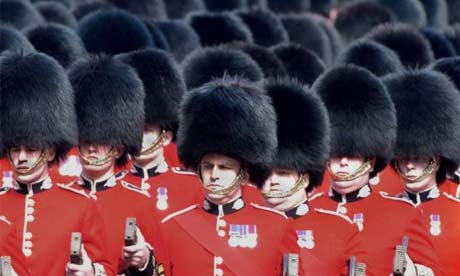
The 'world famous' bearskin (hat) worn by the ceremonial Grenadier Guards will finally go. See the Guardian.


PeTA's campaign worked. Actually, I was surprised that bears in north America were still being hunted and killed just to make those hats.

Where bears skin comes from (warning - this may be highly disturbing)


I find any form of hunting despicable, being that it is some form of enjoyable leisure time activity or sport. Killing for pleasure is disturbing. To make an animal suffer is beyond redemption. Even rangers who need to kill bears because they are a danger to human life do so humanely using tranquilisers first (I hope).
******************
I lost my glasses.... again, second time this year.

26 August 2008

Oh dear! Celebrities should stick to their principles.

Last year, I wrote about Sophie Monk going nude for vegetarianism for a PETA campaign.

She even criticised KFC.

Now look what she's done.


Why should the general public take any notice of celebrities who cannot stick to their principles?

***************
What a boring day today at work.

Stella came over after work for dinner of duck leg confit, roast pumpkin and beetroot, and broccoli. She didn't want to come when I walked Kane.

20 July 2008

Who knew that World Youth Day was on?

In Australia, it was hard to escape the news coverage of World Youth Day (WYD SYD 08). Saturation coverage indeed from The Australian, Sydney Morning Herald, ABC and SBS to name a few.

Crikey, on the other hand, came up with a totally different angle.
WYD: Sydney converted, it's time to rein-in Spain
Thursday, 17 July 2008
Nicholas Pickard writes:

On Sunday Pope Benedict will announce that Madrid will be the World Youth Day host city for the next event in 2011. The focus will then shift from Cardinal George Pell and Sydney, as the Catholic world focuses its attention to another battleground in the fight to resurrect a dying religion's popularity. Spain is, for the Vatican, the last bastion.

Not only is Spain experiencing the usual drop in Catholic adherence, but the country now has a socialist government within a society that is very liberal. Abortion, divorce and gay marriage are all legal, so the Church must make some inroads to reverse these trends.

Leading the charge will be some of the most right-wing and conservative elements of the Church. The elite Opus Dei with their stranglehold on power in the Vatican will of course be there but not far behind are the newer and more youthful right-wing organisations. And they are all here in Sydney.

From the outside, this big youth day event appears to be a religion united, but nothing could be further from the truth. Such is the rift between the right-wing and more liberal elements of the Catholic Church many within are busting at the seams to come out and say what they think.

To understand the politics of what is happening domestically, it is vital to understand that Pell isn’t particularly popular among your rank-and-file Catholics and this whole World Youth Day event is less about the Pope, and more about our local Cardinal boosting his career opportunities in the Vatican and impressing the people that matter.

With the Pope by his side, he can hurl a few two-fingered salutes to the liberal members of the congregation. Aside from Opus Dei, one of the organisations prominent in youth day events is a big contingent of neocatecumenals, an extremely conservative organisation that emerged out of Spain and has spread to more than 105 countries and more than 860 parishes worldwide. I understand that 40,000 neocatecumenal pilgrims have descended on Australia, 3000 from Spain.

For a moment, forget about all the Guy Sebastian, hippy type guitar events, this World Youth Day is largely influenced by restorationist Vatican I theology. Out with new fangled liberal views on environmental concerns, the role of women in the Church, contraceptives and gays and in with Opus Dei, Eucharistic Adoration, aggressive evangelism, relics of stigmatics and a host of rites that haven’t been seen in Australia since the introduction of Vatican II.

Cardinal Pell will be presiding over a meeting of the neocatecumenals on Monday and has asked them to make the Gospel spread around Australia and provide some spiritual help for a country that has some “very serious problems”.

For the left of the Church these associations are having some very practical and alarming consequences. Stephen Crittenden reported in last week's episode of the ABC’s Religion Report, that in one instance “the Jesuits have been ordered to withdraw their plan to host a forum with the gay Catholic group Acceptance and PFlag, the organisation for parents and friends of young gays and lesbians”.

All this will very pleasing for the Opus Dei members in the Vatican.

As soon as the Pope arrived, Pell swiftly transported him to Australia’s Opus Dei headquarters. Pell is one of its 500 or so members in Australia. Opus Dei isn’t particularly popular here and is at odds with many.

"There is a great dissatisfaction with the Restorationist spirituality, which is also devoid of any commitment to social justice," Fr Confeggi, a parish priest in the outer Sydney suburb of Mount Druitt, told The Sydney Morning Herald.

Many of the kids flying in from all over the world would be unaware of this theological undercurrent. Nevertheless, they will be the ones taking part in these baroque rituals that will not necessarily take them closer to God, but will move them toward the Opus Dei view of the Church.

At one stage, George Pell even wanted to get the Catholic conservative and sometime racist Mel Gibson to direct the WYD Stations of the Cross ritual. It never happened, but we are getting close to the type of doctrines exposed on the youth walking around Sydney with their red back packs.

And none of this even comes close to the worries within the Church over the cost. It's costing the Church an estimated $150 million on top of the $86 million that NSW taxpayers are throwing in. The left of the Church might have other ideas for where they would rather spend that money. Let's see how they go in Madrid in three years time.
It makes sense that in any large organisation, there would be politics involved.

******************
Aside from an early afternoon outing with Kane, today has been a lazy day.

So was yesterday, though Kim came over for dinner and I made baked chicken (marinaded in preserved lemon, marmalade and soy), with dry roast potatoes (skin on, no oil), baked corn and blanched broccolini.

26 June 2008

Bernard-Henri Lévy on Darfur

Usually, I don't bother with French pop philosophers and their ramblings, but occasionally they are worth reading, especially Bernard-Henri Lévy on Darfur (at PEN World Voices Festival of International Literature, on 29 April 2008, at Flourence Gould Hall in New York City). See Guernica.

*************
I stayed home today in order to shake off some bug (probably a mild dose of a virus going around). Kane was happy to have me home.

Emily came over for dinner, having returned a few days ago from a holiday to Nepal, Iran, Lebanon and Syria. I made roast pork, potato and pumpkin with blanched green beans. Things are returning to normal a little bit.

01 March 2008

Saturday, February 30, 2008

When I was in Melbourne last weekend, Michelle asked me for the date of my birthday. I told her February 30 and she believed me. It was quite funny when she found out - I made her look up a calendar.

In any case, I don't see why February should not have 30 days (and 31 days in leap years).

February has been unfairly shortchanged by at least TWO days.

There are four months with 30 days (April, June, September and November).

The rest have 31 days (seven months).

It would be equitable to redistribute a day each from August and January towards February, so that there are seven months of 30 days, and five months of 31 days.

In leap years, there would be six months of 30 days and six months of 31 days.

I mean really, why February? It has been a long time since the old Julian calendar when emperors decided to lengthen the days of the months named after them (Julius Caesar and Augustus).

We must rectify this historical megalomanic anachronism.

I propose an international campaign called 30 Days for February.

************
Today was a do nothing day, aside from a few walks with Kane.

Keiser would have turned 18 today. I'm still sad that she didn't make it to her 17th birthday. If she did not have the tumour near her liver, she would still be around today.

18 February 2008

just ignorant, or dumb?

On 1 December 2007, I wrote about ignorant people who also vote and posted a clip from Are You Smarter Than A 5th Grader.


There was a great article in the New York Times, which suggested that dumbing down reflects attitudes today, rather than genuine lack of knowledge.
February 14, 2008
Dumb and Dumber: Are Americans Hostile to Knowledge?
By PATRICIA COHEN

A popular video on YouTube shows Kellie Pickler, the adorable platinum blonde from “American Idol,” appearing on the Fox game show “Are You Smarter Than a 5th Grader?” during celebrity week. Selected from a third-grade geography curriculum, the $25,000 question asked: “Budapest is the capital of what European country?”

Ms. Pickler threw up both hands and looked at the large blackboard perplexed. “I thought Europe was a country,” she said. Playing it safe, she chose to copy the answer offered by one of the genuine fifth graders: Hungary. “Hungry?” she said, eyes widening in disbelief. “That’s a country? I’ve heard of Turkey. But Hungry? I’ve never heard of it.”

Such, uh, lack of global awareness is the kind of thing that drives Susan Jacoby, author of “The Age of American Unreason,” up a wall. Ms. Jacoby is one of a number of writers with new books that bemoan the state of American culture.

Joining the circle of curmudgeons this season is Eric G. Wilson, whose “Against Happiness” warns that the “American obsession with happiness” could “well lead to a sudden extinction of the creative impulse, that could result in an extermination as horrible as those foreshadowed by global warming and environmental crisis and nuclear proliferation.”

Then there is Lee Siegel’s “Against the Machine: Being Human in the Age of the Electronic Mob,” which inveighs against the Internet for encouraging solipsism, debased discourse and arrant commercialization. Mr. Siegel, one might remember, was suspended by The New Republic for using a fake online persona in order to trash critics of his blog (“you couldn’t tie Siegel’s shoelaces”) and to praise himself (“brave, brilliant”).

Ms. Jacoby, whose book came out on Tuesday, doesn’t zero in on a particular technology or emotion, but rather on what she feels is a generalized hostility to knowledge. She is well aware that some may tag her a crank. “I expect to get bashed,” said Ms. Jacoby, 62, either as an older person who upbraids the young for plummeting standards and values, or as a secularist whose defense of scientific rationalism is a way to disparage religion.

Ms. Jacoby, however, is quick to point out that her indictment is not limited by age or ideology. Yes, she knows that eggheads, nerds, bookworms, longhairs, pointy heads, highbrows and know-it-alls have been mocked and dismissed throughout American history. And liberal and conservative writers, from Richard Hofstadter to Allan Bloom, have regularly analyzed the phenomenon and offered advice.

T. J. Jackson Lears, a cultural historian who edits the quarterly review Raritan, said, “The tendency to this sort of lamentation is perennial in American history,” adding that in periods “when political problems seem intractable or somehow frozen, there is a turn toward cultural issues.”

But now, Ms. Jacoby said, something different is happening: anti-intellectualism (the attitude that “too much learning can be a dangerous thing”) and anti-rationalism (“the idea that there is no such things as evidence or fact, just opinion”) have fused in a particularly insidious way.

Not only are citizens ignorant about essential scientific, civic and cultural knowledge, she said, but they also don’t think it matters.

She pointed to a 2006 National Geographic poll that found nearly half of 18- to 24-year-olds don’t think it is necessary or important to know where countries in the news are located. So more than three years into the Iraq war, only 23 percent of those with some college could locate Iraq, Iran, Saudi Arabia and Israel on a map.

Ms. Jacoby, dressed in a bright red turtleneck with lipstick to match, was sitting, appropriately, in that temple of knowledge, the New York Public Library’s majestic Beaux Arts building on Fifth Avenue. The author of seven other books, she was a fellow at the library when she first got the idea for this book back in 2001, on 9/11.

Walking home to her Upper East Side apartment, she said, overwhelmed and confused, she stopped at a bar. As she sipped her bloody mary, she quietly listened to two men, neatly dressed in suits. For a second she thought they were going to compare that day’s horrifying attack to the Japanese bombing in 1941 that blew America into World War II:

“This is just like Pearl Harbor,” one of the men said.

The other asked, “What is Pearl Harbor?”

“That was when the Vietnamese dropped bombs in a harbor, and it started the Vietnam War,” the first man replied.

At that moment, Ms. Jacoby said, “I decided to write this book.”

Ms. Jacoby doesn’t expect to revolutionize the nation’s educational system or cause millions of Americans to switch off “American Idol” and pick up Schopenhauer. But she would like to start a conversation about why the United States seems particularly vulnerable to such a virulent strain of anti-intellectualism. After all, “the empire of infotainment doesn’t stop at the American border,” she said, yet students in many other countries consistently outperform American students in science, math and reading on comparative tests.

In part, she lays the blame on a failing educational system. “Although people are going to school more and more years, there’s no evidence that they know more,” she said.

Ms. Jacoby also blames religious fundamentalism’s antipathy toward science, as she grieves over surveys that show that nearly two-thirds of Americans want creationism to be taught along with evolution.

Ms. Jacoby doesn’t leave liberals out of her analysis, mentioning the New Left’s attacks on universities in the 1960s, the decision to consign African-American and women’s studies to an “academic ghetto” instead of integrating them into the core curriculum, ponderous musings on rock music and pop culture courses on everything from sitcoms to fat that trivialize college-level learning.

Avoiding the liberal or conservative label in this particular argument, she prefers to call herself a “cultural conservationist.”

For all her scholarly interests, though, Ms. Jacoby said she recognized just how hard it is to tune out the 24/7 entertainment culture. A few years ago she participated in the annual campaign to turn off the television for a week. “I was stunned at how difficult it was for me,” she said.

The surprise at her own dependency on electronic and visual media made her realize just how pervasive the culture of distraction is and how susceptible everyone is — even curmudgeons.
- Amazon.com listing for Susan Jacoby's The Age of American Unreason

Having an idiot for a president certainly doesn't help. If knowledge is power, then a nation of morons makes them easier to control. How hard is it to remember a few simple facts anyway? It wouldn't be surprising that people know more about celebrities than the real world.

****************
Kane now has his own blog - kanetails.blogspot.com to make it easier to read all about his adventures (linked in my right hand menu).

13 January 2008

the end of history or of democracy?

Last year, Francis Fukuyama wrote that he did not imply his thesis of 'Western liberal democracy as the final form of human government' in The End of History and the Last Man meant American style democracy as the model.

Mary Dejevsky, writing in The Independent wonders whether democracy is ideal anyway.

Mary Dejevsky: Maybe we set too much store by democracy

Could a benevolent authoritarianism, with a meritocracy at the head, provide the answer for some countries?

Published: 02 January 2008

The Houses of Parliament were recently named the most recognisable landmark in all the world. And the merest glimpse of that familiar skyline, silhouetted against the fiery cascades that ushered in the New Year, surely brought a lump to many a British throat. Just now, however, anyone tempted to espouse the evident superiority of the democracy those buildings represent has some explaining – and perhaps some rethinking – to do.

Three former British colonies in different parts of the world offer graphic illustrations of how the democratic process fails. Kenya, regarded as one of the most stable countries in east Africa, is on the brink of civil war, after an election that many voters believe was stolen on the count. Pakistan is in uneasy political limbo, following the assassination of the Opposition leader, Benazir Bhutto, and the violence her death precipitated. An announcement is expected today, postponing the elections that had brought her, fatefully, back to Pakistan.

Meanwhile, voters in the snowy farmland of Iowa tomorrow start the great national pageant that culminates in the election of a new US president. Peaceful and even joyous this feast of politics may be, but also distorted by dollars, dynasties and discriminatory electoral registers. The election of 2000, which hung on a disputed vote in Florida, a politicised Supreme Court, and an electoral college victory that contradicted the popular vote, exposed the flaws for all to see.

If the democratic process is often imperfect, however, few venture to challenge the actual principle of democracy. The clinching argument tends to be Churchill's well-used quip about democracy being the worst possible form of government – were it not for all the rest. And the presumption, when things go wrong, is that the practice, not the principle, is to blame.

If elections and everything they entail could be brought up, for instance, to Canadian or Scandinavian standards, then good sense and harmony would reign. So in Kenya, you might argue, as many have done in recent days, that everything went admirably until the count. In Pakistan, all would have been well had Ms Bhutto been afforded better protection. And how much fairer US elections might be were the selection process not slanted towards the north-east and so dependent on moneyed lobbyists. Seduced by the spectacle of "ordinary" voters standing in patient queues to exercise their democratic right, everywhere from South Africa through Romania to Hong Kong and post-Soviet Russia, I am as guilty of romanticising the democratic process as anyone.

Churchill, though, has another much-quoted and rather different quip that also deserves an outing. The best argument against democracy, he said, is a five-minute conversation with the average voter. And perhaps it is time to ask whether it is not electoral practice, but democracy – "people power" – that is the problem.

In many parts of the world elections divide voters, not along political lines – which may foster productive debate – but along ethnic, religious or clan lines. The imposition of a recognisable political process on Iraq, via elections, was supposed to bring democratic government and peace. But the US and British administration had to downgrade its objective from "democracy" to "representational government", and finally to "security". However conscientiously Iraqi voters turned out for successive elections, these only institutionalised old divisions in the new order.

The same happens in much of post-colonial Africa. The parties in Kenya are divided pretty much along tribal lines, which is why resentment of the outcome is so bitter, and potentially so destructive. In Pakistan there was a strong regional and clan element to Benazir Bhutto's appeal. She recognised that in bequeathing leadership of the People's Party to her husband and her son. If her party wins a majority in Pakistan's parliament, is this a manifestation of democracy, or is it dynasty dressed up in democratic clothes?

Where clans, birth and names matter, the circles of power become closed. A seat in parliament, even national leadership, is inherited. And while a ruling caste may produce responsible leaders born and trained to rule, it may equally spawn an effete priviligentsia that sucks the country dry, perpetuating a cycle of penury and popular revolt.

It so happens, though, that some of today's most successful countries – in the narrow economic terms used by today's number-crunchers to define national success – are neither democracies or dynasties. Some, such as Russia, might fancy themselves to be democracies, or moving in that direction; others, most egregiously China, are nowhere near. What we supporters of democracy have to recognise, however, is that there are governments that would not qualify under any definition as democratic, that are nonetheless doing well by the vast majority of their citizens. And they are doing so by virtue of an essentially technocratic, apolitical approach to nation-management.

Not all are happy, of course. Those at the bottom of the pile who see others getting rich, and those intellectuals who set more store by spiritual than material things. But who are we in the prosperous world to say that the freedom to discredit the government on the airwaves is more important – even as important – as a decent education, healthcare or having a job? Especially if standards in all these areas are rising?

In some ways, this is the old Cold-War era argument about the right to work, education and health-care versus the right to freedom of expression, movement and assembly. Then, though, these were very clear alternatives. Living standards in the non-democracies were, at best, static, and most brands of communism veered from the merely repressive to the barbaric.

But when the difference between our system and theirs is the lack of what might be described as a classic dual- or multi-party system, then what? If there is an ostensibly competent ruling group that renews itself as and when, while producing rapid growth rates and rising living standards across the board, then what? If there is not Western-style freedom, but enough to satisfy most people, then what? Judgements are surely more difficult.

Should we then allow perhaps that a stage of benevolent authoritarianism, with a selected – rather than elected – meritocracy at the head, might provide an answer, especially if it kept internecine rivalries at bay? This need not be the neo-imperialism some have argued for; it would not be imposed from outside. It would be government for, if not of or by the people. The get-out clause would be that such a stage would last only so long as economic well-being were regarded as the chief determinant of contentment.In time, surely, more personal freedom would be granted from above, or successfully demanded from below.

With the rise of China, whose leaders seem to be pursuing just such a course, we may be about to learn whether there might indeed be an alternative to democracy. If there is, we would not be contemplating the end of history, but we would be watching the end of politics as we know it.

m.dejevsky@ independent.co.uk

And in a follow up by Claire Soares and Katherine Butler in The Independent
The world's biggest democracy chooses its leader in November and the season has opened with a bang in Iowa. Before most people in the 48 other states have started paying attention, the course of the 2008 presidential election will have been shaped, such is the disproportionate influence of the two tiny states where polling begins. There is anger that Iowa and New Hampshire, two overwhelmingly white, rural states, have such a loud voice in America's democracy.
Even in liberal democracies, not all people are equal.

******************
I forgot to mention this fantastic Dutch film that was on SBS on Friday night called Phileine Zegt Sorry. The Dutch can certainly push the boundaries, tastefully.

http://www.a-film.nl/film/poster/RELx550/00000266NL.jpg

Another superb film I watched today on DVD was The History Boys (adapted from the play). Definitely some shades of Dead Poets Society there, but far more intellectual and superior with amazing dialogue. Makes 'seize the day' lame indeed, from teacher Hector
Pass the parcel. That's sometimes all you can do. Take it, feel it and pass it on. Not for me, not for you, but for someone, somewhere, one day. Pass it on, boys. That's the game I want you to learn. Pass it on.
http://www.puroemule.com/config/files/2977-the.history.boys.dvd-rip.xvid.mp3-.jpg

Today was a very warm day so, much of that was on the couch with two fans on.

28 December 2007

celebrity activism... driving the policy agenda

There was an interesting article in The National Interest last month by Daniel W. Drezner about celebrity activism, particularly in world politics, discussing whether they are actually effective.
Increasingly, celebrities are taking an active interest in world politics. When media maven Tina Brown attends a Council on Foreign Relations session, you know something fundamental has changed in the relationship between the world of celebrity and world politics. What’s even stranger is that these efforts to glamorize foreign policy are actually affecting what governments do and say. The power of soft news has given star entertainers additional leverage to advance their causes. Their ability to raise issues to the top of the global agenda is growing. This does not mean that celebrities can solve the problems that bedevil the world. And not all celebrity activists are equal in their effectiveness. Nevertheless, politically-engaged stars cannot be dismissed as merely an amusing curiosity in foreign policy.
Um, who is Tina Brown and why should I care? I think this may also be a case of political leaders wanting some celebrity glamour to rub off on them
Why has international relations gone glam? Have stars like Jolie, Madonna, Bono, Sean Penn, Steven Spielberg, George Clooney and Sheryl Crow carved out a new way to become foreign-policy heavyweights? Policy cognoscenti might laugh off this question as absurd, but the career arc of Al Gore should give them pause. As a conventional politician, Gore made little headway in addressing the problem of global warming beyond negotiating a treaty that the United States never ratified. As a post–White House celebrity, Gore starred in An Inconvenient Truth, won an Oscar and a Nobel Peace Prize, promoted this past summer’s Live Earth concert and reframed the American debate about global warming. Gore has been far more successful as a celebrity activist than he ever was as vice president.
Al Gore had a film to promote. Without the film, nobody would have taken any notice of him.
Current entertainers have greater incentives to adopt global causes than their precursors. Furthermore, they are more likely to be successful in pushing their policy agenda to the front of the queue. These facts have less to do with the celebrities themselves than with how citizens in the developed world consume information. Whether the rise of the celebrity activist will lead to policy improvements, however, is a more debatable proposition. Promoting a policy agenda is one thing; implementing it is another thing entirely.
Some of these celebrities should put their money where their mouth is and run for high political office with an election agenda.
The final reason more celebrities are interested in making the world a better place is that it is simply easier for anyone to become a policy activist today. An effective policy entrepreneur requires a few simple commodities: expertise, money and the ability to command the media’s attention. Celebrities already have the latter two; the Internet has enabled them to catch up on information-gathering. Several celebrities even have “philanthropic advisors” to facilitate their activism. This does not mean that celebrities will become authentic experts on a country or issue. They can, however, acquire enough knowledge to pen an op-ed or sound competent on a talk show.
Perhaps some of these celebrities want to be taken seriously and use activism as a means to demonstrate that they have some intelligence. It's a pity that many don't show any sound judgment.
At its core, star activism hints that the famous are somehow better than you or me. Some Americans view celebrities who pontificate on politics and policy as taking advantage of a bully pulpit that they did not earn. There’s a fine line between principled activism and righteous indignation, and the celebrity who crosses that line risks incurring the wrath of the common man or woman.
Ha! I wonder if Governor Schwarzenegger has traded in his gas-guzzling Hummer. Some of these celebrities could reign in their over-consumption for a start and live by example.

*****************
After three days off work (public holidays), it was strange going to work on a Friday. Hardly anybody was in. Strangely, I completed a fair bit of work today.

06 November 2007

Hollywood Writers' Strike

I found an explanation from NPR.
What's Behind the Hollywood Writers' Strike?

Film and television writers are going on strike, as talks have not produced a new contract between the Writers Guild of America and the Alliance of Motion Picture and Television Producers. The writers' demands include a percentage of DVD profits, plus a cut of money from new-media distribution. NPR.org offers this explainer.

Why have Hollywood writers called a strike?

TV and movie writers, represented by the Writers Guild of America, had been negotiating with studios and the entertainment industry off and on since the summer about compensation issues. Many issues were on the table, but the parties reached an impasse over the writers' demand for a larger share of profits from DVD sales and revenue from viewings of their work on the Internet. They also want a percentage of growing revenue in new distribution channels — mobile viewing, for instance, and other new ways of watching the shows they write.

Where do the studios stand?

The studios, represented by the Alliance of Motion Picture and Television Producers, say it's still unclear how much revenue those new-media distribution channels are going to produce — and where the money will be coming from. They proposed a study to look for answers, but the writers reject such studies as irrelevant. They say they're entitled to a share of the profit on any material generated through any new technology, even if that compensation is small.

What happens now that a walkout has been called?

The immediate effects will be apparent on TV, where viewers are likely to start seeing more reality shows, which don't fall under guild jurisdiction, in place of regular scripted programming. (Think singing, dancing and weight-loss contests.) Some networks will show reruns, while some are looking at programming that hasn't been on their air before. NBC, for example, has considered running the original British version of The Office.

But the networks can't immunize themselves entirely, or so the writers argue. They say that running heavy loads of reality TV on all the major networks will have broadcasters stepping on each others' toes, competitively speaking.

As for movies, the effects will be less obvious in the short run, since big-screen production takes longer. The strike probably won't affect what you see at the multiplex for more than a year.

When was the last time this happened?

The last time writers went on strike was in 1988. The walkout lasted for five months.

Compiled by Andrew Prince and Trey Graham from reporting by Kim Masters.
I reckon that obscenely over-paid actors should really take a pay cut. Honestly, their livelihood depends on good writing.

************
Today was a public holiday here - for what, I have no idea. I meant to do a lot of things, and again, I ended up doing nothing.

28 October 2007

nude for a cause

Not all nudity is gratuitous. Despite the prudishness of some, going nude always draws attention.

"If you are going to take your clothes off for something, it better be a good cause."
—Sophie Monk

And she did.

Vegetarian cheesecake ... Sophie Monk strips off for a red-hot cause.

See PeTA Asia Pacific - Sophie Monk Poses Nude to Promote Vegetarianism


Unfortunately, 'nudity for a cause' has its critics, including Andrew Bolt who is a conservative opinion columnist for the (Melbourne) Herald Sun.
Just take the new poster from PETA of Sophie Monk lying naked on a carpet of chillies.

She looks simply delicious, and makes me salivate for a beef curry.

Oh, apologies. Looking closer I see that the body of our Aussie starlet, now bravely trying her luck in Hollywood, appears over the words: "Spice Up Your Life. Go Vegetarian."

How odd, though. Why present flesh so beautifully, and then tell the ravenous to eat chillies instead? But when did reason have anything to do with stripping for a cause?

For instance, I've never understood how the annual World Naked Bike Ride could persuade anyone to get out of their eco-sinning car and on to a bike.

All I could think of, seeing all those bare buttocks grinding along on narrow seats, was red-raw rashes.

Also mystifying was why Greenpeace got 600 volunteers to pose nude on Switzerland's Aletsch glacier the other day.

All those people standing naked on ice, and we're supposed to panic that global warming might make them warmer?

And why pick the Aletsch glacier for this, when scientists say this very same glacier not only melted like this before, but in the hotter Roman times had so shrunk that it "was even somewhat shorter than today"?

But I guess the sight of 600 splendid bodies is meant to make your brain freeze and reject mere facts.

Is that, then, the explanation - that the Left has better bodies than brains, and so goes with its strength?

This could explain why, for instance, campaigners against genetically modified crops have staged naked protests in Britain, while the scientists who have proved these crops safe feel no need to remove even their lab coats.

It's another bodies versus brains argument, and you know that when someone tries to convince you of a political point by showing you their genitals, the facts no longer count.

Mind you, protesters of the Left aren't more inclined to strip simply because they are dumber.

Some simply think nudity buys them just enough of your attention to get across a point you'd otherwise ignore.

Yet I'm looking now at pictures taken during last month's Sydney protests against George Bush and wondering if that's really true.

Here I have a picture of a naked man with what looks like a sock on his penis being dragged off by police.

Am I paying attention? Yes.

Do I now think Bush is the idiot? Well, not Bush, no . . .

Or here is a picture of a protester who's painted "No war" over her great cellu-blighted buttocks.

Has she persuaded me of her cause? Er, her getting dressed would persuade me much sooner.

Mind you, if I were a woman like Californian eco-artist Donna Sheehan I might see this differently.

She once heard of a protest against an oil company staged by Nigerian women threatening to do the most shaming thing in their culture: to undress.

The company gave in, and Sheehan was so inspired she formed Baring Witness, urging women to use their bodies to catch "the attention of the patriarchal system; seducing it into partnership".

What haven't these women since stripped for?

In Byron Bay in 2003, 750 of them - led by singer Grace Knight - stripped to stop the Iraq war.

It didn't work, of course, and not one of Baring Witness's scores of protests around the world have managed to seduce the patriarchal system into any partnership at all.

Not that the women were as worried about a them, as much as enjoying an us. As Knight said of her protest: "Stripped bare of any clothing or adornment that label and separate us, we become united as a single entity.".

Aren't most naked protests just as selfish?

As we ponder this, let me read the caption to another PETA ad, this time starring "international cover model, actor and spokesperson for Dollhouse Clothing, sexy supermodel Joanna Krupa", who declares: "I'd rather go naked than wear fur."

And she proves it. In fact, the caption declares "she posed in not one but three versions of the sexy ad".

What a noble girl. Such a big heart, she has. But such a small . . . waist.

So he does have a tiny sense of humour. But he is still an idiot.

*****************
There were lots of things that I had planned to do. The problem with having a long 'to do list' is that often, you end up doing nothing. Which is what I did today. Well, not exactly, I did put clean laundry away. Now, should I do some ironing or not?

22 September 2007

save Burma and Zimbabwe

Surely Burma and Zimbabwe must have oil. Perhaps those regimes are developing weapons of mass destruction.

****************
Today I did some house cleaning (still need to do some more) and even cleaned the bathroom. Then I started making pea and ham soup.

Devi came over with her electric hedge trimmer and trimmed the hedge by the drive way. She earnt her supper of pea and ham soup and a strawberry dessert.

We watched the season three finale of the new Doctor Who.

09 September 2007

dumbed down university graduates

From an article in the Sydney Morning Herald by Erin O'Dwyer,

For centuries universities have been held up as hallowed halls of light and learning. Even in this country, where a decade of budget cuts has crippled classics departments and left research funding pools in drought, universities are valued for their contribution to intellectual debate. They are also seen as a salve for unemployment and social disharmony.

But Australian educators face a serious problem: how to enliven a student body that thinks googling a wiki is a serious academic endeavour. In a world swamped by information, many students have little interest in accessing it. We have law students who have never read a case, English students who do not read books and journalism students who do not buy newspapers. Don't laugh, it's true.

Each semester I ask my students how many of them buy newspapers. Five at most raise their hands. The showing is even more dismal when it comes to listening to radio. Television and online news sites are more popular. But when I ask how many get their main news from headlines on their Yahoo! webmail there is a round of sheepish laughter.
...
Another law faculty lecturer recalls how her discussion about Nixon and Watergate drew a blank. No one had any idea about either.

A health sciences lecturer recalls how she played her students a YouTube clip of geriatric musicians covering the Who's My Generation. "My students had no idea who the Who were," she says. "And no idea why it was significant that the single was recorded at Abbey Road."
...
Plagiarism is rife. Academic references include wikis and lecturers' notes. Cut-and-paste technology has made libraries redundant. Many students do not know where the library is and some leave their laptops only reluctantly to attend classes. Some academics believe that in an industry worth almost $10 billion, as many as one in two students are cheating.

It must be said, this is not a criticism of students. Students for the most part are doing it tough. Most full-timers work part-time jobs and all part-timers arrive straight from work. ...

What must be addressed is the ideology of the ignorance. Students know what needs to be done and they'll be damned if they'll do any more. One colleague pointed me to the book Age of Extremes, in which the historian Eric Hobsbawm recalls a student asking whether the description "World War II" meant there had also been a first world war.
...

Sadly, I tend to agree with what Erin O'Dwyer wrote. Not only is general knowledge lacking and any interest in the world at large, but standards of literacy have also fallen. Too many young people have appalling spelling and grammar skills, even those attending university. Not only that, but they don't even care to learn from their mistakes.

***************
After such a busy day yesterday, I finally managed to do the laundry and do some grocery shopping. I was meant to visit Devi for afternoon tea, but did not make it. This meant I missed out on her home made Portuguese custard tarts. Serves me right.

05 September 2007

Mrs who?

I quite liked this article by Catherine Deveny in The Age

Why do some wives still change their names?

Catherine Deveny
September 5, 2007

Insecure or conservative or stupid women are bowing to the wishes of their husbands.

WHO the hell is Jana Rawlinson? Jana Wendt I know, Jana Pittman I know, but Jana Rawlinson? So I check out the snap. It looks exactly like Jana Pittman. But her name is Jana Rawlinson. How bizarre. That has to be some crazy coincidence. A woman called Jana with a different surname who looks exactly like Jana Pittman. And, get this, she's a hurdler too. Freaky.

Oh, I get it. She has put a few noses out of joint in the past so she's keen on a bit of incognito action. You'd think she'd change her first name too. Then it dawned on me. She has got married, bizarre enough in itself these days, and changed her last name to her husband's. What an anachronism. Maybe she changed her name to go with the chastity belt, the crinolines and the stick "no thicker than his thumb" that her husband is allowed to beat her with.

Wake up! We are in 2007. Women are no longer owned by their father and then their husband. So why are some women still changing their surnames? And why do some men still want them to? It's sad, it's misogynous, it's archaic, it's insecure and it's unnecessary.

Why would you do something so drastic simply because you decided to delude yourself it was easier? Because you are deeply insecure, deeply conservative or deeply stupid. And in deep denial.

I ask women why they change their last name. They tell me "it's just easier". It's not. How easy is it changing the name on everything from your driver's licence to your library card? It's not. Many of the families I know have up to three different surnames and have no problem at all.

If people really believe that mum, dad and the kids having the same surname is easier, why doesn't the guy change his name? Why don't they flip a coin and it's heads we go for her surname and tails we go for his? Because it is not about it being easier. It makes me despair. We've come all this way and we're still here.

Many women will say that their husbands wanted them to change their surname. So they did. Here's a flash for you sister: if you do everything that your husband wants you to do, you may find yourself teetering round in a pair of stilettos and an apron all day saying, "Shall I fix some more food for you and the boys?", or wearing a burqa.

Thanks to feminism, women should be allowed and encouraged to do anything they want. But the question I ask is why do some women still want to change their surnames?

And not the stock answer they give, but why, deep in their hearts, they feel the need to dilute themselves.

So I kept reading the article and Jana has won a couple of gold medals. Good on her. She has an eight-month-old son and she was doing it for him. Here's a reality pill for you, Jana. You weren't doing it for him, you were doing it for you. He doesn't care.

Then it goes on to use the word "supermum" to describe her. How can a woman who has handed over her kid to be cared for by someone else while she has pursued her dreams with little or no thought to what the child needs or wants be described as a supermum? A supermum is a woman who has done the weekly shop with four kids under five and not killed any of them. If Jana had won the race with the baby strapped to her back while pushing a shopping trolley, I would have called her a supermum.

People are bagging Jana for putting her career above the needs of her young child. Which I can understand. What I can't understand is why the father is not mentioned at all. And never is.

Whenever two parents are working and the child is propped up on the sideline waiting for its turn, why is it only the woman who gets bagged, as if the father has no responsibility for the care of his own child? Why, when a woman is working, does she always get asked, "Who's looking after your children?", but the father never does? We need to take the focus off the role of mother and put it on to parents as a team.

Men have become much more hands-on fathers in the past 10 years and it has been magnificent to see. The kids, the dads and the mums have benefited greatly but we still have a long way to go. Dads, here's a sure-fire way of getting lucky tonight. Try this line: "I've made the lunches, done the reading and filled in all the excursion forms. The clothes are all laid out and I'm just going to put the kids to bed."

Duh! Being called Mrs is becoming fashionable again. But having the husband change his name is an interesting and anti-patriarchal idea.

Non-Australian readers really do not need to know who this Jana Pittman/Rawlinson is. It was used as an illustration. But click here if you want to know.

******************
Thank goodness half the working week has gone. Two more work days before the weekend again.

Last night's episode of Torchwood was really cool (which I had recorded).

22 August 2007

NetAlert

The Australian government is now providing a free internet filter to protect children.

Actually, it's not free. It is costing taxpayers A$84.8 million.

I hadn't realised that the federal government is now taking on parental responsibilities on such a large scale.

What next? Perhaps the government should also provide free school lunches to ensure that children are receiving adequate nutrition.

Better yet, remove children from parents - after all, their parental skills are woeful - and place them all in state run institutions.

*****************
It's been a long day. Taking minutes for a work conference and participating can be tiring, and continuing on with a work dinner.

22 July 2007

swallowed by Singapore

Stephen Mayne, of crikey.com wrote an interesting opinion piece in The Age today.

WHEN shareholders in Perth-based energy utility Alinta Ltd gather to vote on the $15 billion carve-up of the company on August 13, few of them will realise the remarkable historical event they will trigger.

In accepting $4.5 billion of cash from Singapore Power for a suite of Australian electricity and gas distribution assets, Alinta shareholders will lift the total value of Australian business assets controlled by the Singapore Government to almost $30 billion.

This will exceed the value of commercial assets owned by our own Federal Government, which is surely an unprecedented situation for any First World country. How can a foreign power own more of Australia than our own government?

While ordinary Singaporeans have limited democratic rights and still don't enjoy benefits such as Australia's minimum wage (the world's highest), the Singapore state has amassed an empire worth more than $200 billion — and it has now put more of it into Australia than any other country.

there is quite a lot there to read, but the crunch

Planes, child-care centres, shopping centres, department stores, satellites, hotels, power lines, gas pipelines and mobile phones: the Singapore Government owns all that and more in Australia yet this is barely mentioned in public debate.

Does anybody else out there feel a little uneasy about this phenomenon, especially given the secretive, autocratic and undemocratic tendencies of the Singapore Government?

Australian companies, let alone our Government, would never be allowed to buy equivalent assets in Singapore.
Click here to read more.

Yep, it's fine for a dictatorship to own a lot of our assets, especially our critical infrastructure.

*****************************
I didn't do much this morning. Went to the club after 1pm to watch the game and met up with Nick for a few beers.

After the game, I came home and made apricot chicken to be cooked in the oven, then cleaned the bathroom. I also managed to clean the floor, but it is only half done. Bah!