Showing posts with label sea. Show all posts

26 July 2010

End of the voyage of the Plastiki

Back on 21 March 2010, I wrote about the Plastiki setting sail from San Francisco to Sydney to raise awareness about maritime pollution. This morning, the Plastiki sailed into Sydney Harbour. From press release
After sailing more than 8,000 nautical miles and spending 128 days crossing the Pacific, the world’s largest ocean, in a boat made of 12,500 plastic PET bottles, the Plastiki expedition and her crew have safely and successfully reached their planned destination of Sydney to cheers of welcome and support.

Arriving at Sydney Heads at 11.10am local time with a 12knot south south easterly breeze, the Plastiki triumphantly sailed into Sydney Harbour to cheers of welcome and support from a small spectator flotilla. The historic expedition was completed in four legs : San Francisco – Kiribati ‐ Western Samoa ‐ New Caledonia before reaching the Australian Coast (Mooloolaba) on Monday 19 July and continuing on to Sydney.

“It’s an incredible feeling to finally arrive in Sydney. We had great faith in the design and construction of Plastiki and while many people doubted we’d make it, we have proved that a boat made from plastic bottles can stand up to the harsh conditions of the Pacific.” expedition leader, David de Rothschild said.

De Rothschild, 31 from the United Kingdom, paid tribute to his fellow adventurers, Jo Royle (Skipper), David Thomson (Co‐Skipper), Graham Hill (Founder of Treehugger.com), Olav Heyerdahl, Matthew Grey, Luca Babini (Photographer), Vern Moen (Myoo Media Film maker), Max Jourdan and Singeli Agnew (National Geographic Film makers) for their skill and commitment during the voyage.

“Jo and the rest of the crew did a remarkable job sailing the Plastiki safely across the Pacific and it is due to their collective efforts that we’ve been able to raise global awareness of the issue of plastic waste in the world’s oceans.

If there’s waste, it’s badly designed in the first place, and we need to start taking a serious look at the way we produce and design every product we use in our lives,” De Rothschild said.
Read more. According to the Plastiki blog, Sydneysiders are also able to visit the craft
The Plastiki will be moored at Australian National Maritime Museum, Darling Harbour for a month and will be open to visitors on Sunday August 1st, so if you weren’t able to make it down today then you’ve still got a chance to explore this one of a kind plastic bottle boat. Keep an eye out for the more information by following us on Facebook and Twitter.
Photos from Getty (Brendon Thorne) via PicApp

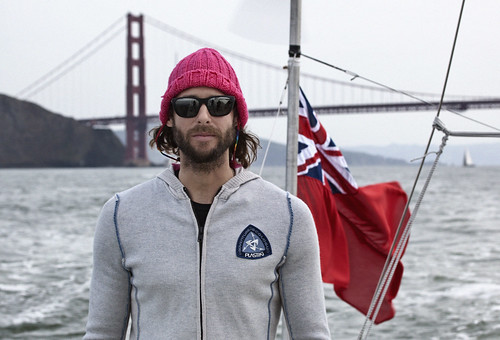
SYDNEY, AUSTRALIA - JULY 26: British adventurer and environmentalist David de Rothschild sails as the 'Plastiki' arrives at Sydney Harbour, completing the 12,860 kilometre journey from San Francisco to raise environmental awareness on July 26, 2010 in Sydney, Australia. The 60-foot catamaran made from 12,500 plastic bottles was designed by Australian Andrew Dovall and embarked on the 128 day journey to bring attention to condition of our oceans and the amount of plastic debris in the Pacific. (Photo by Brendon Thorne/Getty Images)

SYDNEY, AUSTRALIA - JULY 26: British adventurer and environmentalist David de Rothschild sails as the 'Plastiki' arrives at Sydney Harbour, completing the 12,860 kilometre journey from San Francisco to raise environmental awareness on July 26, 2010 in Sydney, Australia. The 60-foot catamaran made from 12,500 plastic bottles was designed by Australian Andrew Dovall and embarked on the 128 day journey to bring attention to condition of our oceans and the amount of plastic debris in the Pacific. (Photo by Brendon Thorne/Getty Images)

See also
- Sydney Morning Herald (has video)
- NPR
- United Nations Environment Programme (UNEP)

21 March 2010

Voyage of the Plastiki

A boat made up of plastic bottles and other recycled material, named the Plastiki, has set sail from San Francisco on a 100 day journey to Sydney, to raise awareness about maritime pollution. See AP video


The project is led by David De Rothschild (photo by Plastiki press centre)


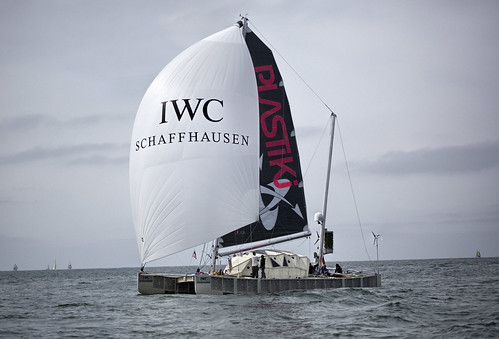
The boat is a catamaran (photo from Plastiki press centre)


You can follow the journey online
- www.theplastiki.com
- www.adventureecology.com
- photos on Flickr

Of course, the name Plastiki is an acknowledgment of the famous Kon-Tiki expedition of the 1940s.

21 July 2009

What if they taste better than whale?

Reported in Japan's Daily Yomiuri newspaper
'Jellyfish typhoon' bearing down on Japan

Swarms of giant Nomura's jellyfish are expected in the coastal waters around Japan this year, a "jellyfish typhoon" that threatens to inflict massive damage to the fishing industry.

One of the biggest varieties of jellyfish in the world, Nomura's jellyfish--also known as Echizen jellyfish--weigh as much as 200 kilograms and have heads reaching up to about 2 meters in diameter. The Fisheries Agency warned fishermen across the country about the arrival of the jellyfish after it received several reports of sightings in the sea around Japan this month.

Nomura's jellyfish are a nightmare for fishermen--damaging fishing nets with their heavy weight and harming fish caught in the nets with their toxins. Fishermen also risk getting stung when removing the jellyfish from their nets.

They may even force fishermen to stop fishing.

In 2007, the last time hoards of Nomura's jellyfish were seen in Japan's coastal waters, the agency received about 15,500 complaints from fishermen concerning damage caused by the jellyfish.

According to experts, an unusually huge number of Nomura's jellyfish are highly likely to come to Japan's coastal waters this year. They usually propagate in the eastern part of the Yellow Sea, then some will drift toward Japan on the Tsushima Current.

Researchers with the Fisheries Research Agency surveyed the central waters of the East China Sea and coastal waters around Jeju Island, South Korea, in June and confirmed the presence of a few Nomura's jellyfish within 10 meters of their vessel.

"The situation is quite similar to that when a large number of these jellyfish came to Japan's coastal waters in the past," said Hideki Akiyama, head of the agency's East China Sea Fisheries Oceanography Division.

Based on the June survey, the Fisheries Agency warned the jellyfish would reach the sea off Tsushima island in Nagasaki Prefecture early this month. Since around July 4, the agency has received a number of reports that small Nomura's jellyfish have been seen in the sea.

Prof. Shinichi Ue of Hiroshima University, a leading expert on Nomura's jellyfish, said highly concentrated groups of the variety had been observed in the Yellow Sea as of Wednesday.

"The arrival [of a large number of the jellyfish] is inevitable. A huge 'jellyfish typhoon' will hit the country," Ue said.

A fertilized egg of a Nomura's jellyfish turns into a polyp that resembles a flower. As the polyp travels, it sheds parts of its body in the form of a cellular mass called a podocyst. The podocyst rests at the bottom of the sea and grows into a polyp that later turns into a jellyfish.

To complicate matters, podocysts maintain their form until the surrounding environment becomes optimal for their growth into a jellyfish.

Last year, there were few sightings of Nomura's jellyfish and no complaints from fishermen were reported.

"I believe the environment in the East China Sea was bad, so the podocysts slept in that form last year," Ue said. "However, they've all turned into polyps this year, resulting in a plague of jellyfish."

The most recent massive infestation of Nomura's jellyfish was observed in 2005. The year before that, only a few were reported.

Experts expect more jellyfish this year than in 2005. They are expected to drift north in the Sea of Japan to Aomori Prefecture, then into the Pacific Ocean through the Tsugaru Strait, then go south. They are expected to plague the coastal waters around Japan through February.

(Jul. 11, 2009)


Perhaps the whalers could be employed to harvest the jellyfish.

05 December 2008

as one sinks, another rises

Last month, many media outlets (including CNN) reported that Maldives is looking for a new homeland in order to relocate its people as its many islands will eventually be submerged by rising sea levels due to global warming.

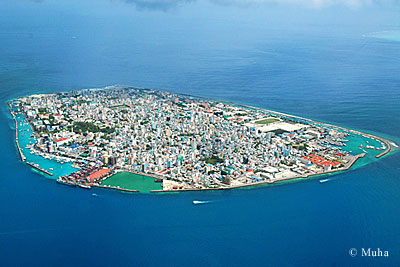
the capital, Male is on one island and protected by a sea wall


Meanwhile, developers in Dubai are reclaiming land from the sea in the form of designer islands such as Palm Islands and The World.

Palm Jumeirah


Perhaps the Maldives could buy into an island development in Dubai, before that too sinks.

**********************
The weekend couldn't come fast enough

07 July 2007

octosquid

From Honolulu Star Bulletin (5 July 2007)

Curious creature caught off Keahole Point

The animal, dubbed an "octosquid," is found off the Big Isle

It's a squid, it's an octopus, it's ... a mystery from the deep.

What appears to be a half-squid, half-octopus specimen found off Keahole Point on the Big Island remains unidentified today and could possibly be a new species, said local biologists.

The specimen was found caught in a filter in one of Natural Energy Laboratory of Hawaii Authority's deep-sea water pipelines last week. The pipeline, which runs 3,000 feet deep, sucks up cold, deep-sea water for the tenants of the natural energy lab.

"When we first saw it, I was really delighted because it was new and alive," said Jan War, operations manager at NELHA. "I've never seen anything like that."

The natural energy lab is a state agency that operates Hawaii Ocean Science and Technology Park in Kailua-Kona, adjacent to one of the steepest offshore slopes in the Hawaiian Islands.

According to Richard Young, an oceanography professor at the University of Hawaii at Manoa, the specimen tentatively belongs to the genus Mastigoteuthis, but the species is undetermined.

War, who termed the specimen "octosquid" for the way it looked, said it was about a foot long, with white suction cups, eight tentacles and an octopus head with a squidlike mantle.

The octosquid was pulled to the surface, along with three rattail fish and half a dozen satellite jellyfish, and stayed alive for three days. According to War, the lab usually checks its filters once a month, but this time, it put a plankton net in one of the filters and checked it two weeks later.

The pitch-black conditions at 3,000 feet below sea level are unfamiliar to most but riveting to scientists who have had the opportunity to submerge. The sea floor is full of loose sediment, big boulders and rocks, and a lot of mucuslike things floating in the water, which are usually specimens that died at the surface and drifted to the bottom.

"It's quite fascinating," War said. "When you get below 700 feet, it's a totally different world. Lots of fish have heads like a fish and a body like an eel. There are fish floating in a vertical position, with the head up, and don't move unless they're disturbed."

Christopher Kelley, program biologist for the Hawaii Undersea Research Laboratory, went to the natural energy lab Tuesday to pick up the preserved octosquid, rattail fish and jellyfish, which had been stored in a freezer, and brought them back to UH-Manoa's oceanography department.

"It's a beautiful squid. It's a gorgeous ruby red color," Kelley said. "We really enjoy these little mysteries that come up."

Also during Kelley's visit to NELHA yesterday, he and War talked about a more formal sampling program to search for other deep-sea critters. War said their goal is to sample the intake screen more often and capture animals alive and study them in captivity.

"This opens up a whole new area of research that UH can be involved with," War said.

In October, NELHA will be checking its deep-sea pipelines, something that usually happens every eight to 10 years, because it is worried that something might have happened to them during the earthquakes in October.

"If it's a new species, (NELHA) would like to name it," War said. "But that is sort of the honor of whoever classifies it."


Hmmm... if it is a cross between squid and octopus, then it would be perfect for quick cooking.

************************
I didn't do much today. Last night and today, I watched about half of the first series of Rome on DVD. Excellent show.

It's raining and cold tonight. I had planned to go to the club and watch the game on their big screen (my team is playing tonight but the game is not televised on free to air, and I do not have pay TV). Instead, I am staying at home and listening to a radio commentary. Tragic!

Scores and pics tomorrow.

15 March 2007

stories of the sea

Three stories from today's Sydney Morning Herald.

1) Massive sunfish about 1.5 tonnes off Jervis Bay on the New South Wales coast spotted in December last year.

See - SMH Science Blog


2) Giant underwater eddies (whirlpools) off the coast of Sydney

See - Cyclone of the deep sits off Sydney


This scientific chart shows the deep blue pools sitting off the coast of NSW

3) Old man who lives on a cliff in Sydney is about to be evicted

See - Time's up for caveman


Jhyimy 'Two Hats' Mhiyles does not want to leave his makeshift home on a Bondi cliff.

**************************

Not much to report today. I convinced Margaret to watch Thumbsucker. She thought it was a teenage film. After she watched it, she decided she liked it.

23 February 2007

not a giant, but a colossal squid

A 450kg (990lb) colossus squid was caught off Antarctica by a New Zealand fisherman.


The squid will probably end up in a museum.

What a waste. No salt and pepper squid.

Links
- National Geographic
- The Age (Melbourne) of 23 February 2007

******************************************

Devi came around tonight for a dinner of baked lamb chops marinated in preserved lemon, soy sauce and marmalade, served with baby King Edward potatoes and broccolini.

It was good to have company as Margaret went to Sydney on Wednesday and returns this Sunday. Returning from work to an empty house is awful. Keiser used to greet me at the door when I came home. Yesterday was awful. Crying comes easy.